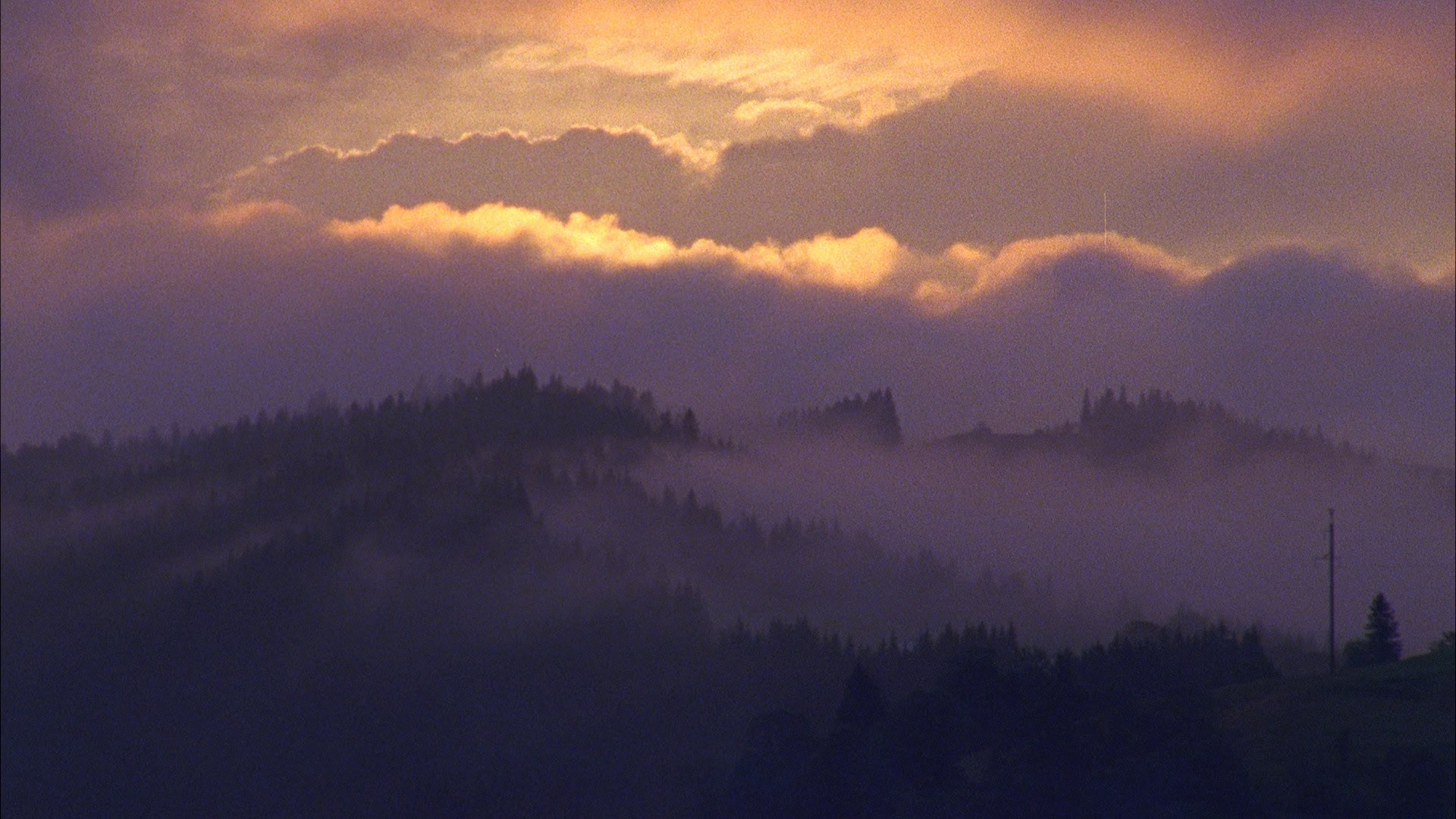
Ernst Karel and Veronika Kusumaryati’s Expedition Content is almost entirely composed of a black screen. The film is a sonic journey, drawing from audio recordings made by anthropologist and documentarian Robert Gardner and his male colleagues, including Michael C. Rockefeller and author Peter Matthiessen, during the 1961 Harvard-Peabody Expedition to Netherlands New Guinea to live among the Hubula (also known as Dani) people. (The only extended scene is an outtake from Gardner’s 1963 film Dead Birds.) There’s an inherent joke, then, to Karel and Kusumaryati’s approach, as they strip away the central visual component that has historically given ethnography its primary appeal for Western viewers.
Expedition Content transforms visual anthropology into a work of sonic ethnography that becomes more about Gardner and his crew than the people that they’re studying. In the final, extended outtake from the production of Dead Birds, the seemingly stoned men mimic the voices of Black jazz musicians. “I’ve got a flip flop floogie and a floy floy,” says one man, after which another one goes on a riff, ending with the words, “Snow White, you Black, bitch, and don’t you forget it.” The outtake lacks important context or commentary, but the implication is that these white men, so amused by their mocking of Black culture, are racist.
The issue of racism sits nestled under both this sequence and the field of anthropology as a whole, giving Expedition Content a nakedly ontological dimension that interrogates how images are produced and who produces them. During an early moment, we hear the men discussing their plans for photographing the Hubula people. One remarks that their group is aiming for “naturalism, if we could use that word.” In the context of Karel and Kusumaryati’s documentary, which is decidedly a work of sonic formalism, the notion of naturalism or realism seems at best quaint. Images are created, and they’re created by people. While that point might seem obvious, its precisely this idea that visual anthropology often works to conceal, making it seem as though what’s on screen sprouted naturally from the Earth.
By acknowledging the fundamental deception of naturalistic ethnography, Expedition Content aligns itself with experimental filmmakers like Trinh T. Minh-ha, whose 1982 work Reassemblage reworks the traditional approach of infiltrating and documenting native cultures. Minh-ha states an intention to “speak nearby” rather than about the lives of women in a Senegalese village, and does so with images and sounds that are given little context. In that sense, meaning and purpose loosen as the sounds and images are freed from narrative intent. Karel and Kusumaryati use sounds of the Hubula people chanting and washing sweet potatoes (which is conveyed through subtitles), or forest noises that, without imagery, becomes oppressive and terrifying, as the screen is rendered nearly irrelevant.
The conceit of dispensing with imagery almost entirely may recall Derek Jarman’s Blue, but Jarman applied it to a very particular context that spoke exclusively to his perspective. In Expedition Content, absence starts to feel like an easier solution than discovering imagery, even if only in select forms, that would further clarify a more detailed point about the nature of ethnographic filmmaking. For anyone familiar with the expansive academic field of visual anthropology, the deconstructive tactics of Expedition Content may feel unimaginative, even as the underlying question of who’s watching (or listening to) who remains ever fascinating.
Since 2001, we've brought you uncompromising, candid takes on the world of film, music, television, video games, theater, and more. Independently owned and operated publications like Slant have been hit hard in recent years, but we’re committed to keeping our content free and accessible—meaning no paywalls or fees.
If you like what we do, please consider subscribing to our Patreon or making a donation.