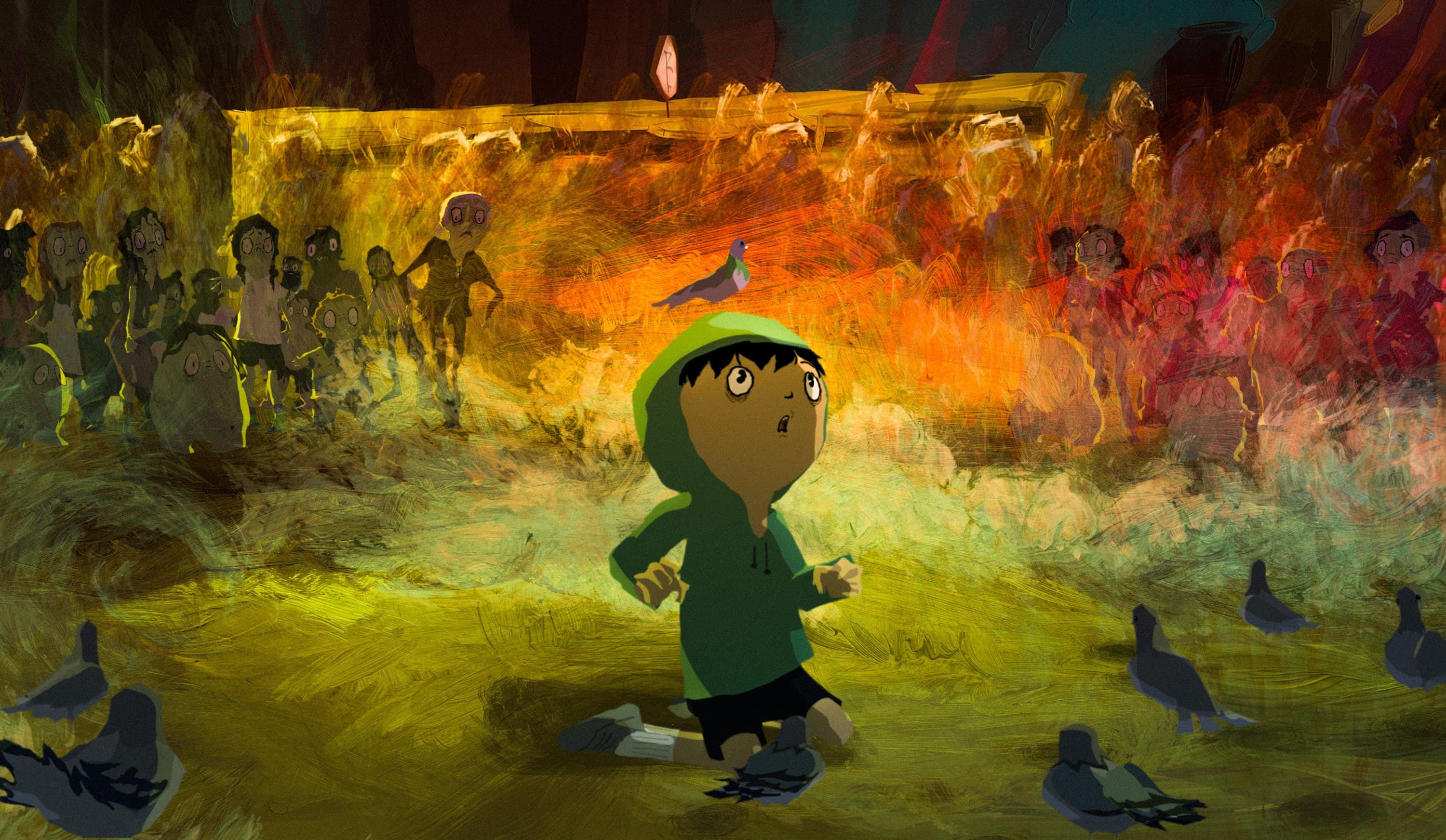
Renata Pinheiro’s salvagepunk burlesque King Car takes Filippo Marinetti’s Futurist Manifesto and drives it over a cliff. In a near-future Brazil where cars learn to speak, Marinetti’s dubious dream of fusing people and technology doesn’t stop at sex with cars, as in Julia Ducournau’s Titane. Here, cars enter what seems like an equal partnership, even class-conscious solidarity with their mechanics, who, like them, know what it means to be treated as tools. But things get complicated when they have a mind of their own.
Set in Caruaru, King Car opens with the birth of Uno in the back seat of the old family car. He grows up in a garage under the tutelage of his uncle, Zé (Matheus Nachtergaele), a savant mechanic. The car he was born in seems to talk to him, though it may only be in the child’s imagination. His father is grooming him to take over the family taxi business, and after his mother dies in an accident driving the same car, the film jumps ahead a decade or so, and we find the teenage Uno (Luciano Pedro Jr.) studying agriculture with Amora (Clara Pinheiro). His father disowns him for defying his plans and Amora’s union votes to take him in.
Meanwhile, authorities institute a law forbidding all vehicles over 15 years old, immobilizing local workers who depend on clunkers for their livelihood and can’t afford to replace them. Uno winds up at Zé’s junkyard, where the battered car speaks once more. Zé rigs a contraption that translates revving into speech anyone can understand. He then refits the vehicle into a flashy concept car. Now fully sentient, the titular King Car is outraged by the law and vows to overhaul as many vehicles as possible to help the poor, extending vehicular sentience in the process. Before long, the gas guzzler betrays its revolutionary aims and seeks power for its own sake, forming a car company in partnership with Uno’s father and pitting fossil-fuel fetishism against the promise of collectivized agriculture, which Amora and Uno are working toward.

With its chrome-and-sulfur color palette, its loving shots of rusted-out chassis, and a mise-en-scène jam-packed with machinery welded together from salvage, the film is as idiosyncratic as it is fully realized. Its scrap-heap aesthetic, set to a chugging EDM score by DJ Dolores, is anything but a rehash of earlier directors’ visions. Pinheiro pours everything into production design and visual allegory, imbuing the film with an unhinged theatricality. King Car itself is theme given form, an electric blue hearse whose blinkers flash predatory red. Rather than simply decrying tech fetishism, Pihheiro makes it look cool—painfully, deathly cool—showing the temptation of giving ourselves up to technology, but also what happens when we do.
At a turning point in the story, the scrappy mechanics of the King Car company accidentally ingest a byproduct of the refitting process, a glowing blue liquid that makes them break into a spontaneous robot dance, calling to mind the automaton choreography of Metropolis and Rite of Spring, and throwing King Car’s revolutionary promises into doubt. Nachtergaele extends this idea to the physicality of Zé’s character, as his ape-like locomotion betrays a prehistoric idolization of the tool which only intensifies under the influence of the liquid. Red-eyed and frothing at the mouth, he harangues the crowd at a King Car trade show, exalting a higher unity of humans and tools: “When you’re at the wheel, you are the wheel.”
Uno may be the protagonist, but the heroines turn out to be Amora, who cultivates a plant that thrives on junkyard soil, and Mercedes (Jules Elting), a performance artist who stamps fascist idols with the Hebrew word for “dead” using an LCD-lit pelvic paint applicator. Technology itself, they realize, cannot liberate us no matter how “revolutionary” it claims to be.
For a film about the appropriation and failure of social movements, though, King Car surprisingly never slides into fatalism, holding out a glimpse of a green post-capitalism. Sure, the story sometimes verges on incoherence and the characters take a backseat to production design, but between its visionary look and hope for an egalitarian eco-utopia, the film boasts the pleasures of shlock while sacrificing none of its philosophical rigor.
Since 2001, we've brought you uncompromising, candid takes on the world of film, music, television, video games, theater, and more. Independently owned and operated publications like Slant have been hit hard in recent years, but we’re committed to keeping our content free and accessible—meaning no paywalls or fees.
If you like what we do, please consider subscribing to our Patreon or making a donation.