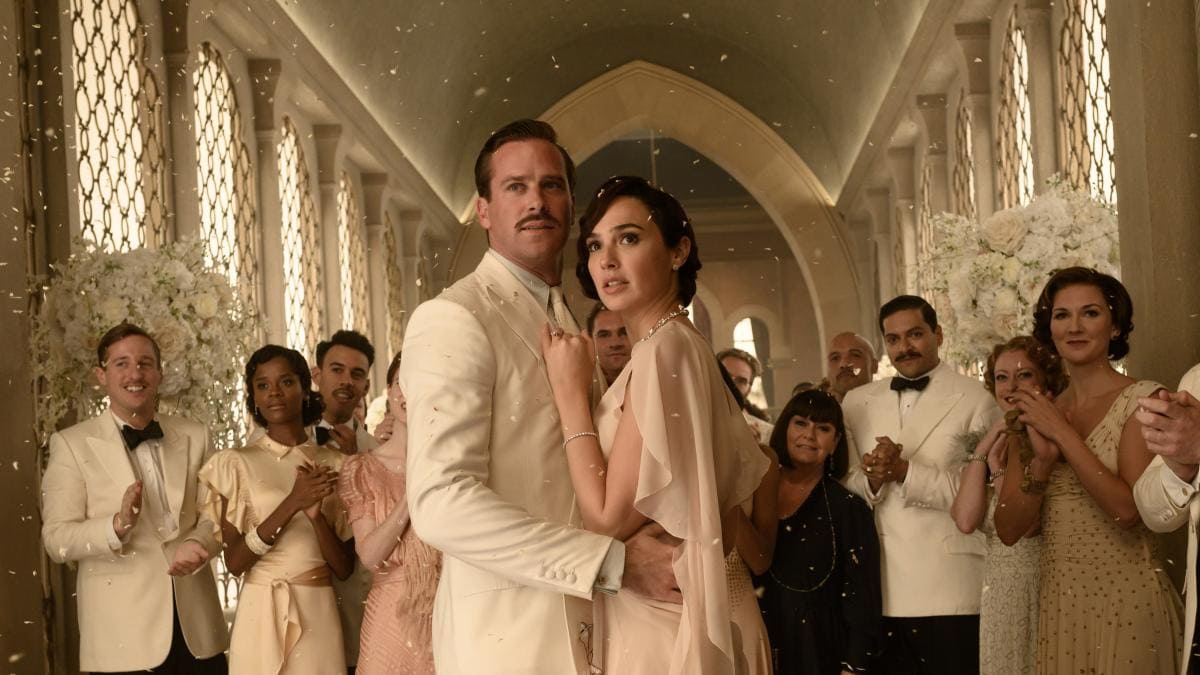
Simon Doyle (Armie Hammer) and Jacqueline de Bellefort (Emma Mackey) couldn’t be more in love at the start of Kenneth Branagh’s adaptation of Death on the Nile. But their future together detonates in an instant when Jacqueline introduces Simon to her friend Linnet Ridgeway (Gal Gadot), an extraordinarily rich and famous socialite. Fast forward a few months and Linnet is now married to Simon and leading a jealous Jackie to turn into a stalker, showing up to give the stink-eye to the wedding party as it celebrates in Egypt.
Enter Hercule Poirot (Branagh), who, by a strange and seeming coincidence, happens to be passing the Great Pyramids of Giza. Devotees of Agatha Christie’s cockily mustachioed Belgian detective and, in particular, Death on the Nile, which ranks among the English writer’s most satisfyingly twisty, should find this adaptation faithful where it counts. The unpeeling of the mystery is a tingly delight, even if the excitement is a long time coming.
Once Poirot materializes on the scene, Linnet and Simon ask him to trail his former flame and investigate her intentions, especially after Jackie reveals that she’s packing heat. But Poirot also has his eye on Linnet’s entourage, which includes her own envious ex (Russell Brand) and her godmother (Jennifer Saunders), who’s set to inherit Linnet’s fortune. As in Branagh’s prior adaptation of Christie’s Murder on the Orient Express, the locale—here the S.S. Karnak, the splashy vessel that Linnet and Simon rent out for their honeymoon—overflows with suspicious types played by the likes of Rose Leslie, Tom Bateman, and a very sardonic Annette Bening.
Michael Green’s screenplay offers up a new foil for Poirot: Salome Otterbourne (Sophie Okonedo), a hard-boiled blues singer hired to entertain the newlyweds. Salome and Poirot are both outsiders who’ve fought their way to fame, and they find themselves, warily, to be kindred spirits. (Poirot even discovers his affinity for blues music.) Okonedo’s commanding presence is well matched by Letitia Wright as Rosalie, Salome’s outspoken niece and business manager who confronts the detective, calling him out for what she perceives as mechanical soullessness, his focus on dissecting facts instead of connecting with human beings.
To support that claim, Green generously pads out the story, providing Poirot with a deep psychological profile worthy of Steven Moffat and Mark Gatiss’s reimagining of Sherlock Holmes in the BBC’s Sherlock; even Poirot’s signature mustache gets its own tragic (and rather far-fetched) backstory. The plainspoken Euphemia (Bening), a renowned painter, describes Poirot to his face as “the most ridiculous man I have ever seen,” and we’re meant to imagine that the detective’s proudly curated appearance masks a tortured soul within.
Despite Rosalie’s aspersions, though, Poirot isn’t a continental Holmes in search of his humanity, as his sleuthing is almost always grounded in a richly empathetic understanding of the people he studies. And since Branagh’s performance is sufficiently warm, sometimes even tender, scenes of Poirot weeping over the photograph of a lost love go well overboard.
Branagh inserts long, meandering scenes of nightclub dancing and desert tours that set the first half of Death on the Nile adrift, though cinematographer Haris Zambarloukos captures some mesmerizing shots that convincingly evoke Egypt’s grandeur—no easy feat considering that the film wasn’t actually shot on location. But Death on the Nile’s sudden gearshift from the scenic route to a riveting, tightly paced cruise is rather remarkable. It turns out that murder, of course, is all that’s needed to set the film in the right direction.
It’s a lot more fun to see Poirot in vigorous investigative mode, accusing each suspect and watching them squirm under his insinuations. The sleuth even gets to participate in a full-throttle, engagingly gratuitous chase sequence. And the rest of the cast rise to the occasion without hamminess, with Gadot and Mackey convincingly caustic as the friends turned rivals for Simon’s affection. Once things get moving, it’s smooth sailing to the double-shocker of a denouement. By the end of this entertaining voyage, a slow start can easily be forgiven.
Since 2001, we've brought you uncompromising, candid takes on the world of film, music, television, video games, theater, and more. Independently owned and operated publications like Slant have been hit hard in recent years, but we’re committed to keeping our content free and accessible—meaning no paywalls or fees.
If you like what we do, please consider subscribing to our Patreon or making a donation.