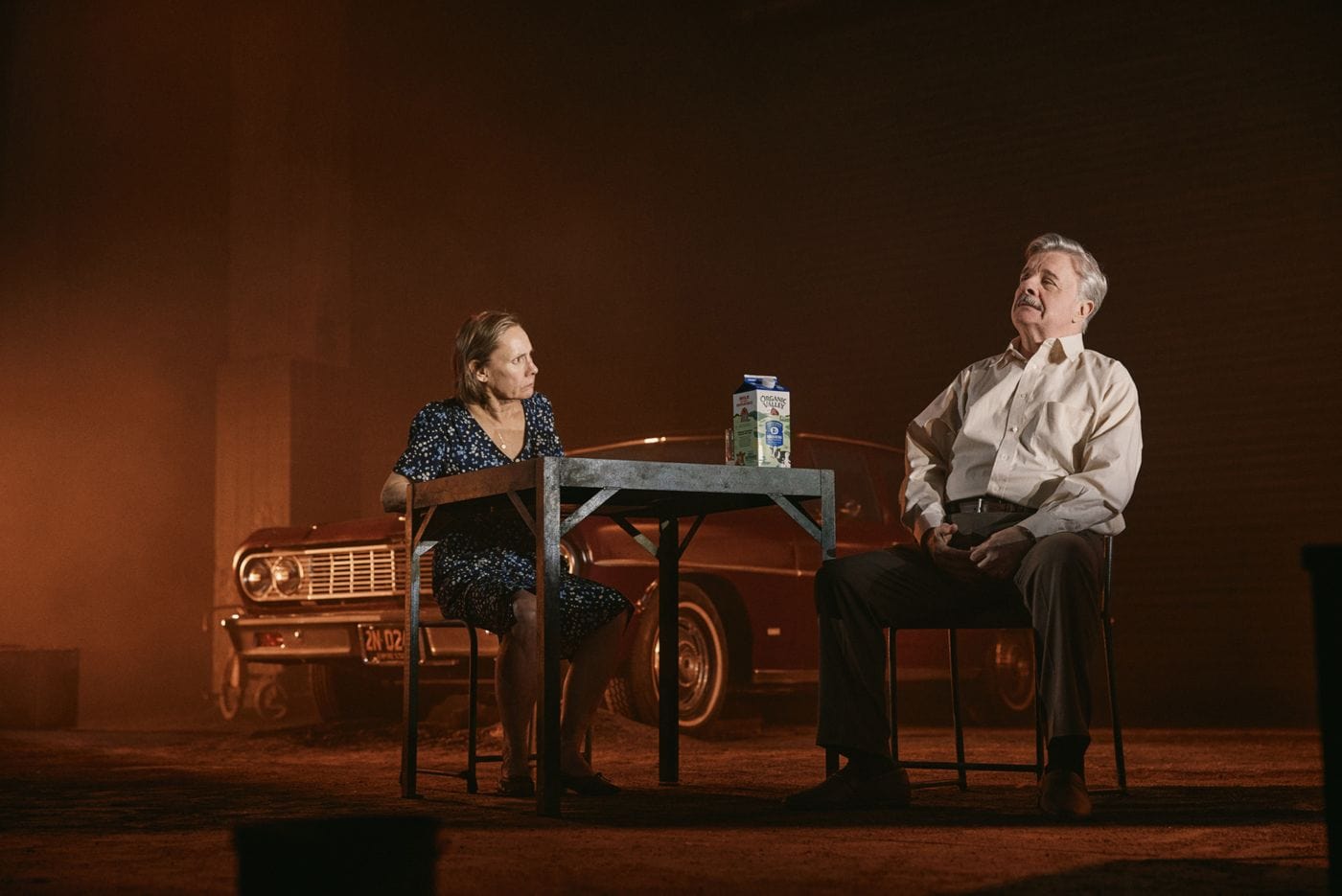
“Will you take that phony dream and burn it before something happens?” Biff Loman beseeches his incurably quixotic father, Willy, in the penultimate scene of Death of A Salesman. Take one look at the stage in the Joe Mantello-directed revival of Arthur Miller’s classic play, starring Nathan Lane as Willy and Christopher Abbott as Biff, and it’s clear from the start that the dream has long since been incinerated.
We’re in some sort of high-vaulted warehouse that looks like a dimly lit interrogation room, hopelessness seeping through the peeling porcelain tiles on the pillars and the stained windows. The centerpiece of the Loman household is the red Chevrolet that Willy drives on stage in a magnificent opening gesture. But don’t take the vehicle’s presence too literally: “I coulda sworn I was driving that Chevy today,” Willy sighs, exhausted, returning home from a route he doesn’t have the will to complete, but he hasn’t owned the Chevy in years. As mounds of dirt pile up across the stage, every corner of it suggests a half-dug grave.
This classic American tragedy’s ultimate despondency is perhaps a little distractingly underscored by Chloe Lamford’s gaping, despairing set, but Miller didn’t envision the Lomans living in a fully realistic house anyway. And while Death of a Salesman’s central dramatic irony—we know Willy’s vision of specialness and prosperity is doomed before he does—may be more obvious from the get-go than in most productions, it’s also right there in the title.
Most importantly, by the time this production hits its stride in the middle of the second act, the cast is simply too excellent and the pacing too electric for the slightly auteurish vision that pulls focus in the first half to matter anymore. Mantello has assembled an extraordinarily balanced and credible quartet for the Loman family, rounded out by his frequent collaborator Laurie Metcalf as Linda and Ben Ahlers as the younger son Happy.
When the play begins, Willy insists his family is at a turning point. After decades of service on the road, he’s exhausted but confident that his boss (a witheringly patronizing John Drea) will move him into a role that won’t demand that he travel so much, and Biff, Willy’s golden child, has come back home to Brooklyn after years of wandering out west. Willy launches into half-addled reveries about his son’s high school football glory days and all the success they should have portended, but Biff is listless now, far from forging a tangible future for himself.
Lane wonderfully succeeds as Willy by repurposing the vocal instrument that’s made him such an effectively broad comic actor. He’s prone to lifting the ends of his sentences into a garbled cry, a sound associated with the cloying kvetching of The Producers’s Max Bialystock that here re-emerges as Willy’s flailing terror at his impotence. It’s a performance all the more impressive for the way Lane finds Willy’s florid self-deception within his existing toolkit, slipping into this subtler skin naturally without reaching for melodrama.
And there’s a fraught casualness about Metcalf’s Linda that masks the frustration that eventually erupts, as the woman has needed to believe, at least a little bit, in Willy’s ladder-less pursuit of upward mobility, in order to stick by his side. There’s the sense that Linda’s the fulcrum of this family, stabilizing the seesaw of Willy and Biff’s tempers. And she’s the emotional pivot of the play, too, often right on the edge of disbelieving laughter.
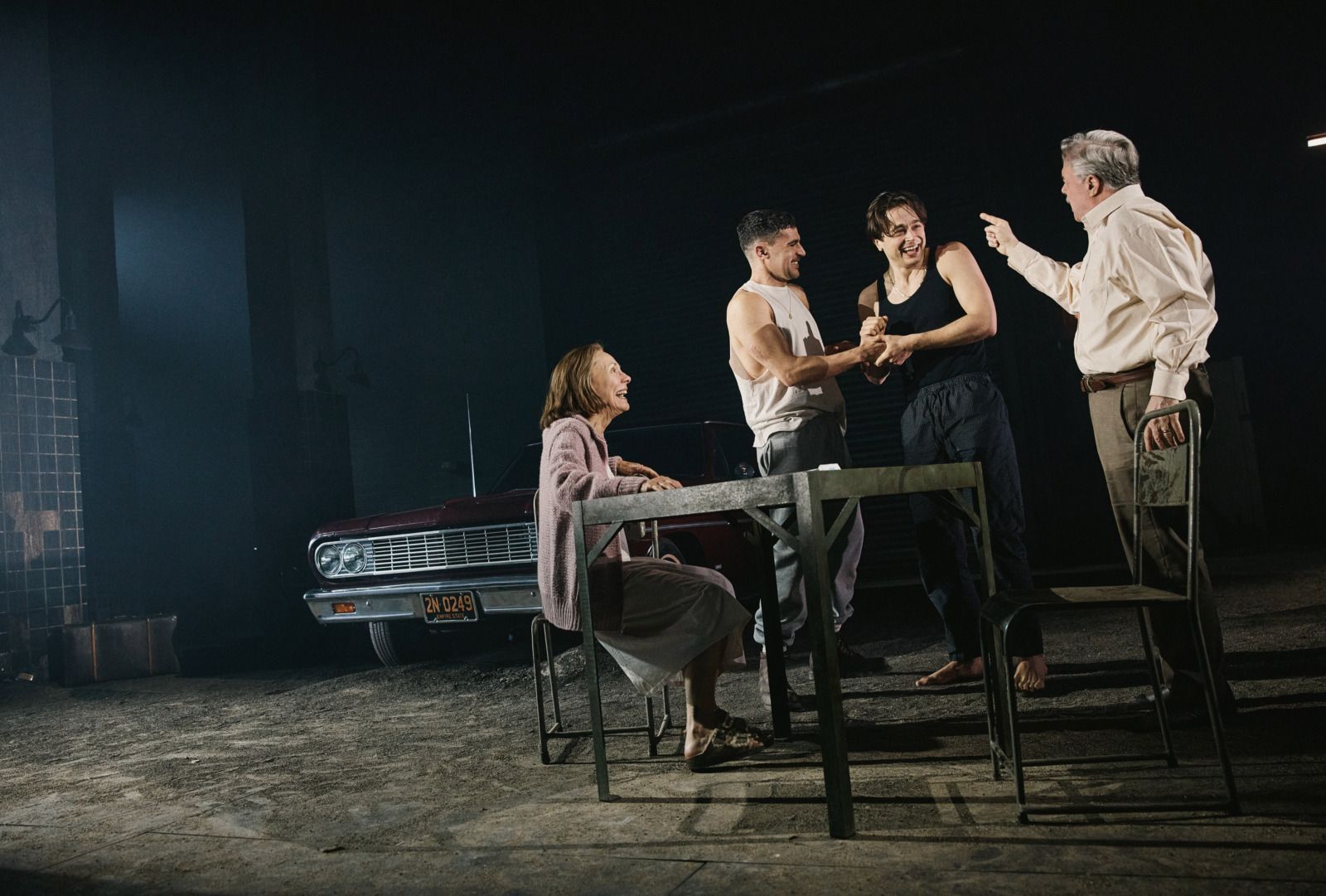
Abbott’s Biff is a quieter presence, a man who’s folded in on himself at the start of the play and seems to rely on Ahlers’s more aggressively alive Happy as the catalyst for his taking any action at all. It’s Happy who seems to be propelling events from a childlike desperation to keep Willy placated: He keeps feeding his father little poisoned slices of hope, choosing the lie to fend off his father’s fury every time. It’s not until the penultimate scene that Biff shifts from barely restrained physical rage to unexpected eloquence: “I am not a leader of men, Willy, and neither are you,” he asserts, using his father’s first name as he demands, man to man, that truth finally enter the family kitchen. Biff is, all of a sudden, as remarkable as Willy has been telling us.
The 2022 Broadway revival of the play, well-acted but too languorously dreamlike, reimagined the Lomans as a Black family with a white neighboring family. (Lorraine Hansberry, in a 1959 essay comparing her antihero Walter Lee Younger with Willy, argued that the Lomans are inherently white: “His predicament in a New World where there just aren’t any more forests to clear…or native American empires to first steal and build upon, left him with nothing but some left-over values.”) But Mantello, cannily, casts the roles of neighbors Charley (K. Todd Freeman) and his son, Bernard (Michael Benjamin Washington), with Black actors.
“Why don’t you want to work for me?” Charley asks Willy after offering him a job, and Willy’s uncomfortable hesitation before in the moment speaks volumes. The color-conscious casting zeroes in on Willy’s anguish at his own failures in the social context of the late 1940s: Saturated in racial privilege, he’s unsettled by the idea that his Black friend could flourish while he falters.
Willy has lived his whole life seeing the world through rose-tinted glasses designed to amplify his own image. And Mantello’s staging is clearest and most visually exquisite in Willy’s impossibly starry-eyed flashbacks to the boys’ adolescence. (Joaquin Consuelos shoulders the most shattering moments of these memories as the young Biff.) A sepia glow pours in through the window as Caroline Shaw’s idyllically cozy underscoring bubbles underneath. (This is, after all, the sort of prestige revival where composers with Pulitzers provide background music, often stirring.) By some trick of Jack Knowles’s lighting design, when actors climb into that red Chevy in Willy’s memory, they vanish completely behind the transparent windshield.
That’s striking stage sorcery, but this Death of a Salesman’s real magic sizzles in the cast’s gutsy, gutting portrait of the Loman family’s striving as they reach, together and apart, to find something, anything to make life worth living.
Death of a Salesman is now running at the Winter Garden Theatre.
Since 2001, we've brought you uncompromising, candid takes on the world of film, music, television, video games, theater, and more. Independently owned and operated publications like Slant have been hit hard in recent years, but we’re committed to keeping our content free and accessible—meaning no paywalls or fees.
If you like what we do, please consider subscribing to our Patreon or making a donation.