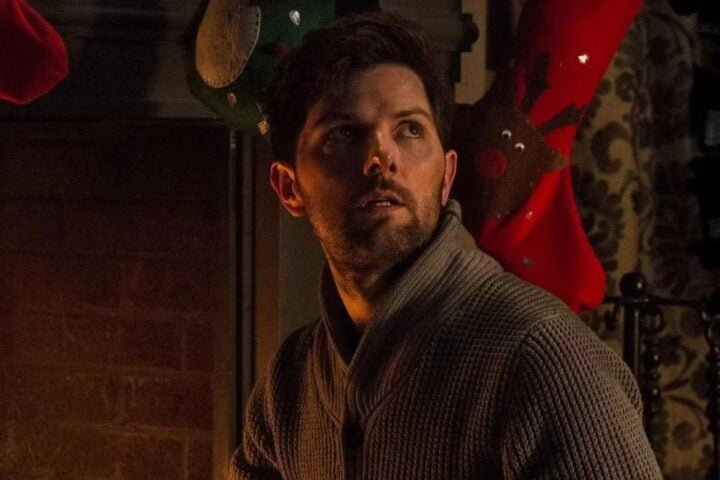
“That’s pretty much my life,” notes Hokum writer-director Damian McCarthy of his film’s opening scene, which dramatizes the writing process. As Adam Scott’s crotchety protagonist, Ohm Bauman, attempts to pen a chapter in his latest book, the mundane details of his surroundings pass through the porous membrane of reality into his fiction. McCarthy admits something similar occurs in his own work: “I’m just writing, trying to scare myself, and looking over my shoulder to see if there’s something there.”
Hokum sees McCarthy at the vanguard of a new wave of horror emerging from Ireland. With worldwide rights held by Neon and a major star on board, the film, in comparison to Caveat and Oddity, afforded McCarthy more resources than ever before to achieve his vision. But even with an elevated profile, the filmmaker stays true to his Irish roots in his take on the genre.
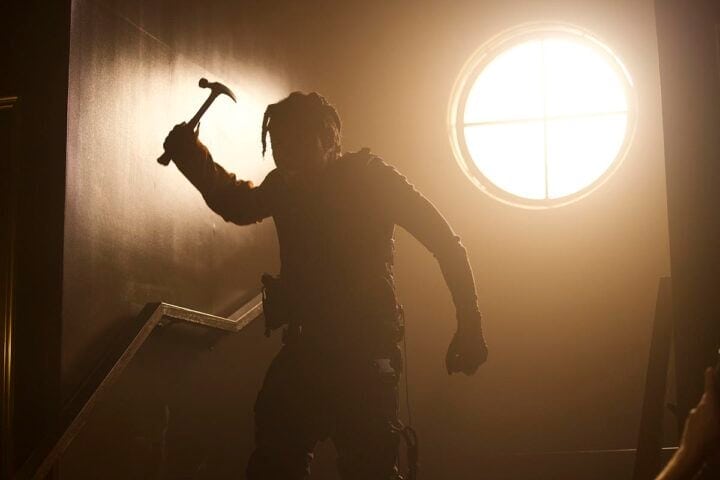
McCarthy avoids contemporary horror’s overreliance on metaphor as Scott’s American writer returns to the secluded Irish hotel where his late parents honeymooned. The film is just a good old-fashioned haunted house tale suffused with enough atmospheric dread to deliver big scares as Ohm tries to survive one terrifying night inside an attic filled with the ghosts of his past.
I spoke with McCarthy ahead of Hokum’s theatrical debut. Our conversation covered what Scott brought to the character of Ohm, how the director approaches crafting a great jump scare, and where he sourced some of his films’ most memorable haunted objects.
What keeps bringing you back to the haunted property subgenre?
I just like the idea of people being trapped in that one location that they can’t get out of. I’m sure it started for practical reasons, not having any money to make movies. Single location, single actor, confined space…I think I started all my short films that way, and then my first feature film, Caveat, which was a no-budget movie. Beyond the practical reasons of how it began as a filmmaker, it’s just something I find interesting.
How did all your short film work shape your sensibilities, and did anything require adjustment once you started making features for the big screen?
I get contacted by a lot of student filmmakers who ask, “How do you get into [film] and how do you do it for a living?” Short films are just such a great way to learn how to make a film. You’ve got the ticking clock [because] maybe somebody’s given you a location for the day. You’ve got to get used to getting in and getting out. I made a lot of short films that I could never get into film festivals that were really bad, terrible stuff. When I finally made something small, a little four-and-a-half-minute short film called “He Dies at the End” in 2008, that was the first thing I made that an audience seemed to like. It seemed to connect with people, and you learn a lot from that.
Then, you learn a lot from sitting in a room with a couple of hundred people at a film festival, seeing how they’re starting to use their imagination. If you turn the camera to an empty hallway and the character looks strange, but looks kind of freaked out by it, they’ll start to nervously laugh, and some of that can be very educational. Then, you’ll pay attention, take note, and go, “Okay, an audience knows you’re up to something.” You’re trying to catch them out. It’s something that I continue to do through my shorts into making feature films. Really, the way I worked hasn’t changed. I still storyboard everything and try to plan it all out, from “He Dies at the End” all the way to Hokum. It’s kind of the same thing, just on a bigger scale.
A lot of your early work broke out on YouTube, so were you getting useful feedback from online as well? A lot of filmmakers say they have to tune that out, although the horror fandom does seem fairly supportive.
People who like horror films, I think, are usually really lovely! There’s something very nice about them because they get all that darkness out in what they’re watching. There’s that danger of paying too much [attention]. I try not to read anything about the films I’ve made, because somebody can be saying, “I hate the way this guy keeps doing this,” and you go, “Oh, I better stop doing that.” But then it can be equally damaging when somebody says, “I really like the way he does this,” and you go, “Okay, well, I’ll do that now all the time.” Both can be damaging in some ways when you’re just trying to make something that you yourself think will connect. There’s a bit of a balance in what feedback you take and how much attention you pay to it.
You noted that this felt like your first American film after casting a lead from the States. Beyond the obvious of them being an outsider in Ireland, did that require you to tweak writing the character for the nationality?
It didn’t, and it was something I always wanted to do. I always wanted to blend my love of living in Ireland, working with my crew there, and using locations that I really like with the American cinema I would have grown up watching. The only tweaking I had to do with the script was really just in the way lines of dialogue would be delivered. I would have sat down with Adam day one and said, “Here’s how I would phrase it in my accent and the way I would structure a sentence, but you say it in the way that would sound natural from your background.” Beyond that, there was nothing in terms of making the character more likable.
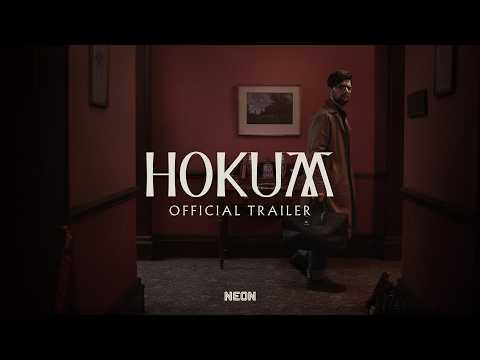
Were those tonal changes flipping into a more comedic register there before Adam Scott, who has such versatility working across genres, was attached to the script?
It’s really just in his performance. Everything that happens is in the script, but that tonal balance between playing it seriously but, in a way, still knowing that he’s very much in a horror movie—there’s just a little bit of silliness [to it]. There’s a little bit of a silliness to all horror films in general—the entertaining ones, anyway—that he got. We never had long conversations about that. He knew how to move between the two and kept that lovely tone going.
A good chunk of Hokum features Adam Scott alone on screen. Did you consciously build to this in the writing?
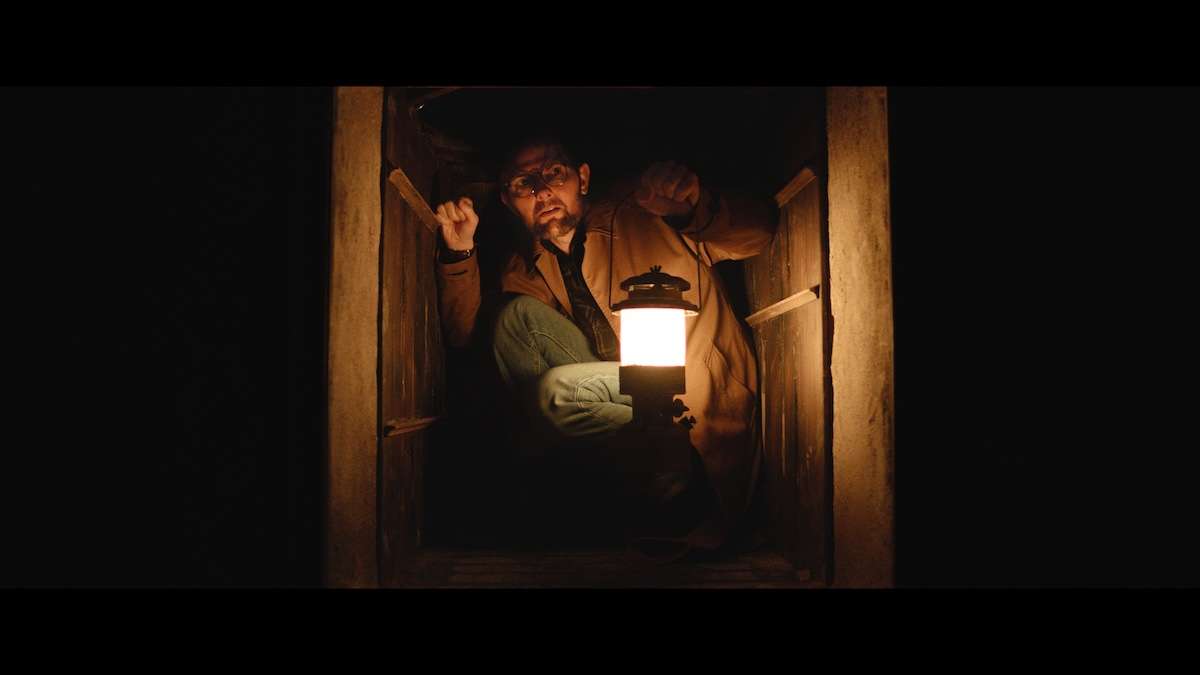
Well, I love that stuff because all of my short films had no dialogue. I was working with friends and people who weren’t professional actors. I was quite excited to go back and see if I could do a good 15-to-20 minutes of no dialogue with just this guy being terrorized. It’s not an easy thing to do because there’s no screen partner, dialogue, or voiceover. You’re just watching Adam getting more and more frightened and frustrated that he can’t get out of this room. I really enjoyed it, though, and Adam has said that it was an interesting challenge for him, too, as an actor. You always have somebody to act off of, your partner in the scene, and they feed off each other.
But with this, our set was sealed up. It wasn’t three flats with an open front. You had to come in through the back. There was a wardrobe at the back of one of the rooms that moved, and that was a doorway. And once that was closed, you could move the camera right around, and you’re in the room. It was like three weeks just in that room, in the dark, with Adam and a lantern, trying to escape. I’m not an actor, but from a method point of view, it’s got to have helped.
In that scenario, I think the director becomes the reflection of the performance back to the actor. How were you helping guide Adam in these sequences?
I try to say as little as possible to the actors. Like with a production designer, you work with them to begin with and talk about it all beforehand, and then from day one, it’s just a matter of [being] against the clock. We’ve got to shoot this, so you’ve got to keep moving. There’s never really a chance to stop and have any lengthy discussions. And I don’t really want to, anyway. If I’ve hired good people around me, it’s up to them now to bring it. We talked a bit about it beforehand in terms of having somewhere to go. You can’t start at 11 of scared because it becomes this thing of gradually building it up as the situation gets worse, the night gets darker, and it looks like all hope is lost. If I ever offered anything, it was just to keep that in mind.
What goes into planning a jump scare?
[The key to] jump scares is just not to be cheap with it. For example, Adam’s character meets David Wilmot’s character, Jerry, in the woods. Jerry is just sitting there, and Adam comes around the corner, and he hasn’t noticed that he’s sitting there. It’s such an obvious place to have a jump scare. Jerry’s sitting there, and he’s this harmless guy not doing anything. You could put in a big sting or something just to startle the audience, but then I feel like you’d lose trust in the audience. [They’d think] this guy is just out to try to startle us as opposed to earn the scare. So, when Adam comes around the corner and sees Jerry sitting there, the scare is just for him. It’s not to startle the audience.
Building on that, every time you do a jump scare, it has to feel earned. You have to establish that and let the audience know, “Okay, something is going to happen. I’m telling you now that, in the next few minutes, we’re going to reach an end to the sequence that’s beginning.” A character opens up a door, and there’s a long, dark hallway. The audience goes, “Alright, here we go, now he’s gonna try to do something to us.” And then it’s just getting the timing right and trying to stretch it out for as long as it can, trying to take your own knowledge of horror films and all the stuff you know. You’re trying to guess, “Oh, I bet it’s going to be here. Now, it’s going to happen.” And if it happens [then], it’s quite disappointing. The idea is to try to have it a little bit too early or a little bit too late. Or, if we think it’s going to come from here, it’s really coming from there. It’s trying to almost weaponize people’s knowledge of horror movies. I know you think this is what should happen, but we’re going to change it ever so slightly.
And what about in the performances and the edit?
When you get into the edit, it can be [down to] frames. Sometimes, an actor will turn, and there’s the ghost or whatever behind them. You can watch it, and everything looks right but is not working. And it’s the strangest thing. It can be taking out a couple of frames, and suddenly, it works. I don’t know why; it’s almost like a gut feeling.
Of course, a big part of it, too, is how an actor performs that scare. One of the first things we shot was Scott just being startled by a desk bell, and he gets a little fright. You’d be surprised: The greatest actors can’t do that. It feels fake. I was watching his whole body tense up, and his hands went up defensively. I thought, “Oh, this is going to be great. This guy’s got a good imagination. He’s seen horror movies, and he’s into it.”
How to do you find these haunted totems in your films? Is that a conversation with the props department or something you’re leading the way on?
It’s a mix of both. I’ve always just had this weird interest in old antique objects. If you go to flea markets, you find something there. When you find a strange ornament, like a figurine of a little old lady, it’s like, “Who made this? Were these mass-produced? When was this made? This was probably a gift to somebody at some stage or a prized possession, so what’s the history behind this thing?” It’s an odd thing to have an interest in, but I’ve always picked up these items.
Of course, there’s that horror trope where something doesn’t just have history but still has something attached to it…or there’s something creepy about it. I’ve always found that entertaining, the idea of an item being haunted. If I’m roaming around while traveling, I’ll try to go into secondhand stores and start picking up things and go, “Yeah, this would make a cool cutaway or insert to have on somebody’s desk, and maybe write something around this.” The nice thing about having a little bit of budget to play within is that you can actually draw these things, design them, and have them built the way you want them to, like the clock in Hokum.
The character of Ohm softens over time, which is the reverse of how horror characters usually harden in reaction to the threats they face. But, as we see in his last interaction, the character does not fully lose his edge. How did you settle on this balance of how the house does and does not affect him?
He’s so hard, cold, and cruel, and at the end, I thought it’d be nice for his guard [to be] down. He’s a little bit more open. He’s not jumping out of bed, hugging people. It’s not an Ebenezer Scrooge, “I’m so happy to be alive” type thing. But the edges have been taken off a little bit, so it was a little bit of a balance to get that right. In the script, certainly, and in the first couple of edits we did, Alby [Will O’Connell] comes in, and he’s still a little cruel and making cracks at him. There was a little bit of work to find that balance of going, “Well, let’s make him just a little bit more welcoming and not as dismissive.” He’s not suddenly filled with the joys of life.
Since 2001, we've brought you uncompromising, candid takes on the world of film, music, television, video games, theater, and more. Independently owned and operated publications like Slant have been hit hard in recent years, but we’re committed to keeping our content free and accessible—meaning no paywalls or fees.
If you like what we do, please consider subscribing to our Patreon or making a donation.