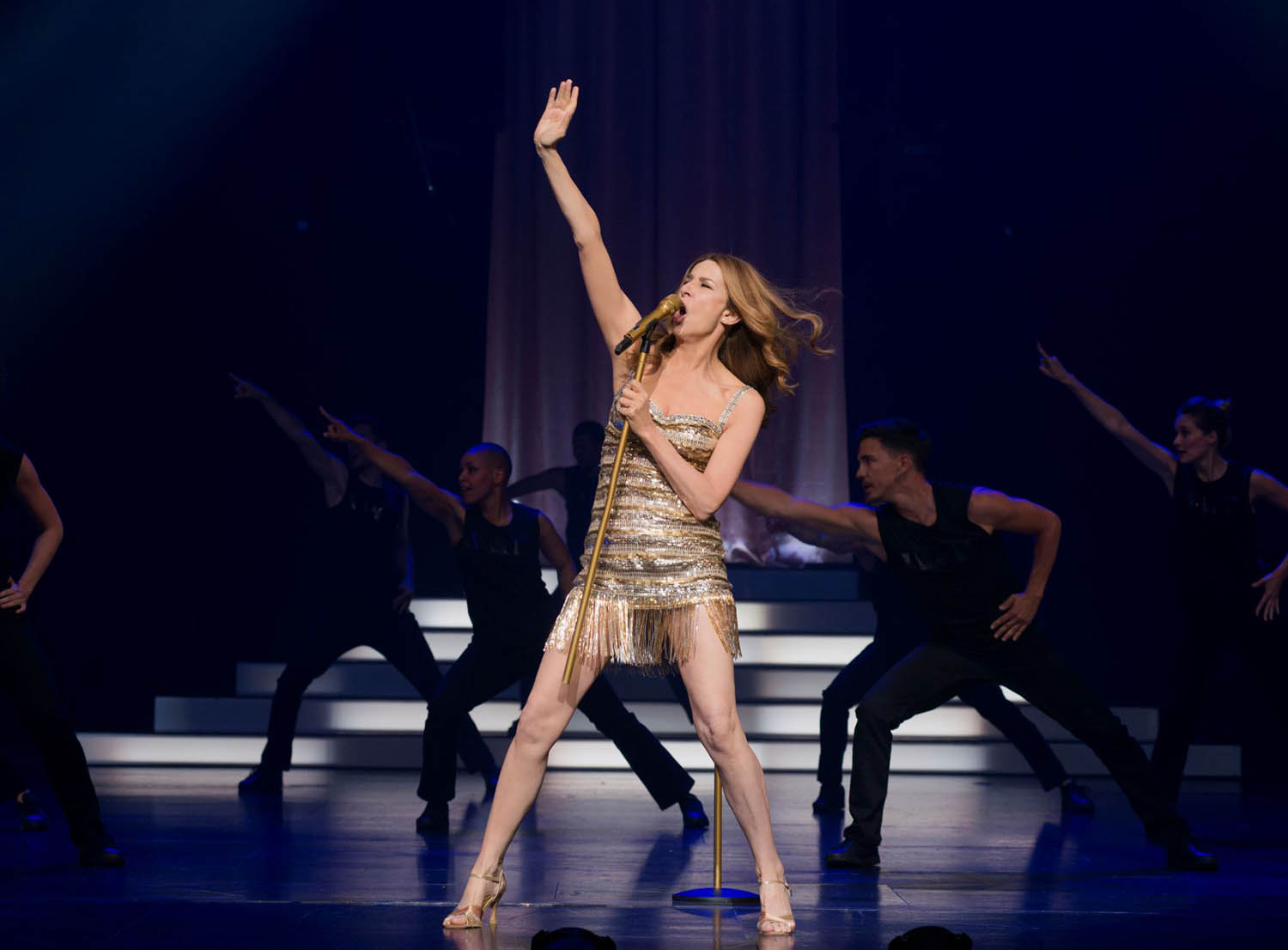
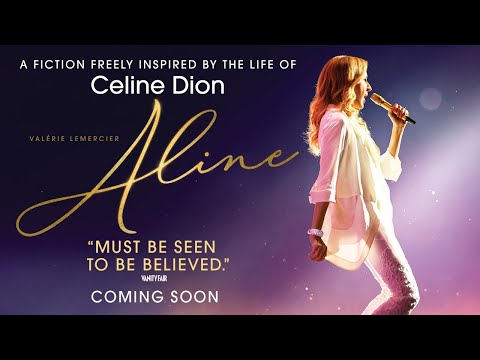
Valérie Lemercier’s Aline is a faux-biopic of Celine Dion that conforms to the tired structures and tropes of the genre even as it’s twisted into something surreal by the nature of its making. While Lemercier got the rights to Dion’s music, she couldn’t use the artist’s name, and so a disconnect immediately comes from watching a straightforward account of what’s clearly Dion’s life, but the person living that life is one “Aline Dieu.”
This isn’t the first time that a film about a living artist has had to make do without their cooperation (Todd Haynes’s Velvet Goldmine, which is based on David Bowie’s life, is a notable example), but typically no one has tried to make a full-on biopic under these circumstances. Second, and more bewildering, Lemercier, who also stars as Aline, elected to play the character at every stage of her life, from childhood all the way through middle age, with the help of CGI.
From the moment that Aline raises her head from a school desk to reveal the digitally smoothed face of a woman in her mid-50s, the film creates an alienating effect that lasts for most of its runtime as it charts her rise from teen sensation to international superstar. Aline is presented as a naif thrown into the whirlwind of fame, which clashes with the world-weariness that Lemercier cannot purge from her countenance no matter how expressively she attempts to convey Aline’s intoxication with the music business. Lemercier’s face exudes a certain caginess, which would be compelling in a noir character, or even a figure in a film that was more cynical about the nature of show business, but is wildly out of place with Aline’s rosy portrait of a talented youngster making it solely on the strength of her abilities.
Behind the camera, Lemercier gives some indication that she understands how strange this whole enterprise is by attempting to work around the uncanny valley of her performance. Many shots are framed as static compositions of Aline in her bedroom and in hotels, the camera placed in long shot to minimize the jarring dissonance of seeing Lemercier’s face digitally transplanted onto younger person’s body. And this decision also has a thematic side effect, as it stresses young Aline’s struggle to stand out in a big working-class family from Québec and, after her breakout, the singer’s feelings of displacement.
Montages abound when it comes time for Aline to perform. As she runs through her songs (the major hits of Dion’s catalog), her live shows are intercut with images of Aline’s personal life, a move that limits the amount of awkward lip-synching that Lemercier had to do (Aline’s singing voice is dubbed by Victoria Sio). But the repetitiveness of the gimmick quickly wears thin, and, ironically, the glimpses of Aline at different stages of her life are so interchangeable that it becomes difficult to tell where, exactly, we are in the character’s timeline.
The preponderance of musical montages in Aline’s back half attests to perhaps the greatest issue with Lemercier’s film: its near-total lack of dramatic conflict. Apart from the teen Aline’s infatuation and ultimate marriage to her much older manager, Guy-Claude (Sylvain Marcel), which is viciously criticized by her religiously conservative and image-conscious mother, Sylvette (Danielle Fichaud), there’s almost nothing here to act as a personal or professional setback that Aline must overcome. From the moment that she gains notice from an open-minded label executive in Québec, Aline is placed on a straight line toward superstardom, facing no struggle more serious than a diagnosis of vocal nodules.
While it’s refreshing to see a biopic about a musician that isn’t a tawdry depiction of them unraveling from substance abuse or toxic relationships, Lemercier doesn’t supplement the absence of such tropes with a compelling alternative. Because she telegraphs her love of Dion in her character’s name—“Aline” means noble, while “Dieu” is the French word for God—it’s no wonder that Aline feels at once like a vanity project for its maker and a glorified fan tribute.
Since 2001, we've brought you uncompromising, candid takes on the world of film, music, television, video games, theater, and more. Independently owned and operated publications like Slant have been hit hard in recent years, but we’re committed to keeping our content free and accessible—meaning no paywalls or fees.
If you like what we do, please consider subscribing to our Patreon or making a donation.