Your honesty is a gift,” Albus Dumbledore (Jude Law) tells magical zoologist Newt Scamander (Eddie Redmayne), “even if at times a painful one.” So let’s be honest and say that director David Yates’s Fantastic Beasts: The Secrets of Dumbledore, the third film in the Harry Potter prequel series, might as well be the last.
Sure, it may be the most adventurous of the three—more gripping than the cute but mulishly prologue-like first one and more coherent than the second, The Crimes of Grindelwald. But there’s a sense that J.K. Rowling, who co-wrote the screenplay with Steve Kloves, is now just enjoying the theme park rides she finished building long ago while the cash rolls in, a celebration of the Wizarding World’s slow decline from unalloyed art to undying franchise.
The Harry Potter narrative never meandered because the passage of time was so clearly delineated: seven school years, seven books, defeat the Dark Lord before graduation. Those film adaptations, too, for the most part, deployed adroit cinematographic storytelling to condense the rich character development and overflowing world-building of the novels into digestible portions. In contrast, there’s little sense of chronological momentum in the Fantastic Beasts series, except for the Wizarding World’s timeline paralleling our own Muggle history. With only a handful of characters registering as fully formed, the plot unspools slowly, relying more on lengthy chases and duels and prison breaks than on human beings.
When The Secrets of Dumbledore kicks off, the Muggle-hating Grindelwald (Mads Mikkelsen, inheriting the role from Johnny Depp) is a fugitive plotting a political comeback. He schemes to take power via the ballot box, and, since it’s an election year for the Supreme Mugwump, the Head of the International Confederation of Wizards, he’ll have a chance to skip right to world domination. Mikkelsen is a suave substitute for Depp, who resigned the role—following Warner Bros’s urging—after filming began in response to allegations of domestic violence. And if this new take on the villain lacks Depp’s threatening sliminess, maybe that’s the point.
Though combatting Grindelwald’s sinister sorcery with Dumbledore’s legendary powers of might seem like a good idea, there’s a problem: Dumbledore can’t battle Grindelwald himself because of a blood pact they swore in their youth never to “move against each other.” Explicit at last in The Secrets of Dumbledore is the adolescent, romantic heat once shared between Dumbledore and Grindelwald, a passion that Rowling first alluded to months after the final Harry Potter’s book release, in response to a question about Dumbledore’s love life.
That 2007 admission frustrated some fans who viewed Rowling’s extra-textual revelation as a poor substitute for writing an actual queer character. Fifteen years later, as Rowling’s transphobic tweets and essays continue to fracture the fandom, her increasing vitriol fueling widespread condemnation from the casts of the Harry Potter and Fantastic Beasts films, Dumbledore’s canonical coming out party seems too little too late.
After two Fantastic Beasts films that only drop subtle hints, Dumbledore’s suddenly out and proud, casually drifting into sensual trips down memory lane. “The summer Gellert and I fell in love…” Dumbledore begins one such reverie, as if introducing a magical gay production of Grease. If it’s campily charming that no one in 1932 bats an eyelid at Dumbledore’s offhand confessions, it’s also insane: So, everyone’s cool with Dumbledore having a still-smoldering crush on the guy who’s plotting the global genocide of non-magical people?
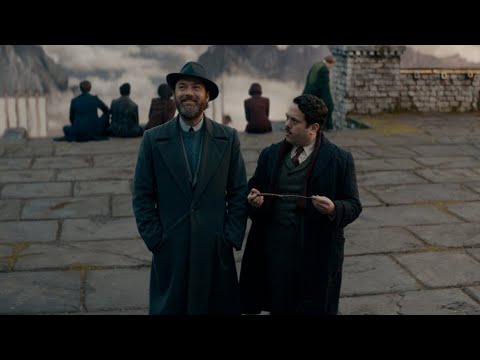
On the other hand, Newt’s love interest (Katherine Waterston) appears in only the most fleeting of cameos. “Tina’s not available,” Newt explains early on when someone brings up her absence. She has a big new job, we’re told, that’s keeping her “very busy.” Right.
Without a girl to pine for, Newt becomes rudderless, carrying out Dumbledore’s missions with no questions asked. His cadre of Grindelwald-fighting companions include his brother, Theseus (Callum Turner); his adoring assistant, Bunty (Victoria Yates); his best Muggle friend, the baker Jacob Kowalksi (Dan Fogler); and an American Charms professor at Hogwarts, Lally (Jessica Williams). They’re all surprisingly jovial given how very much in the dark they tend to be about why they’re carrying out dangerous assignments on Dumbledore’s behalf.
More glum are the two possible traitors now living in Grindelwald’s castle: Queenie Goldstein (Alison Sudol), Jacob’s long-ago fiancée who can read minds but still trusts the wrong people, and Credence (Ezra Miller), who harbors an unusually dark and parasitic magic inside him. The prior film concluded with the revelation that Credence might possibly be an abandoned relative of Albus himself. And the titular secrets of Dumbledore, such as they are, turn out to be rather mild. Still, the Obscurus, the explosive force that surges within Credence’s tormented mind and body, remains the creepiest magical element since the soul-sucking Dementors.
That political plotline almost works in illustrating how populist figureheads manipulate the will of the people they claim to care about to serve their own ends. Grindelwald’s swift rise from imprisoned rebel to legitimate candidate clearly references Adolf Hitler; he seizes control in Germany of all places, crowd-surfing on the shoulders of a mob of Aryan-looking supporters. But the filmmakers seem utterly uninterested in building out the rest of this political world except to signal that wizards embrace multiculturalism in the broadest of terms. For one, Grindelwald’s political rivals, Vicência Santos (Maria Fernanda Cândido) and Liu Tao (Dave Wong), are diverse but disappointingly underdeveloped.
There are still some satisfactions to be found by the Harry Potter fan who swoons at the slightest hint of John Williams’s musical motifs, and a brief appearance from a young Professor McGonagall (Fiona Glascott) is one such delight. George Richmond’s camera seems to take refuge in the scenes that swoop over the turrets of Hogwarts and through the school’s Great Hall while a Golden Snitch flits by, and The Secrets of Dumbledore is on safest ground where the warmth of familiar scenery offer sufficient distraction from the plotholes.
As for the fantastic beasts, the one that matters most to the plot is the qilin, a gaunt, four-legged creature derived from Chinese mythology with the power to choose the next leaders by sensing the goodness in their souls. The quasi-religious dichotomy between good and evil has always been present in Rowling’s Harry Potter books, but it was the characters who lived in the gray areas—Severus Snape, for example—who gave the beloved series such psychological depth. In this film, nuance seems to have disapparated from the wizarding world altogether.
The Secrets of Dumbledore works best as a film in the moments that require as little context as possible. There’s an uncomplicated pleasure in watching Newt and Theseus scuttle like crabs across a cliff face, trying to get a mob of pincered creatures to mimic their movements. As a smoothly built action flick, this enterprise is endearingly perky, but as a meaningful contribution from Rowling to the Harry Potter universe, well, 10 points from Slytherin.
Since 2001, we've brought you uncompromising, candid takes on the world of film, music, television, video games, theater, and more. Independently owned and operated publications like Slant have been hit hard in recent years, but we’re committed to keeping our content free and accessible—meaning no paywalls or fees.
If you like what we do, please consider subscribing to our Patreon or making a donation.