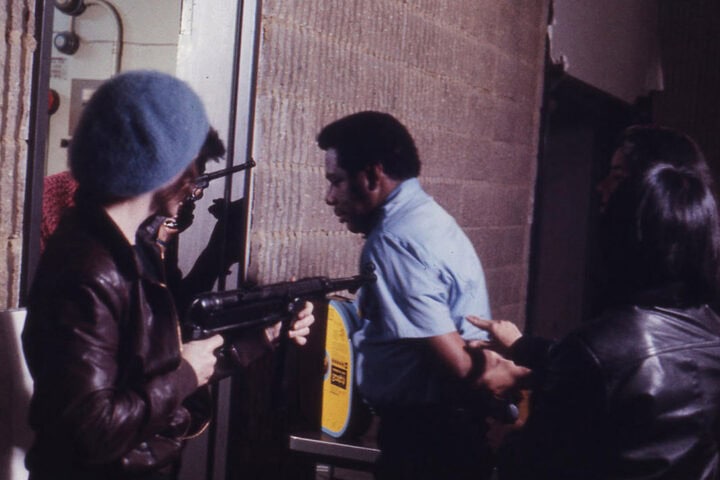
Lizzie Borden’s Working Girls is a near-anthropological study of a Manhattan bordello. It demystifies and de-eroticizes sex work, portraying scenes of carnal intimacy with neither titillation nor sensuality. The film’s sex scenes, which are set to a disorienting avant-electronic score by David Van Tieghem that distances us from the action, seek to capture not the amatory pleasure of the john, but the dissociative mental state of the sex worker going through the uncomfortable grind of her job. “I never come in this place,” says girl-next-door-type Molly (Louise Smith) to one of her regulars. And why would she? This is just a job after all.
It’s that emphasis on work that distinguishes the film from most other cinematic depictions of prostitution. Sex work, in Borden’s view, isn’t inherently degrading, or at least no more so than flipping burgers or sitting in an office all day. The job may have its own peculiarities—oddball clients, the illusion of a deep intimacy, the increased potential for violence and disease—but at the end of the day, it’s exploitative in the same way that any paid employment is: You work your ass off to enrich a boss.
The boss in this case is Lucy (Ellen McElduff), a prim and proper madame whose sunny demeanor masks a mercenary instinct for squeezing every last drop of surplus value out of her employees. She glides in and out of the brothel—an antiseptically well-appointed apartment that looks not unlike a corporate waiting room—with constant complaints that the place is too messy, that the girls don’t answer the phone properly, and that her employees take too much time for their own personal matters. In one scene, Lucy obliviously shows off her expensive clothing to the very workers whose labor allows her to purchase such fine things, distilling the essence of capitalist exploitation to its most outrageous and darkly funny essence.
Borden conducted extensive research on the Manhattan brothel scene, and the film is peppered with insights, small and large, about the industry, such as the harassing phone calls that come in through the bordello’s appointment line or the way the girls log hourlong sessions as a half hour to pocket a little extra cash. There’s a verité quality to the film’s mundane fly-on-the-wall detail, a comparison underlined by the cameo from direct cinema pioneer Richard Leacock as a bondage-loving john. But Borden’s directorial approach is really closer in spirit to an industrial film, one that could almost be used by a madame to train aspiring sex workers if it weren’t so explicitly Marxist in its depiction of labor relations.
Molly is aware of her exploitation, but she’s largely accepted it: She gets good money, and if she has to hide her day job from her loving partner, Diane (Deborah Banks), that feels like a small price to pay to preserve their life of tranquil domesticity, which we glimpse in the film’s largely dialogue-free opening scenes. However, her commitment to her work is tested as the film, which is set over the course of one particularly grueling day, goes on. Just as Molly is about to clock out, Lucy emotionally manipulates her into staying on for a second shift during which she’ll be conscripted into training an anxious newbie with no sex work experience.
For Molly, it’s not the work itself that’s untenable, but the domination of her time. Work for her isn’t entirely unpleasant, as she seems to enjoy talking to at least a few of her clients, for whom she’s as much a therapist as a paid sex worker. She listens to their problems and helps make them feel a little less alone in the world. But Borden understands that a job isn’t merely a set of tasks, but an obligation to be in a certain place for a set amount of time, during which one’s family, friends, interests, and passions must be put on hold. She also recognizes that down time isn’t free time, and the film is attentive to the girls’ boredom while on the clock, as they sit around eating bad food, leafing through magazines, and kvetching about the job.
The gray walls of the brothel’s waiting area gradually start to look like those of a prison cell, one that, as the night wears on, Molly begins to feel like she may never escape. Capitalism, the film argues, isn’t merely the exploitation of labor but the complete hijacking of one’s time, beginning with the ring of the alarm clock in the morning. Molly may be frequently naked in Working Girls, but, significantly, there’s one item she can never take off: her watch.
Image/Sound
Working Girls creates meaning through subtle juxtapositions of space and color, such as the contradistinction between the drab, over-lit grayness of the brothel’s waiting room and the colorful, low-lit interiors of the bedrooms. The natural sunlight of the film’s few exterior scenes provides a soft, gentle image that’s positively refreshing after the fussy mutedness of the brothel. Featuring a new 4K transfer from the film’s original 16mm camera negatives, Criterion’s release highlights these subtle visual cues without artificially pumping up the contrast or color saturation. The monaural soundtrack, remastered from the original magnetic tracks, is clean and clear, with little noise audible beneath the dialogue.
Extras
True to the spirit of Lizzie Borden’s film, this release’s extras are dominated by female voices. Borden, director of photography Judy Irola, and actress Amanda Goodwin provide a dense commentary track chockful of anecdotes about the film’s scrappy, low-budget production. A virtual discussion between Goodwin, Smith, producer Andi Gladstone, and assistant director Vicky Funari covers some of the same ground, with the participants emphasizing the power of working with a largely female crew and the awkwardness of shooting the many sex acts contained in the film. A conversation between Borden and Variety director Bette Gordon focuses on the two filmmakers’ related approaches to sex-positive feminist cinema.
Perhaps the disc’s boldest feature is a virtual roundtable featuring several sex workers reflecting on the film’s insights into their work and the contrast between the film’s milieu (a Manhattan brothel catering to financially stable men) and such spaces as strip clubs. An attractively laid-out booklet includes a Marxist-feminist take on the film from critic So Mayer and excerpts from a 1987 interview with Borden conducted by film scholar Scott Macdonald in which the filmmaker reflects on Working Girls place within feminist cinema of the time.
Overall
Fittingly, the extras on this long-overdue Blu-ray release of Lizzie Borden’s under-sung feminist milestone meet the film at its level by centering female voices.
Since 2001, we've brought you uncompromising, candid takes on the world of film, music, television, video games, theater, and more. Independently owned and operated publications like Slant have been hit hard in recent years, but we’re committed to keeping our content free and accessible—meaning no paywalls or fees.
If you like what we do, please consider subscribing to our Patreon or making a donation.