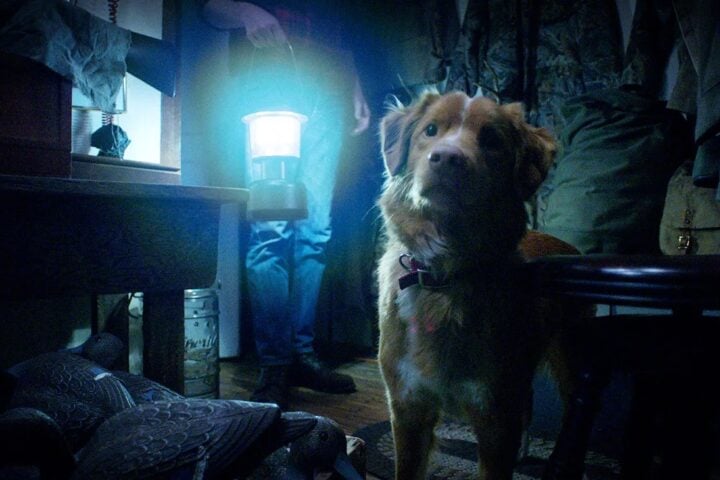
Though it doesn’t feature Old Joy’s Air America radio call-in Greek chorus, Kelly Reichardt’s follow-up Wendy and Lucy is nonetheless a somber politicized lament for hardscrabble lives struggling to exist on the economic precipice. Reichardt’s latest (based on Jon Raymond’s short story Train Choir) opens on Wendy (Michelle Williams) and her beloved dog Lucy amiably strolling through the Oregonian woods, their casual and affectionate rapport amid their verdant environment underscored by the soundtrack’s melancholy humming by Wendy, who’s on her way from Indiana to Alaska in the hopes of finding employment at a Northwest fish cannery. Dressed in a flannel shirt, a hooded sweatshirt and homemade corduroy cut-offs, and boasting a boyish haircut, Wendy looks the part of an aimless drifter, yet her desire for stability becomes clear once she comes across a group of itinerants’ campfire, her face peering through the brush with fearful hesitancy that suggests her stark contrast with these nomads. Her plans to reach Alaska, however, go awry in a small Oregon town when she’s arrested for shoplifting dog food and carted off to jail, with Lucy left to fend for herself while tied to a post outside the grocery store. When Wendy makes bail and returns to retrieve Lucy, the dog is gone, initiating a desperate search that soon consumes the narrative.
Both the callous self-interest and compassionate altruism of strangers are on display in Wendy and Lucy, as Wendy’s circumstances are created by the insensitivity of a grocery store employee and aided by the generosity of a Walgreens security guard who provides encouragement as well as the use of his cellphone. Permeating her plight is an encompassing sense of sadness rooted in loss, loneliness and, most strikingly, departure, with Reichardt repeatedly closing scenes with the sight of Wendy, her back to the camera, exiting the frame. Wendy has not only left Indiana but, now specifically, wants to “pass through” Oregon, a place where, per Wally Dalton’s security guard, there are few jobs and fewer people. Thus, her northern migration soon becomes emblematic of a country where financial and—as evidenced by the coldness of Wendy’s sister over the phone—also familial instability have fostered rootlessness on both a personal and societal scale. In Wendy’s efforts to endure, which additionally involve figuring out a way to repair her car, Reichardt taps into a larger cultural malaise, her film’s stripped-down realism capturing—in gorgeous shots of the damp, misty Pacific Northwest pines and aged train yards (further symbols of departure), or of Williams’s determined countenance struggling to maintain self-possession—the arduousness of subsisting alone in the face of hardship.
Despite a lost-dog story primed for manipulative sentimentality, Reichardt’s gracefully unfussy direction maintains consistent tonal composure, so that when Wendy finally breaks down after having a nocturnal forest run-in with a wacko (Larry Fessenden), her sobbing registers not as melodramatic hysterics but as hard-earned release. With regard to finding Lucy, a pound employee tells Wendy, “It’s going to be up to you now,” and despite espousing the belief that one can still sometimes rely on the kindness of others, Wendy and Lucy ultimately does grant Wendy control over her and Lucy’s fate. Likewise, it places the burden of carrying the film on Williams, whose expression of at-the-breaking-point strain—a combustible fusion of fear, despair and misery over having lost the only genuinely true, reciprocal love in her life—is made intimately wrenching by her shaky suppression of those feelings behind a façade of defiant solemnity. Absent any showy histrionics or mannerisms, her performance makes painfully real Reichardt’s depiction of everyday problems magnified by poverty into mini-calamities, exhibiting a measured grace that’s matched by complementary beginning-middle-end tracking shots—of woman and dog playing fetch, of dog pound cages, and of dusk-dappled trees spied from a moving train—that encapsulate the film’s emotional trajectory from contentment to sorrow to hopeful uncertainty.
Image/Sound
The image honors Kelly Reichardt’s intentionally drab color palette, but there are some instances of bleeding, with the blue of Michelle Williams’s hoodie exhibiting flashes of neon-ness from time to time. Two audio tracks are available, and though the differences are negligible, the superiority of the 5.1 surround becomes apparent whenever a train lumbers across screen.
Extras
If you’re aware of Reichardt’s caginess about doing press in support of her films, you probably didn’t expect a commentary track on this Wendy and Lucy DVD, and if you read our interview with the director you probably didn’t want to hear from her again. In lieu of recording a track, Reichardt offers the fine folk at Oscilloscope Laboratories a collection of short experimental films (Peter Hutton’s Boston Fire and New York Portrait, Chapter II, Peggy Ahwesh’s The Scary Movie, Les LeVeque’s flight, and Jacqueline Goss’s How to Fix the World) made by four of her Bard College colleagues and which should appeal to fans of Guy Maddin and the Strand Releasing logo. Rounding out the disc is a collection of trailers for other Oscilloscope films past, present, and future.
Overall
Like Old Joy, Wendy and Lucy’s calculated understatement is at once instrumental to its bliss and damnation.
Since 2001, we've brought you uncompromising, candid takes on the world of film, music, television, video games, theater, and more. Independently owned and operated publications like Slant have been hit hard in recent years, but we’re committed to keeping our content free and accessible—meaning no paywalls or fees.
If you like what we do, please consider subscribing to our Patreon or making a donation.