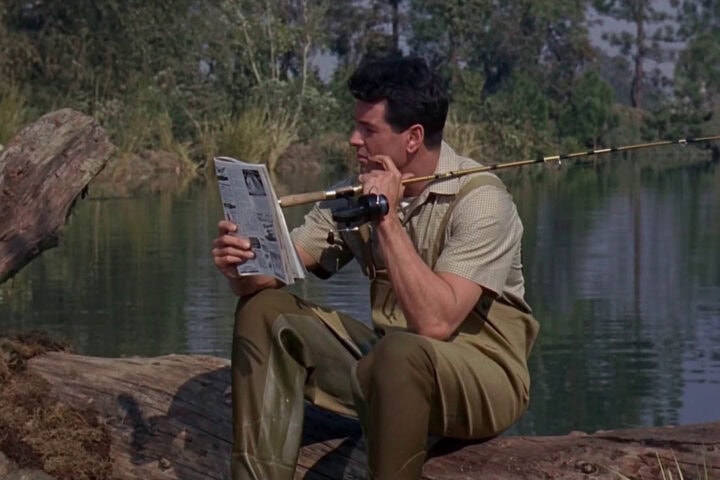
Ambiguity and understatement are the watchwords when it comes to the titles collected in Arrow’s box set Twisting the Knife: Four Films by Claude Chabrol. Though they often take the form of a crime thriller, a murder mystery, or even an old-fashioned whodunit, these works typically provoke more questions than they resolve. This state of affairs allows Claude Chabrol to keep a chilly distance from his characters, the better to view them in their native habitat, and the easier not to come to any easy moral judgments about their often perverse behavior.
Ostensibly a featherweight lark about confidence tricksters and their low-stakes scams, 1997’s The Swindle initially seems closer to The Sting than it does to The Grifters. But underneath all the briskly delivered élan lurks a sly study of manipulation and the slipperiness of identity. For one thing, it seems difficult to pin down the precise relationship between aging con artist Victor (Michel Serrault) and his partner, Betty (Isabelle Huppert). The nature of their link seems to shift as often as Huppert doffs a differently colored wig. They may be romantically linked, or they could even be father and daughter. The film refuses to state anything categorically.
The Swindle shifts into darker terrain when Victor and Betty decide to take their con to the next level, far above their usually modest take, which Victor enjoys likening to a form of taxation. They target Maurice (François Cluzet), a courier for big-time money launderers, in an elaborate con that involves switching out a securely locked attaché case, though the exact details of the execution remain as elliptical as anything else in the film. A shocking moment of violence leaves Victor and Betty in the clutches of Mr. K (Jean-François Balmer), whose name may be a Kafkaesque in-joke but whose Bond villain-like demeanor seems to link him to Dr. Kha (Akim Tamiroff) in Chabrol’s 1965 spy spoof The Blue Panther.
The Color of Lies, from 1999, is another of Chabrol’s explorations of the moral rot at the heart of a rural community. Here the rape and murder of a 10-year-old girl sets events in motion. Suspicion centers on her art teacher, René Sterne (Jacques Gamblin), a former professional artist who gave up his career after he was severely wounded in a terrorist attack in the ’80s and subsequently nursed back to health by his now-wife, Vivianne (Sandrine Bonnaire). It’s not a plot point that receives a lot of attention, but it does indicate the presence of a subtle political dimension to the film. It also comes out when local media hotshot Germain-Roland Desmot (Antoine de Caulnes) flippantly jokes about working for both left- and right-wing outlets.
The town at the center of the film itself is populated by a shifty cast of characters that includes Marchal (Pierre Martot), a dealer in stolen goods, and the Bordiers (Bulle Ogier and Noël Simsolo), antiquarians who traffic in fakes and forgeries. As such, a miasma of guilt and wrongdoing hangs over the entire village. Though René is ultimately proven not to be the murderer of the little girl, he’s nevertheless guilty of the murder of Desmot, which he confesses to his wife at film’s end. He’s lost his sense of self, his reason for living. Once again, Vivianne is responsible for saving his life, exhorting René to revive himself, the notion of living seemingly inscribed in her very name. But where can they go from there?
Ambiguities abound in Nightcap, from 2000, where every narrative assertion seems open to doubt. The film begins with chocolate heiress Marie-Claire “Mika” Muller (Isabelle Huppert) and renowned pianist André Polonski (Jacques Dutronc) tying the knot. The film then traces the progressive unravelling of the links between the members of the Polonski family by any means possible, introducing into the storyline such devices as swapped infants, adopted children, and artificial insemination. As so often with Chabrol, doubles and doubling figure prominently. Most significantly, the attempted murder at the film’s climax echoes Mika’s murder of André’s first wife in a car crash years before.
Over the course of Nightcap, nothing really happens. It’s all insinuation and implication. Even the flashback that relates the murder of André’s first wife actually shows nothing more than Mika watching out the window while a car drives off. We have only her confession that she poisoned the hot chocolate drunk by André’s first wife. One of the film’s foremost fascinations lies in watching Huppert find sly mannerisms to indicate the torment that roils just beneath Mika’s cold impassivity. So it’s all the more revelatory when her character breaks down in confession in the film’s final moments, collapsing against the symbolically cobweb-shaped throw on the sofa where she curls up in a fetal position.
The Flower of Evil, from 2003, is the most overtly political film in the set. The story centers on a mixed family, the Charpin-Vasseurs, whose matriarch, Anne (Natalie Baye), is running for mayor. Her husband, Gérard (Bernard Le Coq), is a philandering pharmacist who just might have written a poison pen letter that brings up several generations’ worth of family misdeeds. Chabrol isn’t really interested in the political campaign per se, save for some rather gentle satire, but it does let him broach a subject—collaboration with the Nazis during WWII—that he takes very seriously, having dedicated an entire documentary to the subject, The Eye of Vichy.
The film opens with an uncharacteristically showy tracking shot. The camera snakes across a leafy garden, passes into a stately home, rushes up a staircase, and slinks down a corridor, where it spies two figures in two different rooms: a girl cowering beneath a window and the sprawling dead body of an older man. These last images will recur toward the end of Chabrol’s film, albeit with different characters taking up their respective positions. Like Nightcap, The Flower of Evil is concerned with an “original sin” and the seeming inevitability of its repetition. But where, in the former, the crime is almost reprised by its original perpetrator, here the guilt carries over from one generation to the next.
Image/Sound
All of the films in this collection come in new 4K restorations from MK2 Productions in Paris, except The Color of Lies. The transfers look uniformly excellent, boasting vibrant colors, lifelike flesh tones, deep blacks, and well-managed grain levels. There’s no discernible damage to the source materials. On the sonic front, The Swindle and The Color of Lies are presented in French LPCM mono, while Nightcap and The Flower of Evil also include French Master Audio 5.1 surround mixes. Both audio options offer cleanly delivered dialogue, and the surround tracks nicely open up the moody scores from Mathieu Chabrol.
Extras
This attractively packaged box set is a fine follow-up to Arrow’s Lies and Deceit: Five Films by Claude Chabrol collection from earlier this year. Each of the films comes in its own digipack with striking new cover art from Tony Stella. Also tucked into the slipcase is a 60-page, generously illustrated booklet with a series of incisive essays from critics Sean Hogan, Brad Stevens, Catherine Dousteyessier-Khoze, Alexandra Heller-Nicholas, and Pamela Hutchinson.
Every film is also supplemented by a helpful intro by film scholar Joël Magny, an excellent behind-the-scenes featurette, as well as select-scene commentaries from Claude Chabrol, which allow the filmmaker to intimately discuss his thoughts on shot composition and camera movement with regard to revealing character relationships.
We also get eminently listenable commentary tracks from a crack team of critics: Barry Forshaw and Sean Hogan on The Swindle and The Color of Lies; Justine Smith on Nightcap (which was released in the States under its original title, Merci Pour le Chocolat); and Farran Smith Nehme on The Flower of Evil. The tracks take various approaches to their respective films, though they tend to overlap in their concern that Chabrol is often critically underrated owing to his staggeringly prolific output. Rounding out the package are a handful of interviews and visual essays that provide further insight into these often playfully evasive films.
Overall
Twisting the Knife collects four taut late-period exercises in ambiguity from Claude Chabrol, together with sparkling transfers, and bountiful bonus materials.
Since 2001, we've brought you uncompromising, candid takes on the world of film, music, television, video games, theater, and more. Independently owned and operated publications like Slant have been hit hard in recent years, but we’re committed to keeping our content free and accessible—meaning no paywalls or fees.
If you like what we do, please consider subscribing to our Patreon or making a donation.