 Robin Hardy’s folk horror classic The Wicker Man introduces its protagonist, Sergeant Neil Howie (Edward Woodward), in only a few short scenes that sketch him as a devout Christian and religious conservative. As he takes the sacrament and sings hymns in a small Scottish church, he appears to be in his element but nonetheless uncomfortable. He’s a man who looks petrified to touch any surface of the material world lest it corrupt his being.
One quickly knows everything about how Howie regards the world. This allows The Wicker Man, as written by Anthony Shaffer, to swiftly upend the man’s sense of reality when the police officer flies out to the remote Hebridean town of Summerisle to investigate a missing persons case and discovers that all of the hamlet’s residents practice a pre-Christian form of paganism.
The film lays the town’s practices out in the open, deriving its chills less from the acts themselves than Howie’s reactions to them. Particularly, the repressed and celibate sergeant blanches at the village’s highly sexual, naturalist customs, from unabashed orgies to childhood education that hinges on teachers discussing topics like reproduction and the symbolic importance of the phallus with students who look barely old enough to spell their names.
Such sights are baffling in the context of a small community of modern Scottish citizens, but The Wicker Man plays that disorientation for comedic and satiric effect by regularly contrasting Summerisle’s religiosity with Howie’s ostensibly “normal” displays of Christian faith. When the sergeant realizes that the community may perform human sacrifice as part of its religious ceremonies to promote bountiful harvests, the filmmakers insert a flashback to the man taking communion, itself a consumption symbolic of Christ’s sacrifice for mankind’s sins. Stumbling across apple crates left on a graveyard headstone as an offering, a furious Howie demolishes the display. He uses the broken wood to fashion a rudimentary and garish crucifix as an unwanted blessing over the body of someone who didn’t practice Christianity.
If anything, The Wicker Man suggests that Christianity is far more unnatural than paganism; for all the unsettling activities of the locals, the underlying motivations of their behavior is carnal and animalistic. Compare their nude gyrations and free-love couplings to Howie’s celibacy and rigid adherence to a faith of self-denial. In that sense, the island’s civic and spiritual leader, Lord Summerisle (Christopher Lee), comes across as far more invested in his own flock than the archly removed ministers and priests who guide the United Kingdom’s Christian laity. For one, Lord Summerisle gazes upon his subjects with genuine benevolence.

The Wicker Man’s sly sense of humor falls by the wayside, though, in the sudden and rapid escalation of the film’s final minutes, when Howie unspools the townspeople’s deliberate obfuscations of his investigation and learns of Summerisle’s true intentions for him. In a flash, the man’s blinkered morality is revealed to be the means of his ensnarement, and Woodward expertly sells Howie’s instant shift from angry confidence to overwhelmed, helpless terror. His pitiful entreaties that the community’s rituals will not affect things like climate and crop yield fall on deaf ears, but as he spends his last seconds praying for absolution, one wonders if it occurs to him that they would say the same for his frantic hopes for a life beyond this one.
Image/Sound
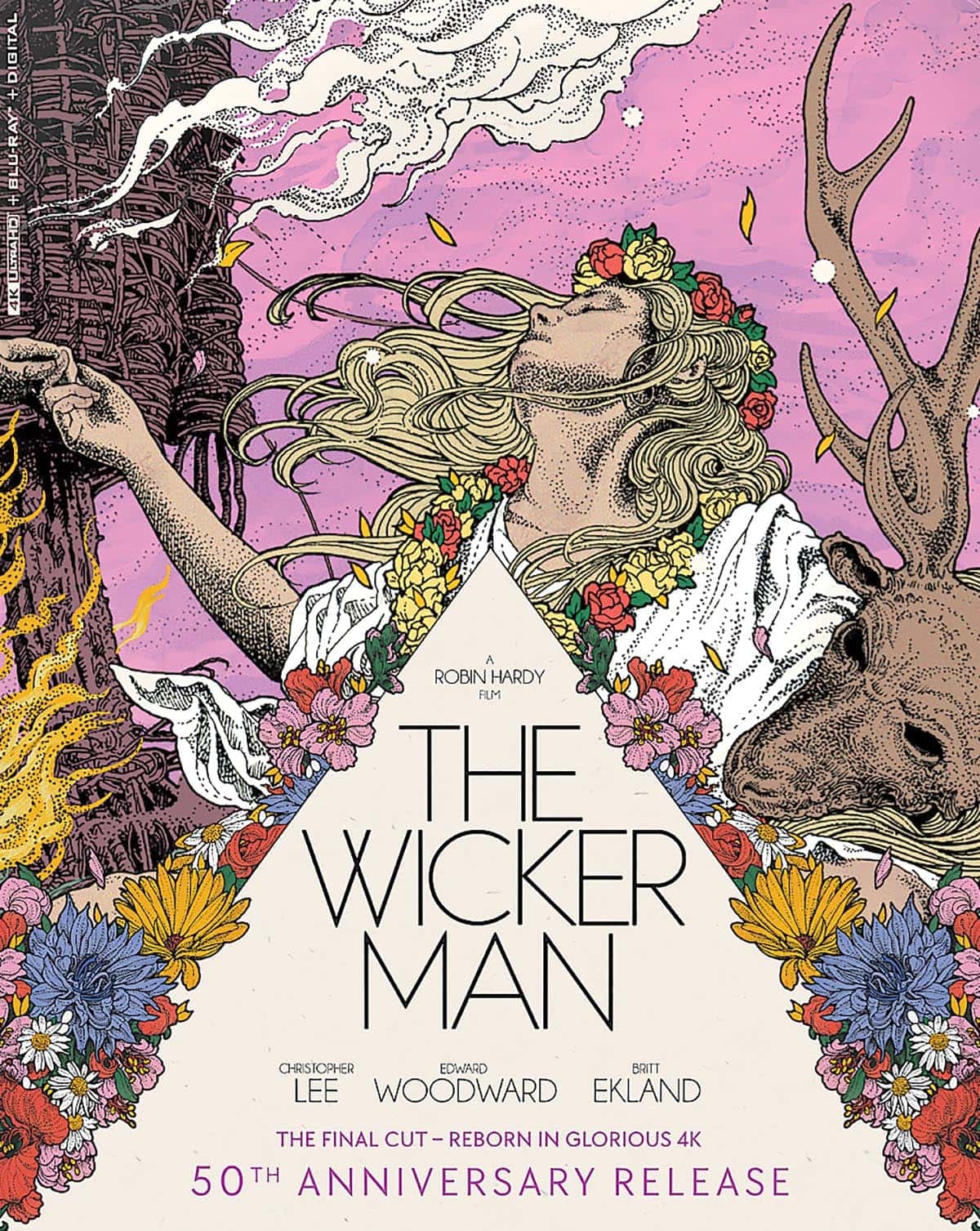
Lionsgate’s 4K disc presents the restoration of the film’s “final cut” as approved by Rob Hardy in 2013, and a pre-film disclaimer notes that the restoration had to rely on 35mm positives for the material excised from the original theatrical release. The discrepancy in image quality between these scenes and those restored straight from the negative are noticeable, but the overall image is warm and filmic, with even grain distribution and stable color balance across all footage. The original 2.0 audio ably creates an enveloping mix of ambient nature sounds, folk melodies, and dialogue with no discernible issues and a clear presentation of each element.
Extras
Lionsgate’s 4K disc comes with several new extras. Robin Hardy’s son, Dominic, revisits The Wicker Man’s shooting locations, and a retrospective look back on the film for its 50th anniversary features another of the director’s sons, Justin, talking to critics about the film’s legacy. Justin also leads a discussion with filmmaker Tim Plester that delves into the first draft of the script and how Hardy made alterations to it, mostly notably to the ending. Elsewhere, a new interview with actress Britt Ekland provides the most insight into the film’s making, and archival interviews and making-of documentaries offer additional accounts of the production.
An included Blu-ray copy ports over the extras assembled on Lionsgate’s 2014 release of the final cut. These include a short documentary featuring testimonials from other filmmakers about their love of The Wicker Man, an overview of the film’s score, an interview conducted with Hardy to promote the 2013 restoration, and a restoration comparison video.
Overall
Robin Hardy’s legendary British folk horror film looks gorgeous on Lionsgate’s UHD release, which boasts a series of new and informative extras.
Since 2001, we've brought you uncompromising, candid takes on the world of film, music, television, video games, theater, and more. Independently owned and operated publications like Slant have been hit hard in recent years, but we’re committed to keeping our content free and accessible—meaning no paywalls or fees.
If you like what we do, please consider subscribing to our Patreon or making a donation.