
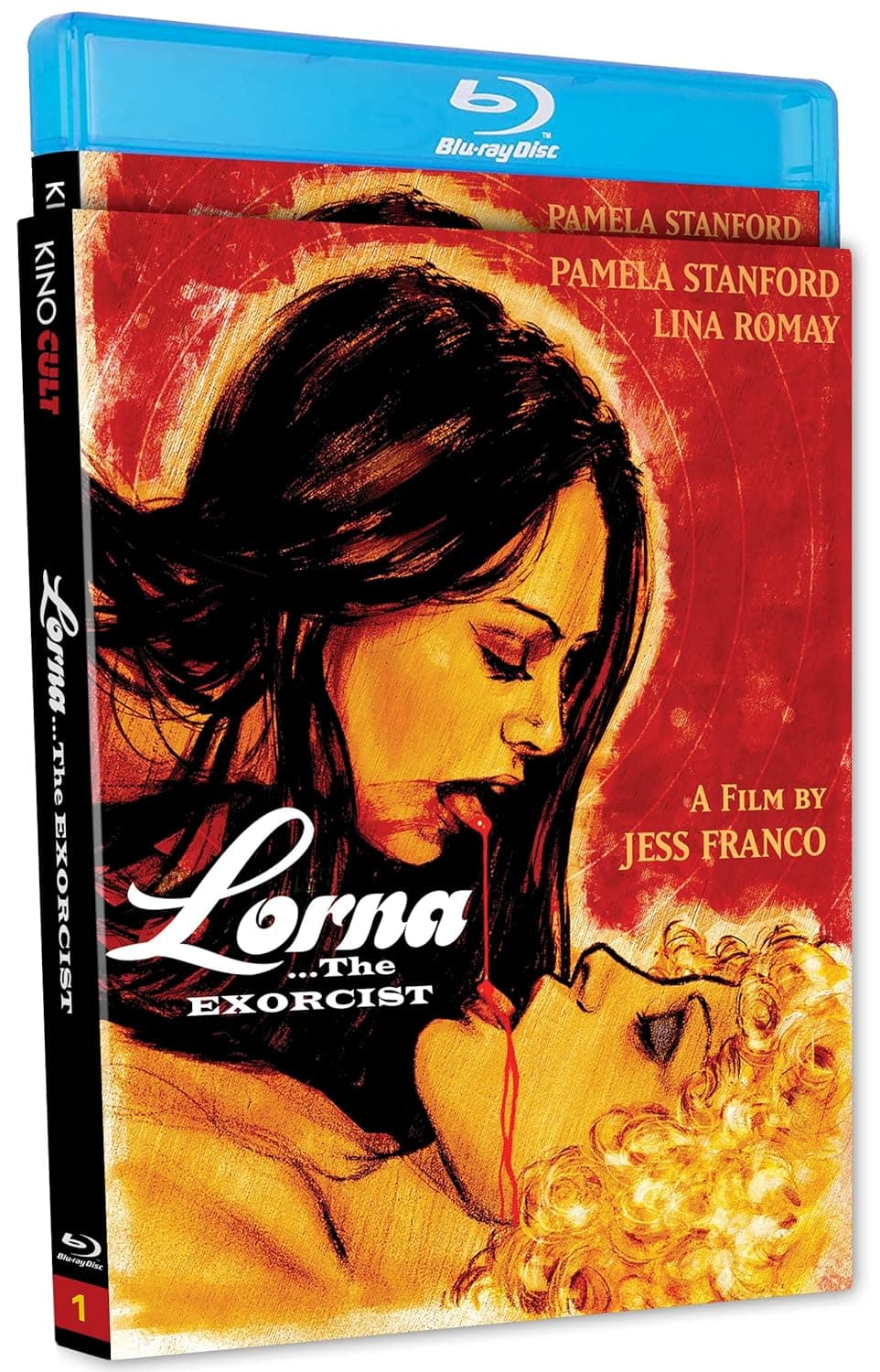
 In 1866, Gustave Courbet painted The Origin of the World, a portrait of a woman’s nude torso and exposed vagina that still possesses the capacity to shock the straitlaced. On one level, the painting proves pretty definitively that there’s a fine line between a timeless work of art and a beaver shot. On another, it provides a convenient precursor for the cinematic sensibility of Spanish maverick Jess Franco, who seemingly never met a pussy he didn’t want to zoom unabashedly in on. This holds especially true for Lorna the Exorcist, wherein the female genitalia play a significant thematic as well as aesthetic role.
For what it’s worth, the film bears only the slightest passing resemblance to the William Friedkin classic that it’s ostensibly ripping off. Both films focus on a character located on the cusp between childhood and womanhood (though here she’s a bit of a late bloomer at 18), who finds herself enmeshed in some dangerously diabolical activity. And both contain some pretty shocking imagery. But that pretty much exhausts the comparison. Eschewing Friedkin’s quasi-documentarian realism, Franco delivers another of his languorously paced, sexually transgressive fever dreams.
On its surface, Lorna the Exorcist explicitly evokes the motif of the Faustian pact. Aspiring bon vivant Patrick Mariel (Guy Delorme) makes a deal with the demonic Lorna Green (Pamela Stanford) for wealth and power. In exchange, he will hand over the child they symbolically conceive together (using Mariel’s wife as the substitute uterus) when she comes of age. (The girl, named Linda, is played by Franco’s muse and eventual wife, Lina Romay.)
But the deeper structure of the film brings to mind Bram Stoker’s Dracula. With her powers of mind control and taste for freshly spilled blood, Lorna is akin to Count Dracula. Franco himself turns up as the Dr. Seward analogue, attending to a catatonic nymphomaniac (Catherine Lafferière) who, like Renfield, is in the vampire’s thrall. The resemblance is reinforced by the fact that Franco had already adapted Dracula twice, most notably as the experimental Vampyros Lesbos, which folded in lesbian overtones drawn from Sheridan Le Fanu’s Carmilla.
With Lorna the Exorcist, Franco sets his sights on some foundational taboos. Lorna is only Linda’s symbolic mother, so that Linda’s sexual initiation at her hands pushes the envelope of acceptability into uncomfortable terrain. Whereas Linda’s subsequent attempt to seduce her own father ignores the existence of an envelope altogether. When seduction fails, murder prevails. As in many other Franco films, sex leads inevitably to death. Linda’s mother proves equally unsafe, prone to ultimately fatal psychic attacks from Lorna that manifest themselves quite disgustingly as tiny crabs issuing from her private parts.
Notions of murdering your father and mother as an act of individuation could’ve been lifted from one of Franco’s Marquis de Sade adaptations, where smashing apart these primal family relations stands as a mark of sexual and philosophical freedom. But here the mood is more somber, as signaled by the bitter fruit of the lemon tree that the camera focuses on under the opening titles. The film doesn’t find freedom in sex, only dread and horror. The final shot of Linda writhing naked on her bed ends with a terrifying scream that’s equal parts agony and ecstasy. Lorna the Exorcist remains one of Franco’s most extreme, and most adult, fairy tales.
Image/Sound
The 1080p transfer of Lorna the Exorcist looks passable. This version seems to have been cobbled together from different 35mm source elements, so there’s a lot of inconsistency in terms of color saturation and image clarity. There’s also quite a bit of damage on display, including the usual speckles, vertical green scratches, and occasional missing frames.
Audio comes in both French and English Master Audio 2.0 mixes. Both tracks sound fine technically, but the English dub isn’t as nuanced and convincing as the French track, which also seems to match the actors’ delivery. Both mixes suitably convey a piecemeal score that alternates between André Bénichou’s haunting guitar themes and library tracks that producer Robert de Nesle seems to have slapped into place, not always appropriately.
Extras
Acquisition value is boosted by the inclusion of another excellent commentary track by novelist and critic Tim Lucas. He delivers lots of pertinent information on the cast and crew, shooting locations, and production history. Particularly fascinating is an excursion into the theme of mind control and the character of Lorna Green, both of which reverberate across Jess Franco’s filmography with talismanic force. Lucas also briefly touches on the role of gambling and casinos in genre cinema, as exemplified by Thorold Dickinson’s baroquely expressionistic The Queen of Spades or the Louis Malle episode of Spirits of the Dead.
Elsewhere, author Stephen Thrower provides a two-part introduction to Franco’s work. In the first part, he describes his first exposure to Franco’s films, articulates their more abstract and elusive qualities, and explains their continued appeal. The second part focuses on Lorna the Exorcist, going into its themes, technical aspects, and place within Franco’s larger body of work.
Also included on the Blu-ray are two interviews. In a 2023 conversation, actress Pamela Stanford discusses her early days as a dancer in the Folies Bergère in Paris, working her way up from extra to actress, her working relationship with Franco, and her subsequent appearance in several Nazisploitation films. And in a 2010 chat, sound editor and future filmmaker Gérard Kikoïne talks about working with producer Robert de Nesle, the process of supplying dialogue and sound effects for films, and the fact that he never met Jess Franco in person.
Overall
Jess Franco’s brazen Lorna the Exorcist is a taboo-smashing adult fairy tale that still manages to pack one hell of a punch.
Since 2001, we've brought you uncompromising, candid takes on the world of film, music, television, video games, theater, and more. Independently owned and operated publications like Slant have been hit hard in recent years, but we’re committed to keeping our content free and accessible—meaning no paywalls or fees.
If you like what we do, please consider subscribing to our Patreon or making a donation.
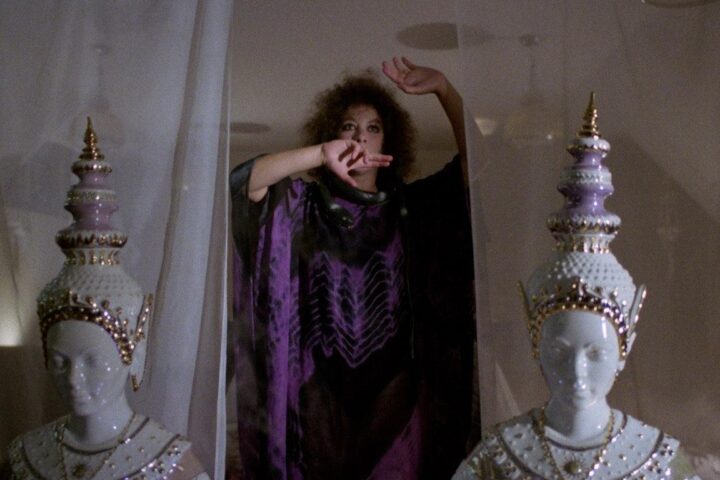
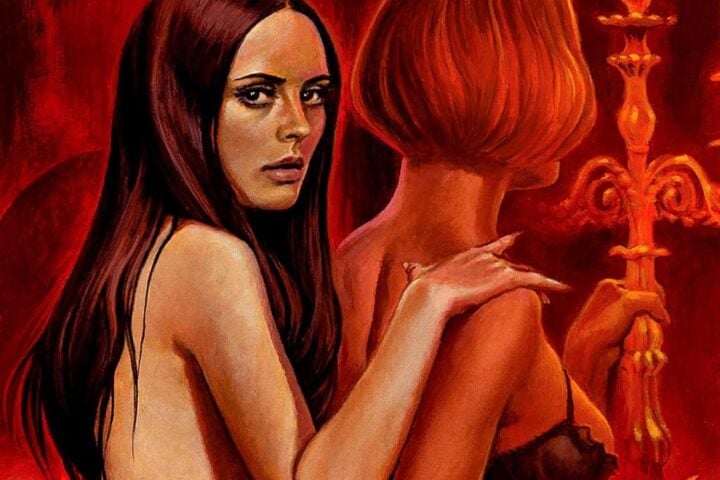


🙄 The Film “LORNA THE EXORCIST” is incredible garbage. A 1974 lesbian fetish film that played only in X RATED Adult Theaters. Made by a director JESS FRANCO that made close to 200 films in his overlong life, and his last film was as incompetent as his first. He never learned a thing about filmmaking with all that practice. This film “LORNA” looks like old pervert Franco is once again filming his own personal lesbian fetish fantasies using a ridiculous cloak of it being a whorish witch on the loose plot. The only moment in the entire 100 min film that looks like “acting” is the very last 60 seconds, and I’d wager he gave that girl drugs to achieve that last min performance. The only value the movie has is as a curiosity like visiting an old time carnival freak show with deformities on display