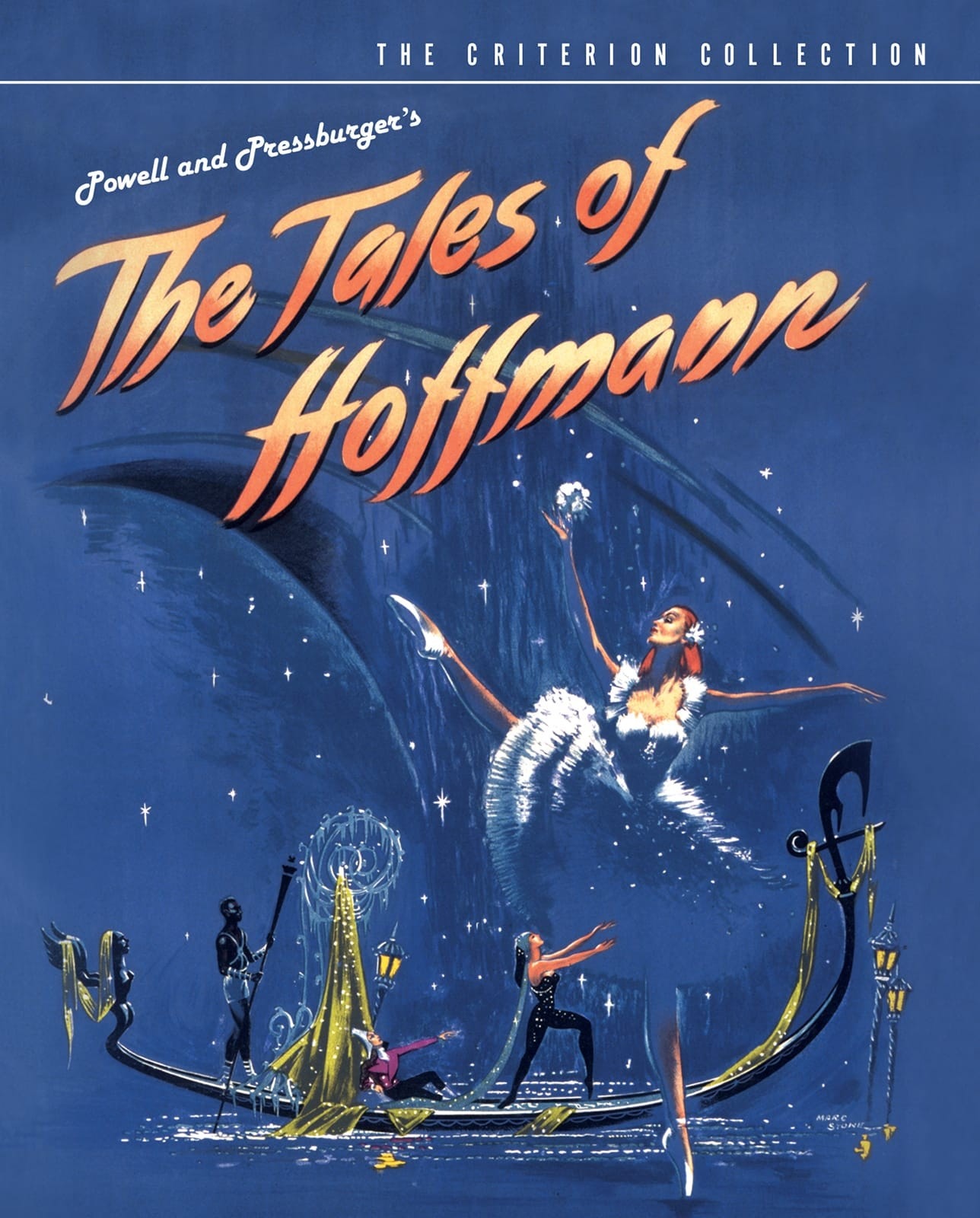
 Here’s a curious little item: a larger than life Michael Powell and Emeric Pressburger film that isn’t generally lumped in with their critically lauded efforts (The Red Shoes, Black Narcissus, The Life and Death of Colonel Blimp), but has a certain devoted cult following. As always, the set design and photography is vivid and colorful, with the restless camerawork grabbing the audience by the head and deliberately pointing it toward whatever Powell and Pressburger wanted them to see. You’re always aware of the image, the deliberate cutting from one frame to another to make a point, and the use of splashy color and big, theatrical, artfully-directed sets. You know you’re watching a movie, and if you profess to love cinema as much as, say, Martin Scorsese, The Tales of Hoffmann is a trip to movie heaven.
But Powell and Pressburger have a way of wallowing in the surface indulgences of cinema without insight into the soul. This adaptation of Jacques Offenbach’s opera-ballet about the poet Hoffmann (Robert Helpmann) fantasizing about three women he loves never allows one into the foolishness or mania of romantic love. As a performer, Helpmann is as closed off as Ryan O’Neal eponymous character in Stanley Kubrick’s Barry Lyndon, a dumb cipher walking through beautiful pictures created by masters of cinema who aren’t masters of humanity.
But if The Tales of Hoffmann fails as an emotional journey, it is sensational as a music video. The poet wanders into a world where his lover is a mechanical performing doll, surrounded by a chorus of dancers on strings. The second tale involves his trip into a Venetian orgy, where his lover is a siren enchanted by jewels and magicians. (There’s a stunning sequence where his lady carelessly walks across mounds of dead bodies that makes a strong case for Hoffmann as a horror film about brainwashed victims, one of the many reasons Night of the Living Dead director George A. Romero is part of the film’s strong cult audience.) The third, and slowest, segment involves Hoffmann’s attempt to woo a beautifully suffering maiden dying from consumption, where Powell and Pressburger seem more amazed by the allure of the wind blowing through the window curtains than showing genuine heartache.
Movie critics often find themselves ostracized from movie clubs for their so-called blind spots, feeling indifference toward the masters. The other day, I seethed at a friend’s muttering that Alfred Hitchcock was the most overrated filmmaker of all time. But my blind spot is Powell and Pressburger and their vapid manipulations of cinematic time and space. Tales of Hoffmann looks magnificent, but it’s ultimately just eye candy for aesthetes.
Image/Sound
The pristine new high definition digital transfer is a gorgeous restoration, and for a movie that depends on its vivid color palette and stunning camerawork, Criterion understood they had to aim for perfection. It’s unlikely that fans of the movie will have seen a better, cleaner version. The sound is also of a very high quality-very well modulated and clear.
Extras
Criterion stacks this DVD edition with first-rate extras, including a vivid commentary from Martin Scorsese and film-music historian Bruce Eder. While Eder is a useful reference for facts, Scorsese is a passionate whirlwind of excitement over the cinematic techniques used throughout. As a devotee of Powell and Pressburger, he understands not only how their effects were achieved, but their thematic heft. It also builds a great case for this kind of in your face filmmaking, which at its best in Powell and Pressburger and Scorsese is sublime and at its worst is gluttonous and busy. There’s a separate interview with horror maestro George A. Romero, which is more nostalgic than informative, though it shows the devotion of a true Hoffmann fan. A short musical of The Sorcerer’s Apprentice, directed by Michael Powell, is also included, which seems like an earlier Powell effort considering its charming low-tech special effects (mostly in-camera and filled with primitive animations) but was actually made five years after Hoffmann. There’s also a gallery of stills and lobby cards, a cheesy theatrical trailer, a gallery of production designer Hein Heckroth’s paintings, and an insightful essay by film historian Ian Christie.
Overall
Criterion offers a superb DVD treatment that will be heaven for fans of this largely unseen Powell and Pressburger effort. If you have no patience for opera or ballet, stay far away; and if you have mixed feelings about the work of these British white elephants, it’s unlikely you’ll be convinced otherwise.
Since 2001, we've brought you uncompromising, candid takes on the world of film, music, television, video games, theater, and more. Independently owned and operated publications like Slant have been hit hard in recent years, but we’re committed to keeping our content free and accessible—meaning no paywalls or fees.
If you like what we do, please consider subscribing to our Patreon or making a donation.