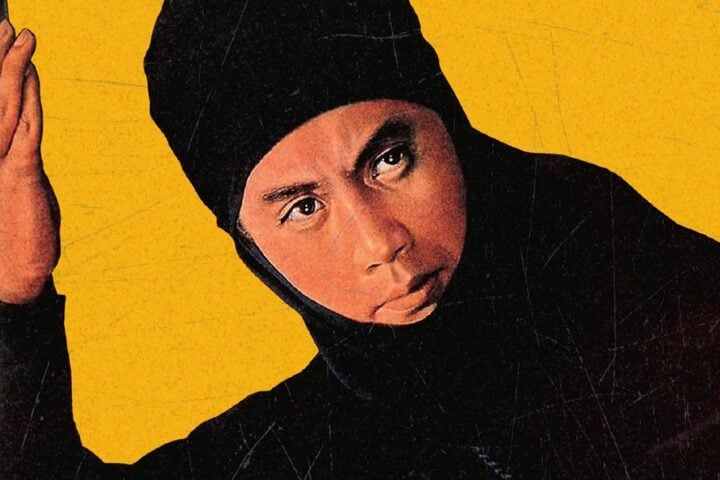
Riding the commercial success of the Gamera franchise, director Yuasa Noriaki decided to make a monster movie of a very different stripe, one that leaned heavily on traditional Japanese folklore for its themes and imagery. The Snake Girl and the Silver-Haired Witch, from 1968, unfolds with all the dark dreamlike logic of a Grimm Brothers tale yet ultimately delivers a conventional happy ending, replete with the neatly beribboned moral lesson of an Aesop fable.
Following a bizarre cold open involving murder by snake, we’re introduced to the unflappably optimistic Sayuri (Matsui Yachie) at a Catholic orphanage where she’s meeting her father, Mr. Nanjo (Kitahara Yoshio), for the first time. On the way home, he casually drops the fact that her mother, Yuko (Hamada Yuko), suffers from amnesia following a car crash. The rest of the domestic situation proves equally surprising, from the bullying older sister, Tamami (Takahashi Mayumi), who spies on Sayuri from her attic abode, to the Mrs. Danvers-like housekeeper, Ms. Shige (Meguro Sachiko), who won’t believe anything that the increasingly paranoid Sayuri has to say. A miasma of secrets and lies hovers over this household, as more bizarre (not to mention life-threatening) events start to pile up.
The Snake Girl and the Silver-Haired Witch is a triumph of style. Yuasa and director of photography Uehara Akira play up the gothic ambience by shooting in shadowy black and white. Yuasa seems to favor disorienting high-angle shots that fix characters to the scenery like so many butterflies to a pinboard. The increasingly frequent dream sequences, which lend the proceedings a diverting veneer of surrealism, are dominated by spiral patterns that often swirl around like images in a kaleidoscope. In keeping with the surreal tone, the dividing line between dream and reality grows ever more porous as the film progresses.
The fabulist narrative is more complex than first glance might suggest. Though the film is narrated by Sayuri, we witness several scenes in which she isn’t present and thus shouldn’t know about. We also hear some of Tatami’s thoughts directly in voiceover. Some of the factual information we’re presented doesn’t seem to jibe or even directly contradicts itself: For instance, Mrs. Nanjo introduces Tamami as Sayuri’s older sister, but later on the Mother Superior (Miyake Kuniko) of the orphanage tells Sayuri that the two were in fact switched at birth. Both versions, obviously, cannot be true. All of these factors combine to suggest that Sayuri is, at the very least, something of an unreliable narrator.
The storyline tries to have it both ways as to the reality of its supernatural elements. One of the baleful titular creatures is eventually unmasked and revealed to be all too human. Then again, Tamami’s facial disfiguration can be lessened through an act of contrition, because, as we’re told, the outer person reflects the inner. This is fundamentally a Christianity-refracted version of Nietzsche’s famous aphorism “monster in appearance, monster at heart.”
Indeed, The Snake Girl and the Silver-Haired Witch contrasts the Catholic orphanage, a place of spiritual and physical consolation, and the Nanjo household’s Buddhist shrine, at which several strange and unfortunate events take place. The film’s final scene synthesizes the two by taking place at a funeral shrine, where Sayuri vows to pursue inner goodness. It’s a disconcertingly trite takeaway for a film that until now has offered up a delirious panoply of gothic and surreal strangeness. Or maybe the ending is simply the most surreal aspect of The Snake Girl and the Silver-Haired Witch.
Image/Sound
Arrow’s 1080p HD transfer of The Snake Girl and the Silver-Haired Witch looks quite good for the most part, with deep, inky blacks really bringing out the gothic flavor, except for some persistent vertical damage most evident in low-light and nighttime scenes. Clarity of fine details, like the sheen on Tamami’s latex mask, stands out with only a slight dip during certain optical process shots. The Master Audio mono track is fairly active with ambient effects, and does well by composer Kikuchi Shunsuke’s eerie, theremin-haunted score.
Extras
Arrow provides a couple of really informative supplements that go a long way toward providing the cultural and cinematic context necessary for a fuller appreciation of the film. David Kalat’s commentary track situates The Snake Girl and the Silver-Haired Witch within three different Japanese cinematic traditions: classic horror films involving snake women, of which there are a surprising number; special effects films of the 1950s and ’60s, given director Yuasa Noriaki and certain cast members’ involvement in the Gamera franchise; and the J-horror phenomenon of the 1990s that was prefigured by certain aspects of The Snake Girl and the Silver-Haired Witch. An on-camera interview with culture writer Zack Davisson delves into the history of Japanese folklore involving snake women, the evolution of manga from itinerant storytellers, and the career of manga creator Umezu Kazuo, who provided the source material for the film and also turns up in a cameo role as a taxicab driver.
Overall
Yuasa Noriaki’s wonderfully weird The Snake Girl and the Silver-Haired Witch gets a solid transfer and a couple of excellent extras from Arrow Video.
Since 2001, we've brought you uncompromising, candid takes on the world of film, music, television, video games, theater, and more. Independently owned and operated publications like Slant have been hit hard in recent years, but we’re committed to keeping our content free and accessible—meaning no paywalls or fees.
If you like what we do, please consider subscribing to our Patreon or making a donation.