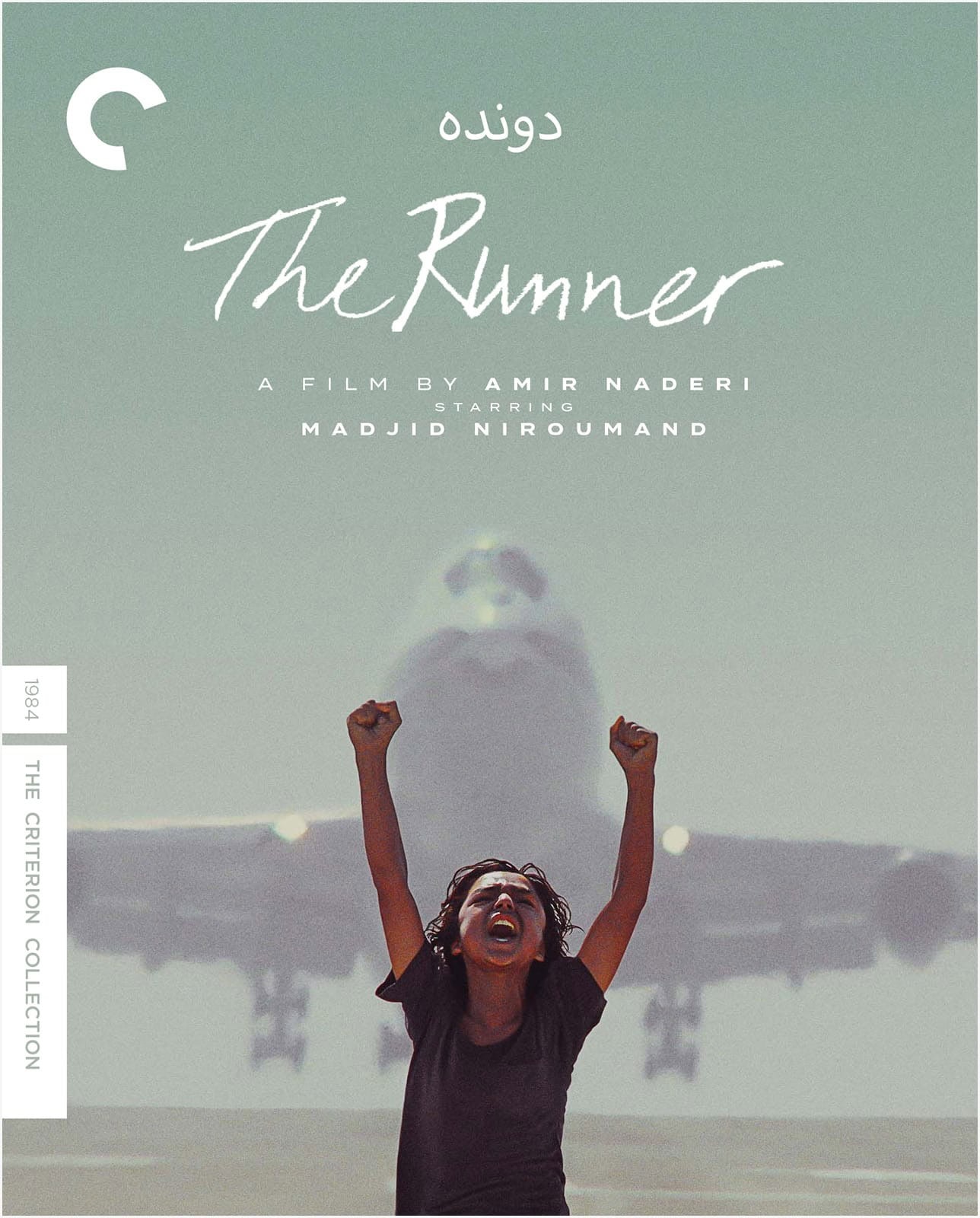
 In the port city of Abadan in southern Iran, 11-year-old orphan Amiro (Madjid Niroumand) gazes out into the Persian Gulf, screaming and waving at the distant ships on the horizon. To Amiro, these vessels represent a sense of freedom that he’s never known yet innately yearns for. His yells are a frequent occurrence in Amir Naderi’s The Runner, and they’re a recurring reminder of Amiro’s unwavering desire to be heard and seen, and to connect with something, anything, outside of a society that has effectively discarded him.
Amiro lives in a region of the world where the oil trade has brought prosperity to few. Like many, he lives among the detritus left behind by the industry’s operations and the callous tourists and businessmen whose shoes he shines for pocket change. Spending his days collecting glass bottles that have been carelessly hurled into the sea and nights in an abandoned ship that he’s turned into a makeshift home, Amiro could easily drift aimlessly through life, but he has an inner fire that refuses to be extinguished.
Amiro’s passion for life is embodied in his near constant movement, whether playing or chasing trains with friends, hustling about the city to earn enough money to eat, or chasing down the adults who steal from him. It’s as if he must remain in constant motion in order to escape the moral and spiritual stasis that can envelop those experiencing the despair of poverty.
Naderi, though, never allows his depiction of impoverishment to stoop to miserablism, nor does he sentimentalize his young protagonist’s hopefulness. To borrow the title of a film by Naderi’s contemporary, Abbas Kiarostami, The Runner is a portrait of life and nothing more. The film traces the ebbs and flows of Amiro’s existence, but Naderi’s style is less distanced and observational than Kiarostami’s, as it embraces the kineticism of Amiro’s being with an ever-panning and -tracking camera that breathlessly tries to keep up with the feisty young boy.
The poetic mirroring of Amiro’s restlessness in The Runner’s formal qualities gives the film a remarkable vibrancy, even in its more heartbreaking sequences. As the film takes on a circular structure, Naderi occasionally references the Sisyphean nature of Amiro’s life, at one point even filming him repeatedly struggling to climb to the top of a giant hill made of rocks. But Amiro’s extraordinary perseverance constantly pushes back against such interpretation.

In one scene where two men steal a block of ice that Amiro has just bought, the boy chases one of the thieves down, trips him, and taunts him for several minutes as he runs away with the mostly melted ice. It’s an impressive sequence, particularly in its naturalistic yet entirely unexpected shift from the tragic to the comic, as Amiro turns a near-disaster into a child’s game.
The scene also foreshadows the film’s most iconic sequences near the end. Here, Amiro races several friends from end to end of an oil field toward a block of ice resting atop an oil drum that’s right in front of a blazing, controlled fire. Surviving the tripping and shoving of mostly bigger kids, Amiro celebrates his hard-earned victory by thrusting the melting ice above his head. Naderi then uses an elegant dolly zoom to frame Amiro in front of what now appears like a hellish wall of fire. Yet again, the boy endures against great odds while the indelible image metaphorically contains all the horrors and joys of his life on the fringes of society.
Image/Sound
The image on this Criterion Collection’s release of The Runner is sourced from a new 2K restoration, and it’s sharp, entirely free of blemishes, and especially rich in detail in the wide shots of Abadan and the dazzling long shots of Amiro running along the coast. If one were to nitpick, colors are occasionally not as vibrant as one might hope for in certain moments. On the audio front, the uncompressed mono soundtrack nicely handles the cacophony of street noise, boats, and planes that’s practically a character onto itself in the film.
Extras
In a new conversation with filmmaker Ramin Bahrani, Amir Naderi discusses his early obsession with cinema and how his early life experiences influenced many of his works. In a particularly enlightening part of the conversation, Naderi talks about coming from the south of Iran and how that gave him a different perspective than the more formally educated filmmakers coming out of Tehran. There’s also an audio-only interview with Naderi, this time with actor Madjid Niroumand, from 2022, in which the director reminisces on conceiving the film during the Iran-Iraq War and how that tumultuous time shaped several of his films. The disc is rounded out with Naderi’s 1974 short film “Waiting” and a brief video diary of Naderi traveling throughout New York and reflecting on his career. The accompanying booklet includes an essay by critic Ehsan Khoshbakht, who expertly puts the The Runner in the context of Naderi’s career and the Iranian political climate in which it was made.
Overall
Amir Naderi’s The Runner is every bit as vital as Abbas Kiarostami’s Where Is the Friend’s House? and Jafar Panahi’s The Mirror, and Criterion’s release should deservedly catapult it into the Western canon of great films about childhood.
Since 2001, we've brought you uncompromising, candid takes on the world of film, music, television, video games, theater, and more. Independently owned and operated publications like Slant have been hit hard in recent years, but we’re committed to keeping our content free and accessible—meaning no paywalls or fees.
If you like what we do, please consider subscribing to our Patreon or making a donation.