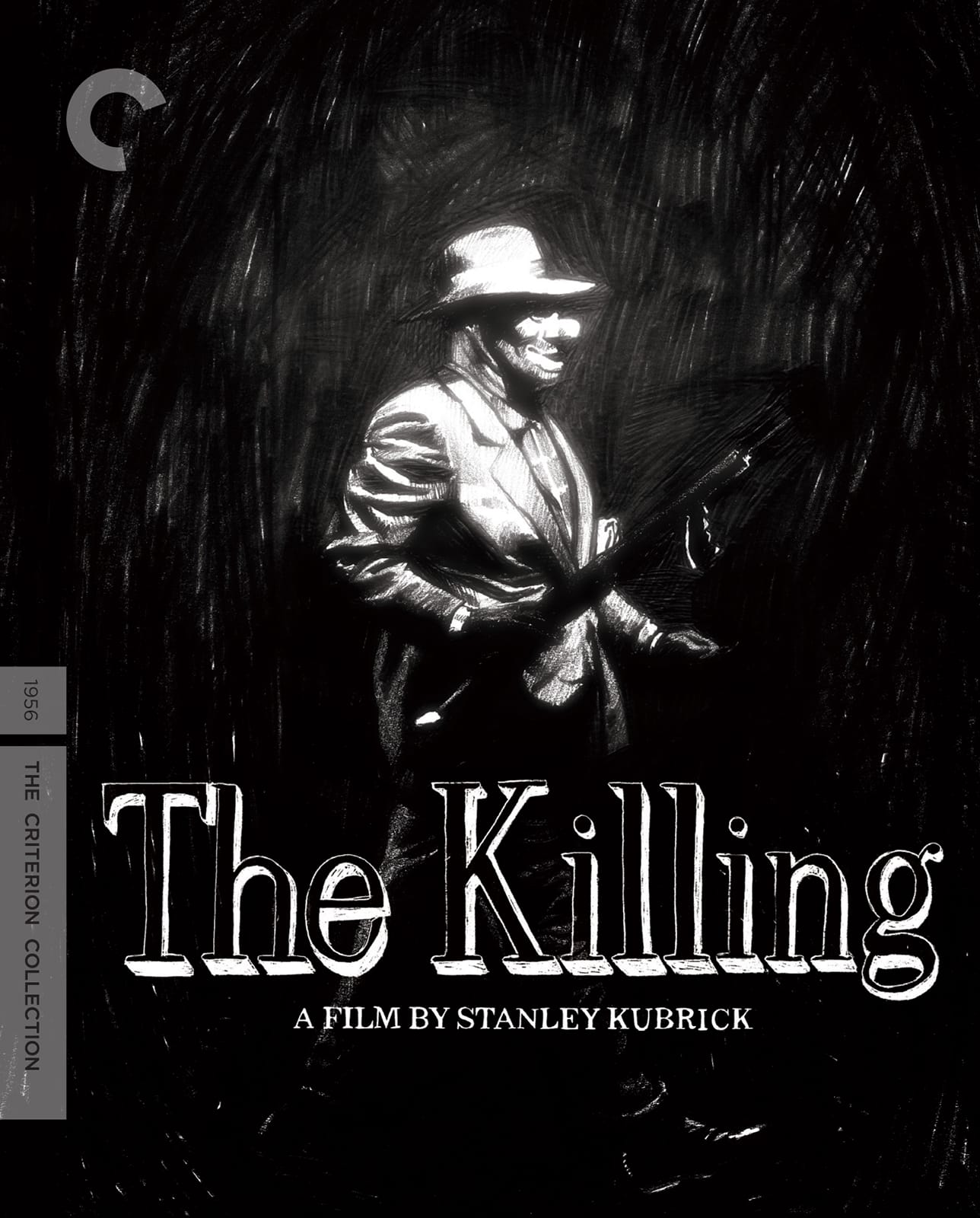
 Every split second counts at the racetrack, where fortunes are won and lost in as much time and the smallest decisions are charged with intensity. The Killing, a blisteringly taut decimation of post-World War II entitlement, understands this better than perhaps any other crime film. Stanley Kubrick’s third feature transports the moral contortions of noir to the pressure-cooker atmosphere of the track, infusing it all with a dread-inducing uncertainty.
The 1956 film employs a sobering, almost clinical voiceover to chart the progress of a robbery at a Los Angeles racetrack, introducing each low-level hood and unlikely schemer’s motivations. The narrator speaks in the past tense, almost as if these men were ghosts foolishly trying to change what’s already been predetermined. Johnny Clay (Sterling Hayden), just released from a five-year stint in prison, instigates the operation, recruiting inside men like bartender Mike O’Reilly (Joe Sawyer), bookkeeper Marvin Unger (Jay C. Flippen), and clerk George Peatty (Elisha Cook), along with corrupt policeman Randy Kennan (Ted DeCorsia), to orchestrate the heist. Each represents a specific role in the intricate process, a key piece to the overall puzzle. How they fit together and break apart becomes Kubrick’s core interest.
The men of The Killing all believe that their newly acquired riches will make up for all the opportunities that they’ve previously squandered. Johnny needs the cash to run away with his innocent lover, Fay (Coleen Gray); Mike hopes to use his cut to cure his sickly wife; and Randy intends to free himself from a brutal loan shark. Everything goes according to plan, except the weak-willed George, naïvely believing that the money will prevent his wife, Sherry (Marie Windsor), from leaving him, told her about the plan, after which she enlists her lover, Val Cannon (Vince Edwards), to steal the money from George and his fellow conspirators. Sherry’s passive-aggressive interrogations are ripe with assaults on George’s nonexistent masculinity, and what begins as idle pillow talk quickly avalanches into full-blown disaster.
In the heist film, any one character’s faith in the group can dissolve in favor of self-survival at a moment’s notice. Early on, Randy warns, “I’ll take care of myself. That’s my specialty.” And as the mistakes pile up, making a once carefully modulated plan on paper turn to dust, The Killing constantly threatens to fulfill such genre conventions. But Kubrick withholds the expectation of capture, betrayal, or death until the last possible moment, juxtaposing the bullying and brilliant dialogue sequences with hypnotically fluid long takes through clogged interior spaces. Given the precision of the film’s aesthetics, the explosions of violence are that much more startling, as in the scene where former wrestler Maurice (Kola Kwariani) starts a brawl in the track common area, taking on a platoon of cops in the process, or the one where Johnny watches Nikki Arcane (Timothy Care) shred a paper target with automatic shotgun fire.
Lucien Ballard’s cinematography is a wonder of texture and shadow play. From Johnny’s overconfidence during a roundtable planning session to Sherry’s tragic underestimations of George, everyone’s fatal flaw is practically amplified by the resonant dimensions of the film’s lighting and compositions. Set inside the cavernous maze of the racetrack infrastructure, the robbery itself plays out as a nearly wordless and always gripping example of narrative misdirection. Johnny dons a clown mask, pulls a shotgun out of a flower box, and patiently waits for a moment to pounce. His house of cards seems set up perfectly for success, but the scales quickly tip against him, and the sequence becomes a panicked sprint to the finish line, much like the horse race unfolding in the background. All the while, the track announcer’s play by play makes for a fitting parallel to the central breakneck robbery.
Symbolism and pungent irony also abound throughout The Killing, as when George, stumbling out of Johnny’s apartment late in the film, his face pockmarked with buck shot, is understood as the horrific personification of the aforementioned paper target. Elsewhere, Kubrick’s wicked brand of jet-black irony is evident after George shoots Sherry and her parrot stars squawking loudly, essentially sounding her death knell. But it’s the final image of an ocean of cash blowing in the wind that best echoes the uncontrollable and unseen machinations working against the film’s desperate characters. Despite their collective hope for the future, they will always be puppets, no matter how hard each tries to cut the strings of fate.
Image/Sound
The release of The Killing on Blu-ray is a special occasion. There have been rumblings about its release on the Criterion label for years, and the disc’s crystalline 1080p transfer proves the wait was entirely worth it. Lucien Ballard’s sterling noir imagery crackles with layers of shadow and light, aesthetics visually dulled in previous DVD transfers. The black levels in the night sequences are especially moody and clear, the best example coming when Johnny talks with his crew at the table in his apartment. Illuminated overhead by only a key bulb, Johnny sways in and out of the shadows as if he was dancing between heaven and hell, and the viewer is privy to every visual detail. In terms of sound design, The Killing beautifully mixes quieter dialogue moments with sudden booms of chaos, and the uncompressed mono soundtrack nicely exhibits this audible juxtaposition of opposites.
Extras
As if having The Killing on Blu-ray wasn’t enough, Criterion has included a new hi-def transfer of Kubrick’s previous feature, 1955’s Killer’s Kiss. Film critic Geoffrey O’Brien provides a great video appreciation of the film, stating that “the accidental comes into play more” in Killer’s Kiss than any other Kubrick film. A chorus line of interviews with key Kubrick collaborators and scholars are also included. Producer James B. Harris talks extensively about his storied partnership with Kubrick, the production process of The Killing, and most interestingly Kubrick’s love and talent for casting character actors in lead roles. A grizzled Sterling Hayden talks about his tumultuous time in Hollywood in a 1984 interview for French television series, Cinema Cinemas. “In no other business can you get paid good money and not know what you’re doing,” Hayden laughingly confesses about his early acting years, the solace of the San Francisco Bay providing a calm background for his gruff façade. Finally, author Robert Polito discusses the factors behind crime novelist Jim Thompson’s involvement in The Killing, citing Kubrick’s desire to improve the dialogue in his pictures. Like all the interviews on this great supplemental package, Polito waxes eloquently and analytically at the same time. Trailers for The Killing and Killer’s Kiss round out the lineup. The booklet is one of the lighter editions in Criterion’s oeuvre, with only a short analytical essay on The Killing by film historian Haden Guest, and a very small excerpt from an interview with Marie Windsor about working with Kubrick.
Overall
The Criterion Collection fulfills a long rumored release with the essential Blu-ray of Stanley Kubrick’s The Killing, one of the great devils of 1950s American cinema.
Since 2001, we've brought you uncompromising, candid takes on the world of film, music, television, video games, theater, and more. Independently owned and operated publications like Slant have been hit hard in recent years, but we’re committed to keeping our content free and accessible—meaning no paywalls or fees.
If you like what we do, please consider subscribing to our Patreon or making a donation.