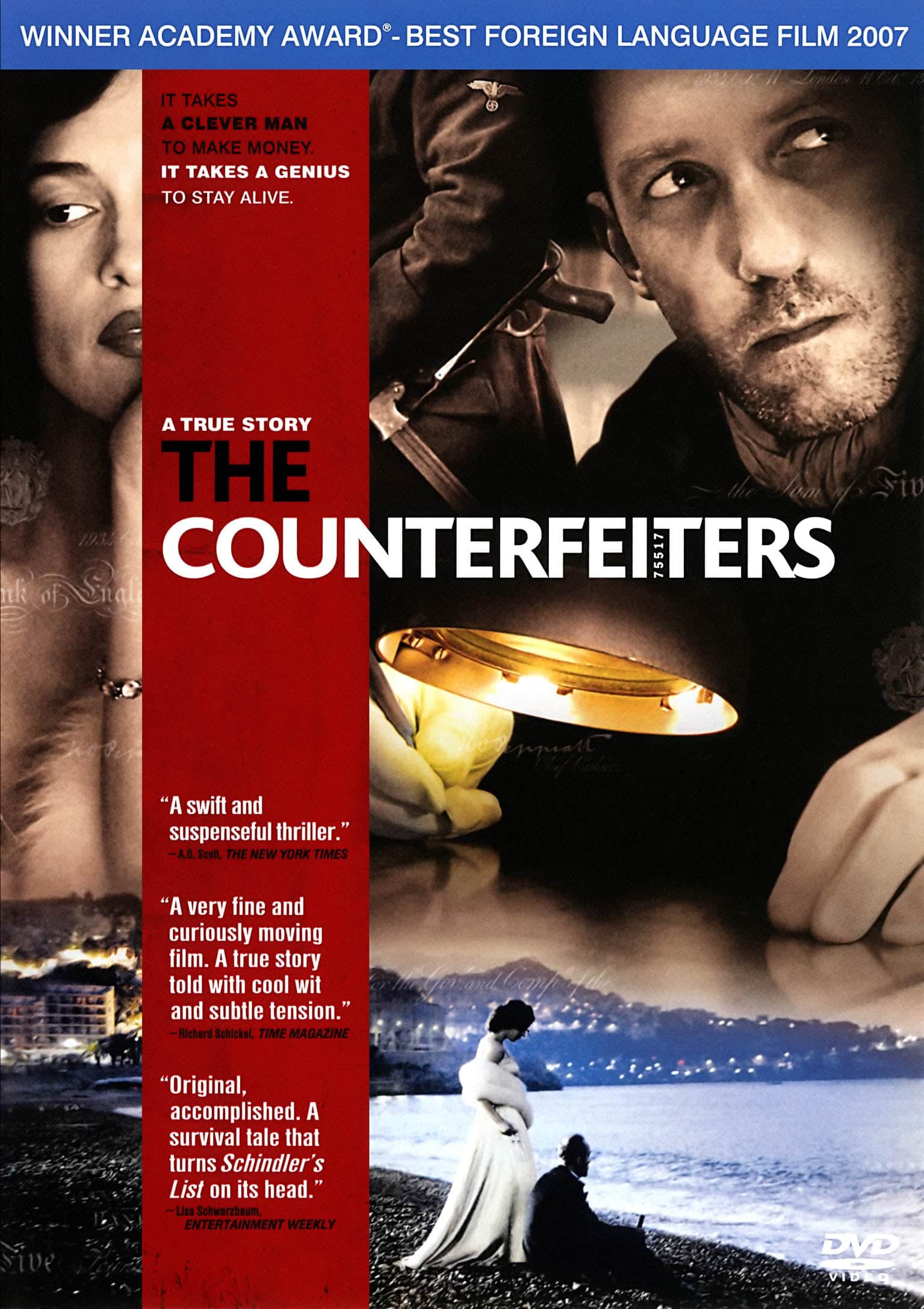
 Framed by scenes of its shabbily dressed, long-faced antihero Salomon “Sally” Sorowitsch (Karl Markovics) showing up at postwar Monte Carlo gaming tables with a suspicious satchel full of American cash, The Counterfeiters differs from the highest-profile Holocaust films by being grounded in exceptional circumstances. Rather than occupying the familiar tableaux of starvation, rapes, and gassings, its skilled male concentration-camp Jews—while hearing the gunfire of executions regularly outside the walls of their isolated block—are treated with chocolate, classical records, and soft, clean beds as they labor over printing plates and presses in the service of Operation Bernhard, an attempt by the German Reich to forge millions in U.S. dollars and British pounds to destabilize their enemies’ economies. Austrian writer-director Stefan Ruzowitzky adapts a memoir by a Bernhard-unit communist prisoner, Adolf Burger (August Diehl), staking the drama on a war of wills between Sally and Burger over whether sabotage and delay of the Nazis’ project is an ethical imperative or certain self-destruction.
Career forger Sorowitsch is introduced in a sepia-toned Berlin sequence as one of the city’s leading reprobates, seducing a woman whose fake passport he’s preparing until they are interrupted by his arrest at the hands of cheery cop Herzog (Devid Striesow). After a grim stay at a punishing camp where he ingratiates himself by painting color portraits and murals for the Germans, Sally is transferred to the Sachsenhausen camp’s counterfeiting detail, where he is presented by now-commandant Herzog as an artisan of “international standing.” Wearing a green triangle that marks him as a career criminal (among many), Sally oversees the production of pound notes that pass scrutiny from the Bank of England, and is charged with producing a Yank dollar as 1945 dawns. Seething idealist Berger takes beatings from hardened inmates when he advocates subversion until the Reich can be defeated, and a shifting game of guilt, power, and shame plays out among him, the pragmatic Sally (“Jews adapt”), and the alternately threatening and coaxing Herzog (who provides a ping-pong table to his charges).
Given the relatively intricate moral algebra, it’s unfortunate that Ruzowitzky’s images are too frequently monotonous and limiting. The novelty of using nearly all handheld shots in a drama of mostly interiors occasionally distracts, as when the camera maneuvers around bunks in a solitary barracks dialogue between Sally and Berger. Plotwise, a pitiable tubercular boy’s symptoms, despite the counterfeiters’ efforts at concealment, are bound to draw the vicious attention of the SS. Markovics’s flinty performance establishes the slippery ethos of Sally, but his shift of conscience is given a coarse motive: The camp’s most hissable guard pisses on him (and his struggle won’t be complete until he makes a Nazi piss in fear). The final image of a tango on the beach suggests little but a man trying to shut out his nightmare with a pale recreation of his prewar self-indulgence. At least if The Counterfeiters cops the foreign-language film Oscar, this workmanlike, somber anecdote rises above the treacly perversity of Life Is Beautiful.
Image/Sound
The image is beautifully film-like with minimal flaws (shadow delineation and black levels are sketchy in spots but edge enhancement and digital artifacts are nil) and the surround sound is ambient and grand, especially when the score dominates the track.
Extras
Stefan Ruzowitzky’s commentary is a mixed bag, more interesting when the director goes on about life inside a concentration camp and the real-life events that inspired the movie than when he’s fawning over the tango music that often fills the soundtrack or simply describing what’s happening on screen. Ruzowitzky pops up again on a short making-of featurette notable for its historical perspective and on an AFI Fest stage, where he’s interviewed by moderator Landon Zakheim. Rounding out the disc: four deleted scenes, three interviews (with Ruzowitzky, Adolf Burger and Karl Markovics), a touching featurette with Burger on which the Holocaust survivor and inspiration for the film pours over the artifacts from his time during the war, a theatrical trailer and a bunch of previews.
Overall
The image and sound, like the hearty collection of extras, are fit for an Oscar-winner.
Since 2001, we've brought you uncompromising, candid takes on the world of film, music, television, video games, theater, and more. Independently owned and operated publications like Slant have been hit hard in recent years, but we’re committed to keeping our content free and accessible—meaning no paywalls or fees.
If you like what we do, please consider subscribing to our Patreon or making a donation.