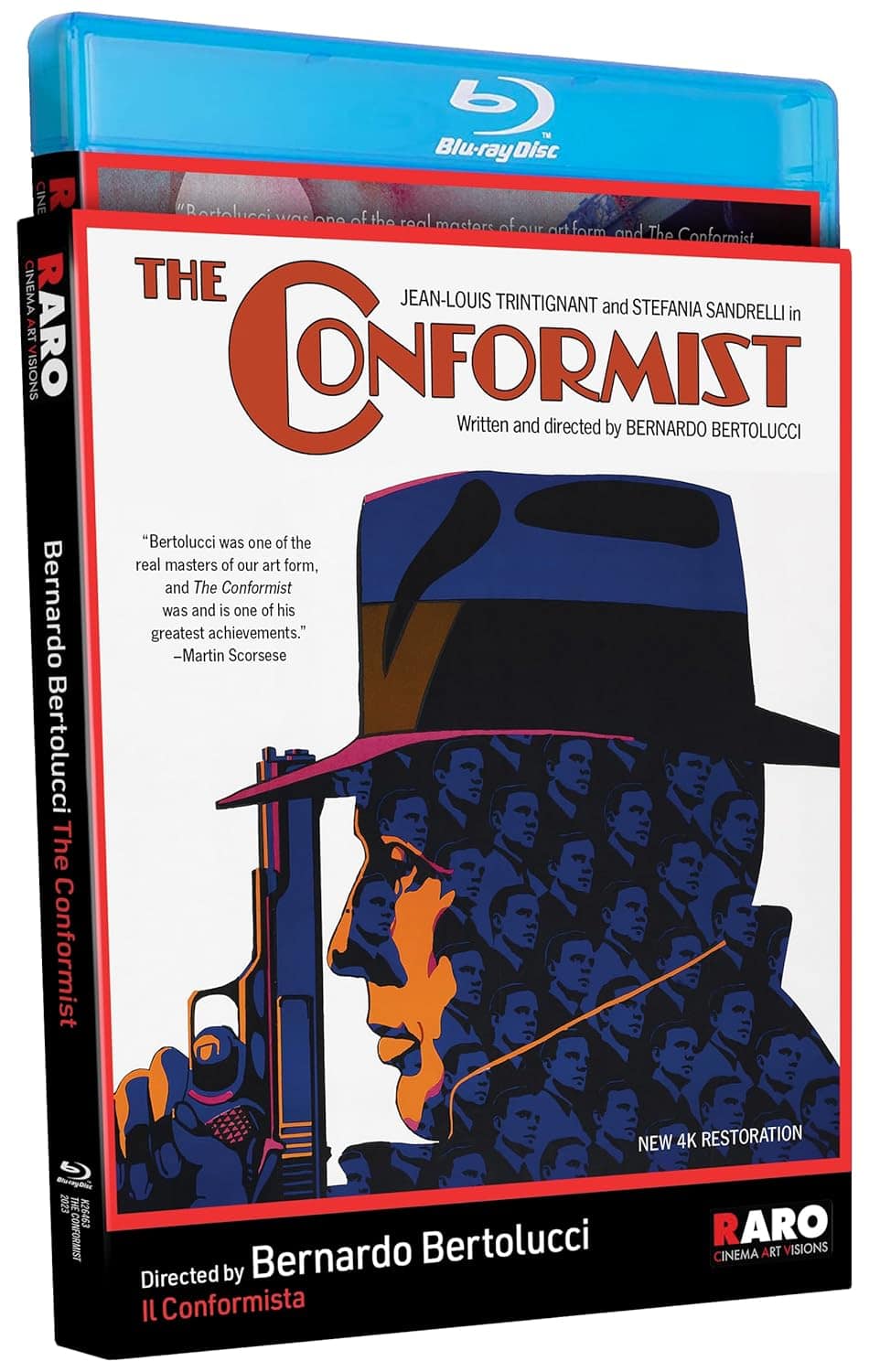
 Absorbing the breakthroughs of the French New Wave and the burgeoning New Hollywood era and applying them to the artier ends of Bernardo Bertolucci’s native Italian cinema, The Conformist presents a façade of overwhelming cinematic beauty only to reveal the rotten soul beneath its surface. Vittorio Storaro’s cinematography captures Rome and Paris with an Antonioniesque eye for architectural detail, swooning camera movements, and even instances of color timing so extreme that certain shots recall the hand-tinted process of early silent film.
The precision of The Conformist’s images, though, only exacerbates the detached, inhuman alienation of the film’s protagonist, Marcello (Jean-Louis Trintignant). He’s the last scion of a diminished aristocratic line whose exhausted wealth and status are symbolized by an expansive but dilapidated and mildewing family villa occupied by a mother (Milly) who copes with a loss of status with copious amounts of opiates (his father’s own breakdown has led to his institutionalization). Born too late to be anything other than mocked by his good name, Marcello is a prime candidate for wooing into Mussolini’s ascendant fascism in the 1930s.
While fascism promises brutality to its designated enemies, it appeals to a target audience with a fawning promise of a return to “normalcy,” and Marcello desperately desires to feel a sense of belonging with society. By the time that The Conformist commences, the man has already fallen so deeply for the party line that he agrees to work as an assassin for the secret police, who task him with murdering his old college professor, Luca Quadri (Enzo Tarascio), who lives exiled in Paris for his anti-fascist sentiments. Like a mafia initiation, Marcello must kill someone with whom he shares a personal connection to prove the extent of his loyalty.
Interspersed with flashbacks that bring added color to Marcello’s efforts to blend in, such as attending confession in order to marry Giulia (Stefania Sandrelli), the plot marches forward as the putative assassin’s efforts to get close to his former teacher create more and more complications that nag at the vestigial remnants of his conscience. As Marcello and Giulia fall into a convoluted web of attraction with both Luca and his wife, Anna (Dominique Sanda), the film builds suspense less from the fate of the professor, who feels doomed from the start, than from the possibility that Marcello may snap out of his blind obedience to an insane, violent order. This moral thriller plays out over the ambiguous impassivity of Trintignant’s muted expressions, which recall the similarly stoic exterior of Alain Delon’s hitman from Le Samouraï.

As Marcello offers few clues to his inner thoughts, the film’s cityscape images pick up the slack. Bertolucci roots many of the Rome scenes in the brutalist EUR district commissioned by Mussolini as a demonstration of fascist aesthetics. And Fascism’s deceptive appeal to a bygone history is epitomized by the use of the then-unfinished Palazzo dei Congressi, a mashup of neoclassical columns and gleaming white marble that forms into an imposing monument to modern, rationalist architecture. Paris, too, is seen via a series of recently constructed faux-retro attractions from the late 19th-century Eiffel Tower to the Palais de Chaillot, completed just one year before the film’s 1938 setting. But the sumptuous, touristic manner in which Storaro presents these landmarks subtly communicates how easily Marcello gets distracted from his mission when away from the strong-arming encouragement of his handlers.
In an early flashback that fills in Marcello’s backstory, the man refers to his then-fiancée Giulia as “mediocre” with a reverent affection that belies the pejorative of the term. He aspires to the complacency that mediocrity can bring, and what makes The Conformist so unsettling under its painterly surface is its knowledge that the allure of being a well-oiled cog in the machine instead of a conspicuous outlier can be so intense that someone would kill to become one.
Image/Sound
Raro Video previously issued The Conformist on Blu-ray in 2014 with a transfer from a 2011 restoration conducted by Cineteca di Bologna, and with the supervision of director Bernardo Bertolucci and cinematographer Vittorio Storaro. This new release boasts a newly prepared 4K restoration by the same studio. Cineteca’s restorations have come under fire for perceived revisionism in color timing that emphasize blue and yellow tints no matter the film in question. Sure enough, the first stills released to promote the film’s theatrical re-release met with kneejerk outrage, which may explain why Raro included a second disc with the previous transfer (which amusingly met with no protest despite also being handled by Cineteca).
While certain images may admittedly look massively different from the previous transfer when paused, in motion the film’s color and light balances look deeper and more carefully separated. What looks yellow in a static picture becomes more naturally white when playing. Blues, reds, and other shades reveal subtler gradations in both studio and on-location shots, and film grain is robust but evenly distributed. If anything, the old transfer now looks artificially boosted at the expense of finer texture. If any work has been done to the 2.0 audio from the previous Blu-ray, it’s impossible to tell. All elements are still cleanly balanced in the mix, with dialogue especially separated from street noise thanks to the contemporary post-sync dubbing of Italian cinema.
Extras
Raro ports over the extras from their 2014 Blu-ray release: an hour-long video essay by critic Adriano Apa that explores Bertolucci’s career and artistic development in the works leading up to The Conformist, as well as a booklet containing numerous essays and archival excerpts of contemporary reviews and interviews with cast and crew. In addition to these, the new disc comes with an informative commentary by critic Bilge Ebiri, whose enthusiasm for the film is infectious as he breaks down its myriad aesthetic choices and thematic fixations. There’s also a lengthy interview with Fondazione Bernardo Bertolucci president Valentina Ricciardelli, who discusses the foundation’s mission as both an archive and an incubator of new talent, as well as her thoughts on The Conformist and Cineteca di Bologna’s new restoration.
Overall
Raro upgrades their strong 2014 Blu-ray of Bernardo Bertolucci’s masterpiece with a new restoration and more informative extras.
Since 2001, we've brought you uncompromising, candid takes on the world of film, music, television, video games, theater, and more. Independently owned and operated publications like Slant have been hit hard in recent years, but we’re committed to keeping our content free and accessible—meaning no paywalls or fees.
If you like what we do, please consider subscribing to our Patreon or making a donation.