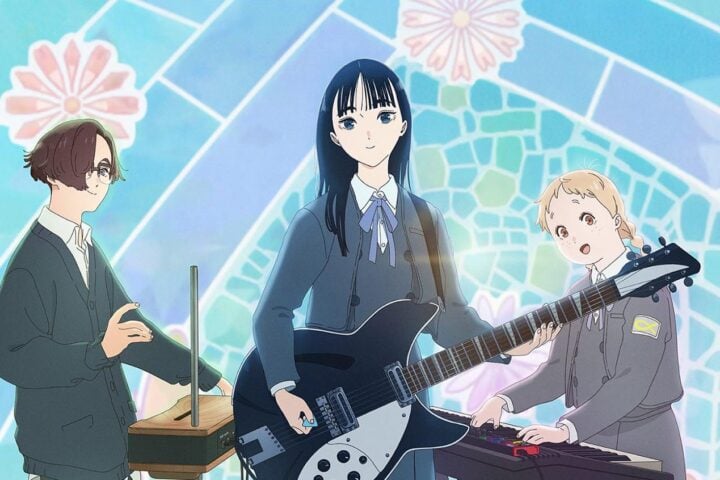
In the contemporary field of Japanese animation, no one makes films and TV shows like Yuasa Masaaki. Compared to the lifelike backgrounds and careful detailing of facial animations that typify much of anime, Yuasa’s mash-ups of disciplines and methods recall the unorthodox approaches of Don Hertzfeldt and Soviet-era Hungarian animators like Marcell Jankovics and György Kovásznai. But Yuasa’s north star—in underlying motivation, if not aesthetic—may be Tex Avery, whose brand of unpredictable comedy can be seen in the filmmaker’s willingness to upend character continuity and even the fundamental outlines of drawings for the sake of pursuing a joke or feeling to its most outlandish conclusion.
The plots of the five films included in Shout! Factory’s new box set are, however fantastical their framings, often elementally simple, and many have reference points in another anime films and shows. A kind of lysergic take on Miyazaki Hayao’s Ponyo, 2017’s Lu Over the Wall concerns a young man’s discovery of and subsequent friendship with a mermaid. The Night Is Short, Walk on Girl, also from the same year, is organized around a series of narrowly missed encounters between a lovesick man and the object of his affections. Ride Your Wave, from 2019, is about a young woman’s attempt to resurrect her dead boyfriend, and it’s filled with an agonized longing that rivals that of your average Shinkai Makoto production. And the general narrative outline of 2004’s Mind Game, about an unjustly killed young man’s strong-willed attempt to return to life, should be instantly recognizable to fans of the classic series Yu-Yu Hakasho.
Even the most sui generis work in this set, 2021’s Inu-Oh, boils down to the story of two disabled outcasts using their artistic skill to win the social acceptance long denied them. But Yuasa uses such simple narratives to ground baffling, surreal twists that add wild complications to the characters’ journeys. For one, the would-be lover’s attempts to arrange the perfect meet-cute in The Night Is Short eventually take so many turns that he ends up infiltrating an underground rare book trading ring and must undergo elaborate rituals to secure a copy of the girl’s favorite childhood novel. This clandestine gathering is, in turn, broken up by a “god of the used book market” who wishes to save books from artificial scarcity and price-gouging.
Lu Over the Wall adds entirely new wrinkles of madness to its fish-out-of-water tale when the mermaid’s father, a shark so colossal that he blots out the sun when he walks past awestruck townsfolk, comes on land to find her. On a more ruminative level, Ride Your Wave takes breaks from its fantastical conceit of a woman communicating with her dead lover to observe the more naturalistic coping mechanisms that the man’s other loved ones use to process their grief.
Above all else, Yuasa uses his stories as a springboard for wild experiments in animation, mingling various techniques to craft deliberately disjointed but spontaneous and idiosyncratic visuals. He typically keeps his line drawing to a minimum, illustrating characters with little more than the outer borders of their body shapes to define them. Many times, background figures don’t even have facial features but are merely eerie, face-shaped blobs, their lack of form keeping focus on the main characters in the frame. Character dimensions are subject to abrupt, expressionistic distortions, making even their basic outlines unpredictable.
Often, landscapes are rendered in watercolor palettes and textures, while occasional moments of CGI chiefly add intensity to camera motions, making action cinema out of everything from racing POV shots of running characters to slight camera pans that reframe the composition. Of the films here, only Ride Your Wave, with its heightened realism, blown-out sunlight, and heightened close-up detail (especially, amusingly, on images of food) looks like anime as one typically encounters it, though even here the characters move in strange, alien ways.
Drawing on Japanese painting, Yuasa uses negative space and minimalistic line drawing to communicate perspective in a way that feels antithetical to more elaborately detailed techniques for achieving the same illusion of depth in Western practice. By the same token, one can look at the thickly daubbed textures of the lush Merfolk Island in Lu Over the Wall and see the influence of Paul Cézanne, or the recurring tic in multiple films of flashbacks being shown via vividly colorized, primitive sketches of blocky shapes that startlingly resemble the cut-outs of Henri Matisse. Just as it’s impossible to predict in any given scene what strange narrative detour will crop up in the next moment, wild clashes of animation regularly rub against one another as Yuasa creates a kind of shared anti-continuity via a unified sense of possibility.
Another dominant feature of these films is their use of music. Yuasa incorporates every genre he can think of, from twee pop to pounding electronica to heavy metal, even dashes of traditional Japanese instrumentation like the droning strings of a shamisen. Often, these styles bleed into one another to create dense yet upbeat soundtracks, and many of the most extreme moments of distorted body animation occur when characters cannot stop themselves from dancing to the odd, propulsive music and their legs and arms jut and wobble. In that sense, Inu-Oh feels like a culminating work. It’s certainly the first of Yuasa’s movies to truly be a rock opera instead of merely feeling like one, and its asymmetrically limbed protagonist the purest representation of the director’s love of turning the human body into a rupturing conduit for emotional expression.
Image/Sound
Each film looks outstanding on Blu-ray, with their highly chromatic palettes and variations in animated style captured pristinely in each transfer. You can see the brushstrokes on some backgrounds, and the moments of more detailed drawing show off all their granular textures. Clarity is so consistent that you can even spot the elements on faces or in the background where things clearly separate based on conflicting animation methods. Sound is likewise strong, with music mixed upfront in each channel without obscuring Foley effects or dialogue.
Extras
Several of the films (Mind Game, Lu Over the Wall, and Inu-Oh) come with commentary tracks by Yuasa Masaaki speaking with other crew members and producers, who provide jovial but informative accounts of how they approached the challenges of helping the director realize his vision. Elsewhere, we get a brief interview with studio co-founder Eunyoung Choi, who marvels at how Yuasa makes sense out of the wild ideas he brings to his animators, as well as galleries of storyboards and scenes at various stages of hand-drawn and computer animation. An interview with Yuasa touches on some of his inspirations but is amusingly more about everyday pleasures, from his hobbies to his favorite restaurants. Two outstanding Yuasa shorts, Happy Machine and Kick-Heart, are also included, as is a booklet containing a broad career overview of the filmmaker by critic Emily Yoshida and copious reproductions from Yuasa’s sketchbooks.
Overall
Shout! Factory brings cult director Yuasa Masaaki’s theatrical features to Blu-ray in an excellent box set with great A/V transfers.
Since 2001, we've brought you uncompromising, candid takes on the world of film, music, television, video games, theater, and more. Independently owned and operated publications like Slant have been hit hard in recent years, but we’re committed to keeping our content free and accessible—meaning no paywalls or fees.
If you like what we do, please consider subscribing to our Patreon or making a donation.