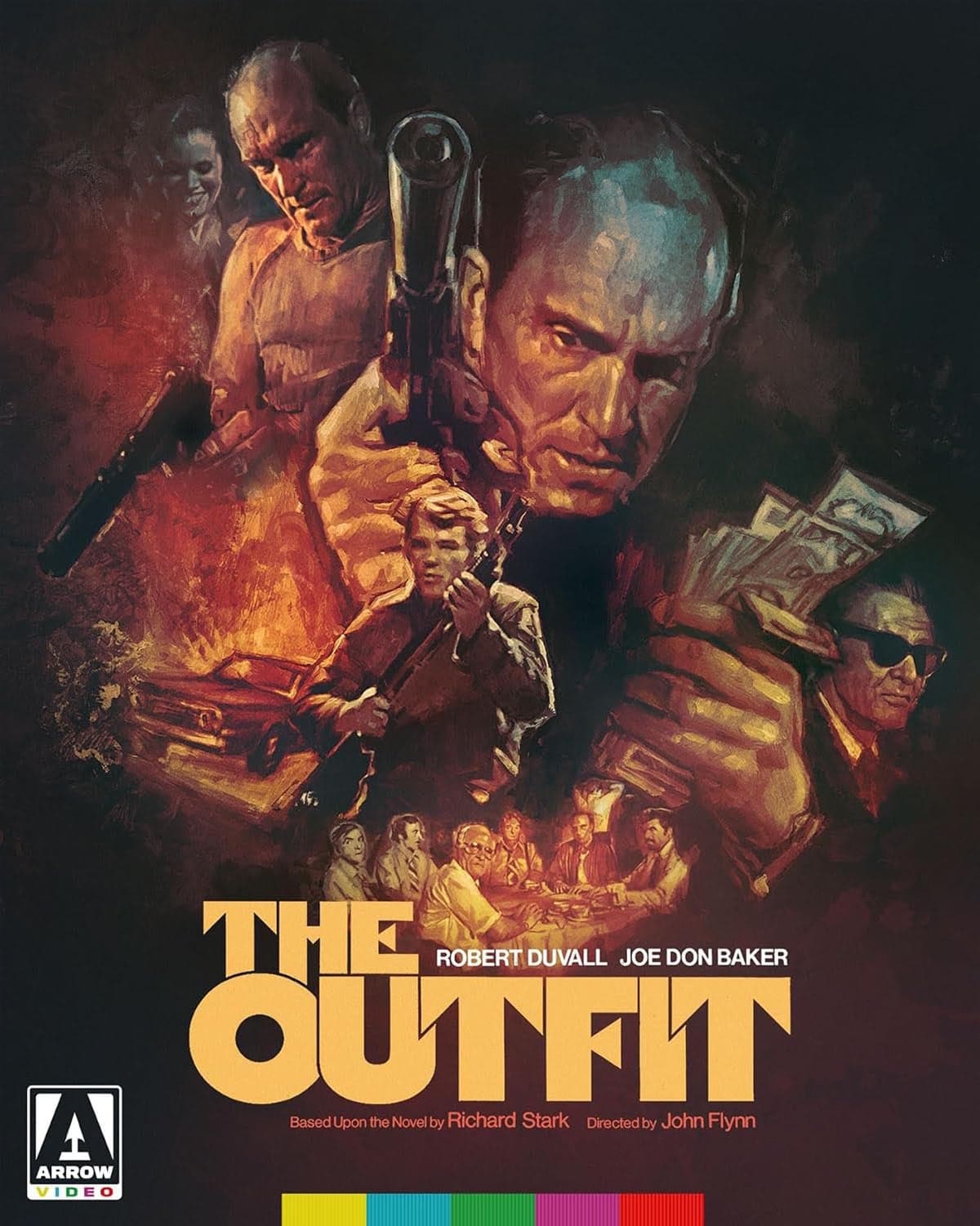
 Donald E. Westlake’s iconic Parker character, the protagonist in 24 of the author’s novels written under the pseudonym Richard Stark, was conceived as the epitome of hard-boiled. Adapted from the third Parker novel, John Flynn’s 1973 film The Outfit takes that spirit to heart, populating the screen with a slew of ruthless, no-nonsense men whose mistrust borders on paranoia and whose unfeeling tenacity often approaches sociopathy.
As the film’s Parker avatar, Earl Macklin, Robert Duvall exudes a ferocious determination. The man—a thief who’s terse, guarded, and eminently professional—is defined wholly by his persistence and proficiency at his job. And, fortunately for him, he’s exceptional at it. As befitting an early-’70s crime film, Duvall’s tightly coiled performance exudes not an ounce of charisma.
At the start of the film, Macklin is behind the eight ball. Freshly released from a stint in prison, he’s almost immediately on the lookout for hitmen hired by Mailer (Robert Ryan), the head of the titular crime syndicate, which owned the bank that Macklin robbed with his now-deceased brother. Whether Macklin knew this or not is beside the point. A man with no illusions over his impending death, he sees himself as living in a world where results dwarf intentions.
True to the spirit of Westlake’s work, Flynn refuses to glorify the world of crime. The Outfit’s downbeat tone mirrors the terrifyingly implacable Mackin’s single-mindedness. His only glimpses of anything approaching joy come at the bottom of a whiskey glass or while cleaning his gun. His girlfriend, Bett (Karen Black), unearths shades of humanity within him, but he seems almost hell-bent on concealing that part of his being upon returning to the task at hand. This is a man who knows that he has no choice but to obsessively bind himself to his work, knowing that the world he exists in is ready to dispose of him the second he slips up.
Image/Sound
Arrow Video’s transfer of a new 2K restoration captures all the grimy details of The Outfit’s world, from the dingy interiors of sleazy motel rooms to the weatherworn faces of everyone from Joe Don Baker and Timothy Carey to Robert Ryan and Elisha Cook Jr. The color balancing stays true to the look of the film, which is defined by the naturalism of its muted, earthy tones. Grain is well-maintained and evenly distributed, while the mono soundtrack is punchy enough to nicely handle the occasional shootout and presents the dialogue cleanly.
Extras
The disc comes with a lively and informative commentary track by critic and author Jedidiah Ayres and film critic Mike White of The Projection Booth podcast. They provide a ton of context for understanding Donald E. Westlake’s fondness for Robert Duvall’s performance, while also touching on the subtle ways that John Flynn attempts to humanize the character. In two new video essays, critic Walter Chaw delivers a sharp analysis of Duvall’s performance and the importance of Karen Black’s character to the film, while authors Alissa Marmol-Cernat and Shay Dennis focus more on the Parker character and the series’s place in literary history.
The disc also comes with two terrific interviews. In one, author and Westlake expert Levi Stahl gives an excellent overview of the author’s prolific career, and in an archival one from 2013, filmmaker Walter Hill briefly talks about his friendship and working relationship with Flynn. Rounding out the package is a 36-page booklet containing stills from The Outfit and new essays by critics Chris D, Glenn Kenny, and Priscilla Page, who collectively provide fascinating breakdowns of the Parker character, Flynn and Westlake’s careers, and the place of the former’s film and the latter’s novels within the genre of crime fiction.
Overall
John Flynn’s 1973 adaptation of Donald E. Westlake’s 1963 Parker novel of the same name is brutal and ruthlessly efficient. It’s the epitome of hard-boiled.
Since 2001, we've brought you uncompromising, candid takes on the world of film, music, television, video games, theater, and more. Independently owned and operated publications like Slant have been hit hard in recent years, but we’re committed to keeping our content free and accessible—meaning no paywalls or fees.
If you like what we do, please consider subscribing to our Patreon or making a donation.