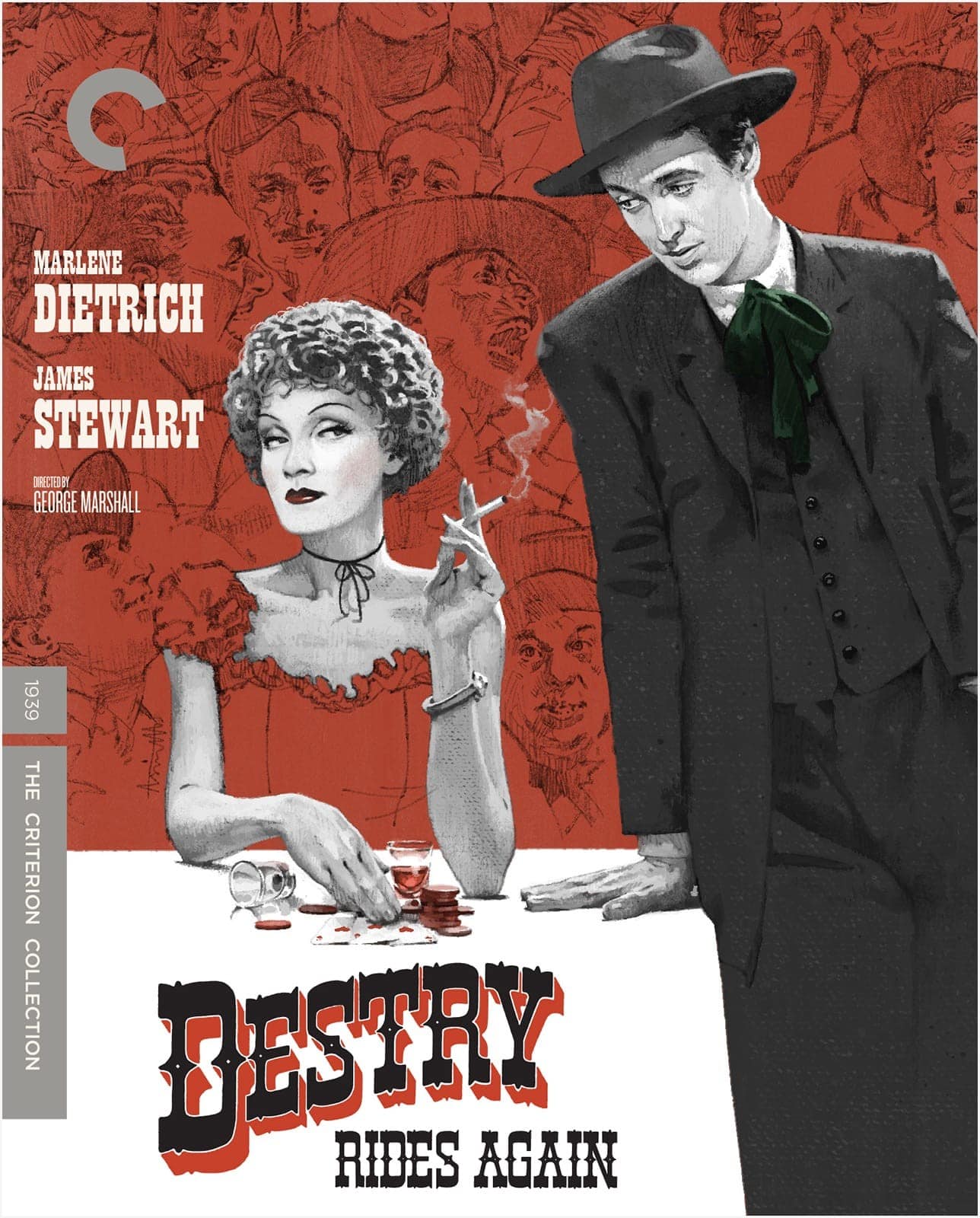
 Much of George Marshall’s 1939 western Destry Rides Again ingeniously pivots on a single set: a saloon the size of a ballroom, with many floors teeming with an array of hearty male drunks. There’s no logical rationale for the existence of such a building in a small town somewhere west of nowhere, though the symbolic justification is robust, as this saloon is understood to be the soul of this society, embodying the intricate fashions in which entertainment, politics, and law comingle in the world at large.
The booze and musical acts, headed by the sexy and commanding Frenchie (Marlene Dietrich), distract the town’s citizenry from the ways in which Kent (Brian Donlevy) robs men of their land, and that connection is literalized when Frenchie spills coffee on a mark so that Kent may cheat him out of a hand of poker. Also a fixture inside the saloon is the easily bribed mayor, Judge Slade (Samuel S. Hines), and the town drunk, Washington Dimsdale (Charles Winninger), a former deputy of the law who physicalizes the hopelessness and lapsed idealism of this community, until he’s made sheriff as a joke that will come back to haunt Kent.
Destry Rides Again has been described as a western spoof, a label which suggests that it might be a lark. And to emphasize the film’s thematic resonance is to run the risk of likening it to homework, compromising its profound sensory pleasure. Above all, Destry Rides Again is fun, with a variety of stars and character actors utilizing their charisma with an expert sense of ease and offhandedness. But few westerns have also so explicitly emphasized the classic saloon setting as an early fount of American entertainment, which, like pop culture at large, can serve as a mass salve and therefore a source of bamboozlement.
Here, Dietrich performs dance-hall numbers that are reminiscent of her legend-cementing work for Josef von Sternberg, which similarly underscored the porous boundary between beautiful illusion and exploitation. Marshall may not be a stylist on the level of von Sternberg, but he films the saloon with sensual and funny aplomb, and certain tracking shots, capturing how various components of the bar work together to manipulate patrons, could have potentially even commanded the respect of Max Ophüls. Under Marshall’s staging, the patrons of the bar are reminiscent of dancers even in the fight sequences, their wave of movement suggesting emotional mood rings, especially when Frenchie is challenged by a newcomer.
Today, James Stewart’s Tom Destry Jr. suggests a comic forefather of Ransom Stoddard, the role the actor later played in John Ford’s The Man Who Shot Liberty Valance. Both characters are pacifists in towns that challenge their essential worldviews—a theme that Ford takes seriously and which Marshall allows to get away from him. Tom’s early scenes are remarkable, as Stewart, with his folksy quicksilver timing, allows pacifism to feel brave and even sexy; he decidedly isn’t the stereotypical wimp who must be taught a macho lesson in vengeance-making. As Kent and his goons ridicule Tom, we’re allowed to understand that the latter is setting a trap, thinking several moves ahead. We’re also able to discern the cojones it would take for a man to order a glass of milk in a den of ruffians, for Tom is resisting the spell that has the entire town, amusingly and suggestively called Bottleneck, enchanted.
The film poses a suspenseful riddle: How will Tom, who had a role in cleaning up Tombstone, handle a rabble of armed men? That riddle is squashed when Tom does eventually arm himself, which Marshall stages neither for comedy nor irony; here, the filmmaker is merely honoring the obligations of a genre, though he redeems himself with an elaborate climax in which the town revolts against Kent and the government that’s at his disposal. Once again, Marshall’s command of crowds is astonishing, and the central image—of wives with garden tools usurping the rein of the drunk and rowdy gunmen—is a stirring moment of empowerment that’s remarkable even for contemporary cinema. When the women storm the bar, Marshall understands them to be gallantly rebelling first by puncturing mythology, tearing down a church of manliness. That’s heavy stuff for any film, let alone one that’s known as a fun Jimmy Stewart/Marlene Dietrich bauble. Marshall’s confidence in his material, his willingness to allow his subtext to breathe almost subliminally, is the ace in his sleeve.
Image/Sound
Per the disc’s liner notes, this new 4K digital restoration was overseen by Universal Pictures in collaboration with the Film Foundation, with special consultation by Martin Scorsese and Steven Spielberg. The results are beautiful, as the image has a lush vibrancy that underscores the precision and detail of the film’s elaborate tracking shots. One can vividly make out the people occupying various portions of the frame at any given moment, and close-ups are equally detailed. Blacks and whites are rich and balanced, especially the whites, of which there is quite a bit of subtle variation throughout the film. The new monaural soundtrack boasts excellent dimension, capturing with pinpoint precision the many variables that are often involved from scene to scene, from gunshots to horse galloping to the movement of dozens of people simultaneously. Marlene Dietrich’s songs have a newfound dynamism as well, emphasizing the unusual, highly theatrical elements of this unconventional western.
Extras
A new interview with critic Imogen Sara Smith and an essay by critic Farran Smith Nehme collectively offer an affectionate and informative history of Destry Rides Again, tracking the films it influenced (including Mel Brooks’s Blazing Saddles), how it rehabilitated Dietrich’s career and gave rise to James Stewart’s own, as well as the gender norms it upended. Smith gives much of Destry Rides Again’s creative success to Hungarian-born American producer Joe Pasternak, who steered the film away from its initial roots as a parody of the 1930 Tom Mix vehicle of the same name into something stranger, richer, and unusually continental. (Many of the people who worked on the production were European, which bleeds into the narrative’s texture, especially during the ballroom scenes.) Meanwhile, Nehme also contextualizes Destry Rides Again as one of many legendary 1939 studio releases, among them the other film that cemented Stewart’s stardom, Frank Capra’s Mr. Smith Goes to Washington.
Speaking of Stewart, a new interview with Donald Dewey, author of James Stewart: A Biography, offers incisive observations of the actor’s techniques, including his unusual affinity for dialogue, which played against the prevailing male stereotype of the strong and silent type. Dewey reminds us that every Stewart film provides the actor with monologues, which he later said he valued as a way to find the voice and consciousness of his characters. In this interview, Dewey also refreshingly emphasizes Stewart’s profound range, illustrating how he gained greatly in confidence moving from Mr. Smith goes to Washington to Destry Rides Again, where he was tutored by Dietrich, who advised him to look askance at his co-stars, focusing on their eye rather than directly into their face, which she said scans as a direct look to the camera. Dewey also covers Stewart’s years as an accomplished bomber pilot in WWII, and his evolution into an edgier leading man for directors such as Anthony Mann and Alfred Hitchcock. Illustrated audio excerpts from a 1973 oral-history interview with director George Marshall and a Lux Radio Theatre adaptation of Destry Rides Again from 1945 round out the package.
Overall
The influential, star-making Destry Rides Again is less a parody than a surprisingly beautiful and somber precursor to many autumnal “late” westerns.
Since 2001, we've brought you uncompromising, candid takes on the world of film, music, television, video games, theater, and more. Independently owned and operated publications like Slant have been hit hard in recent years, but we’re committed to keeping our content free and accessible—meaning no paywalls or fees.
If you like what we do, please consider subscribing to our Patreon or making a donation.