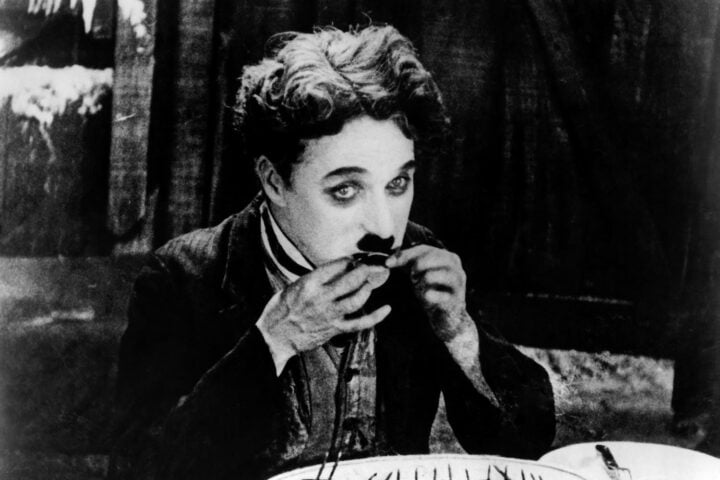
On May 6, the San Francisco Silent Film Festival returned to its longtime home: the Castro, which closed for renovations in 2024 and reopened in early 2026. The theatrical experience is a little different—the seats were removed to create a concert venue, with modular risers and rows of lightweight padded seats brought in for the festival—but the restoration of the frescoes and interior designs is beautiful, the sight lines improved with the increased rake, and the atmosphere…well, let’s just say that it’s good to be home.
This year brought 18 features and seven shorts, all presented with live musical accompaniment, plus a special presentation of Japanese films produced on paper strips, and the annual “Amazing Tales from the Archives” program. Among the new restorations of films both legendary and forgotten were early features by Carl Theodor Dreyer and William Wyler, as well as revelatory German and Polish productions previously unseen stateside.
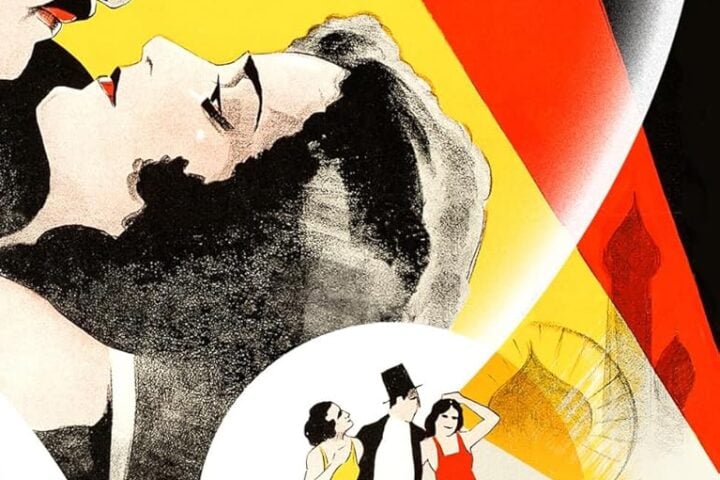
Opening night offered the new restoration of the famously unfinished Queen Kelly, Erich von Stroheim’s notorious 1929 production starring Gloria Swanson as an innocent corrupted. Von Stroheim’s overruns and excesses proved too much for Swanson and producer Joseph Kennedy (yes, the paterfamilas of the political dynasty), with production shutting down with less than half of his script in the can. Now, still photos and descriptions drawn from the complete script suggest Stroheim’s vision for the film’s missing sequences.
Milestone Films released their first reconstructed version in the ’80s. Over 40 years later, with a whole new suite of restoration tools and a couple of small additions, Milestone’s reconstruction is back to showcase Stroheim’s brazen, boundary-pushing imagery with stunning detail and texture. This screening came toward the end of its current festival rounds—it premiered at Cannes in 2025—and makes good on SFSFF’s commitment to “live cinema,” with composer Eli Denson conducting a live performance of his restoration score.
Released in 1921, just a year after the 19th amendment gave women the vote, Miss Lulu Bett reminds audiences that the march for women’s rights had barely begun at the time. Lois Wilson proves a great talent in the title role, an unmarried young woman practically in servitude to her older sister and brother-in-law in exchange for room and board. The film is adapted from a Pulitzer Prize-winning play, and director William C. DeMille proves to be a more sensitive and intimate director than his brother Cecil. If the traditional Hollywood happy ending seems to rush past very real hurdles for a single woman in 1920, it’s still satisfying given what she’s endured and how she rebels. Miss Lulu Bett is one of two Paramount films restored by Artcraft, a collaboration between restoration veterans Robert Harris and James Mockoski.
Artcraft also provided Lewis Milestone’s 1926 comedy The Caveman, an American twist on Pygmalion starring Marie Prevost as a millionaire, Myra Gaylord, so bored with society that she decides to prank New York’s upper crust by passing off a coal heaver, Mike Smagg (Matt Moore), as a society gentleman with little more than a physical makeover and a few rudimentary tips on social etiquette. Milestone earned his reputation tackling serious issues and big themes, but this picture shows a natural comic director with top-notch timing, a gift for character, and a knack for well-turned sight gags. Myrna Loy has a small but memorable part as a French maid intimidated by her mistress’s new project. Both Miss Lulu Bett and The Caveman feature new scores by Rodney Sauer performed by the Mont Alto Motion Picture Orchestra, which will accompany the upcoming disc releases from Artcraft.
The San Francisco Film Preserve, a non-profit organization created to focus on film restoration, presented the local premiere screening of another Paramount feature: 1927’s Hula, directed by Victor Fleming and starring Clara Bow in her follow-up to her breakout hit Mantrap. Bow’s character is no temptress or a flapper but a child of nature raised on a ranch in Hawaii, all innocence and budding sexuality without the constraints of social convention. Clive Brook’s understated performance as the visiting, married engineer is perfect next to Bow’s unbridled energy and, age difference aside, the engineer’s easy appreciation of this wild child’s directness and honesty sells the simmering embers of a passionate romance waiting to ignite.

Other recent restorations include Sidney Olcott’s The Humming Bird, from 1924, with Gloria Swanson donning boys’ clothes and the mannerisms and cocky swagger of an early 20th-century Paris street urchin who robs the rich and taunts the gendarmes, and Blazing Days, a five-reel oater from 1927 directed by William Wyler with unexpected energy, playful humor, and charm.
Germany dominated the festival with four impressive features. His Greatest Bluff, a zippy 1927 lark directed by and starring Harry Piel, delighted audiences with its tale of jewel thieves, rival criminal gangs in formal evening wear, a car chase up and down a winding mountain road, and more. (All this plus Marlene Dietrich as a savvy, stylish thief with a diminutive partner who can pass himself off as a child.) Piel, who plays twins in the film, was one of the biggest screen stars of the ’20s in Europe and elsewhere for his “sensationsfilms,” German action spectacles built on daring stunts and high-speed chases, but few of his films survive. On the evidence of this restoration, he’s a talent worthy of further research, both as director and actor.
Sensation im Wintergarten, from 1929, is also built on thrills, in this case a celebrity trapeze artist (Paul Richter) who swings over a bed of spikes and flies through a ring of knives for nightly entertainment. He’s the quintessential boy who ran away to join the circus, and his homecoming pits him against the predatory Baron (Gaston Jacquet), who drove him away years ago. The film is missing an entire reel (which, devoted to a subplot, is barely missed) and a couple of more substantial scenes (which, though explained with text and stills, are more glaring), but it plays well nonetheless. Director Gennaro Righelli came to Germany from Italy and brings a light touch and a grand look to the film, the latter thanks to access to Berlin’s Wintergarden nightclub, destroyed during World War II.
Much heavier is 1930’s Bookkeeper Kremke, the sole feature directed by Marie Harder. Set during the depths of the depression in Germany, this uncompromising look at the hard times and armies of unemployed in 1930 Germany charts the decline of a middle-aged widower (Hermann Vallentin) when a new accounting machine replaces him after 20 years of service. Harder leans into the social politics of 1930 Germany and makes a point of Kremke’s class prejudice and social conservatism, which even hard times can’t budge. Anna Sten (in her first German feature) co-stars as the grown daughter that Kremke’s intolerance drives away. Harder frames the fiction with the raw numbers of Germany’s unemployed ranks and concludes with a call for workers to rise up and demand their rights. Real life, obviously, didn’t work that way and the progressive Harder fled Germany a couple of years later.
Even more harrowing is Love One Another, Carl Theodor Dreyer’s 1922 drama about the 1905 Russian Revolution, Tsarist oppression, and virulent antisemitism weaponized by the Russian government. The trials of a pair of young lovers, the Jewish Hanne-Liebe (Polina Piekowskaja) and Russian revolutionary Sascha (Thorleif Reiss), gives the story its through line. The opening half is frustratingly text-heavy, with scenes playing like illustrations to the lengthy intertitles, and the plot is overly complicated, but the film blooms into something powerful and deeply disturbing. Dreyer is on the side of the revolutionaries and portrays the Russia’s Christian peasants as petty, hypocritical, and all-too-willing to blame their poverty on their (equally impoverished) Jewish neighbors, which is startling for German film of the early ’20s.
Elzbieta Wysocka, deputy director of the Filmoteka Narodowa in Warsaw, was honored with SFSFF’s Award for commitment to the preservation and presentation of silent cinema, and she brought a pair of Polish films with her to the festival. Janko the Musician, from 1930, is one of many dramatizations of a classic Polish story about a peasant child with passion for music. It’s a sentimental bit of romantic melodrama—the buddy story between the grown Janko (Stefan Rogulski) and a pair of street hustlers (comedy team Adolf Dymsza and Kazimierz Krukowski) is the best part of the film—and was originally released as both a silent and with synchronized music and sound effects on 78 rpm discs. SFSFF presented a hybrid, with some sequences accompanied by sound-on-disc and others with live music by Guenter Buchwald (slipping between piano and violin), Mas Koga, and Frank Bockius.
Shot on location in the snowy peaks of southwest Poland, the 1932 adventure spectacle The White Trail is slight on narrative and rich with texture. Essentially an early independent production made by a cast and crew of filmmaking amateurs, it features veteran skiers and mountaineers in a simple story of romance and adventure. Director Adam Krzeptowski, a former documentarian who serves as his own cinematographer and editor, delivers astounding imagery with a photographer’s eye for composition and detail.
The British anti-war sci-fi film High Treason, from 1929, borrows liberally from Fritz Lang and H.G. Wells for its vision of life in 1950. There’s a romance between a pacifist (Benita Hume) and a patriotic air force officer (Jameson Thomas) and a cabal of munitions moguls pushing the world powers to war. The film anticipates the Channel Tunnel (a target for terrorists) and gives us videophones at every desk, silver lamé formal wear, and black military uniforms that would look at home on the Death Star. Director Maurice Elvey suggests a scope outside of its austere studio sets with the futuristic cityscapes of the miniatures department and the screenplay (adapted from an eccentric play by an inventor and far-right political conspiracy theorist) gives the women of the world an active role in standing up to militarism. It’s genuinely fascinating with unexpected dramatic touches and inventive direction by the prolific Elvey.
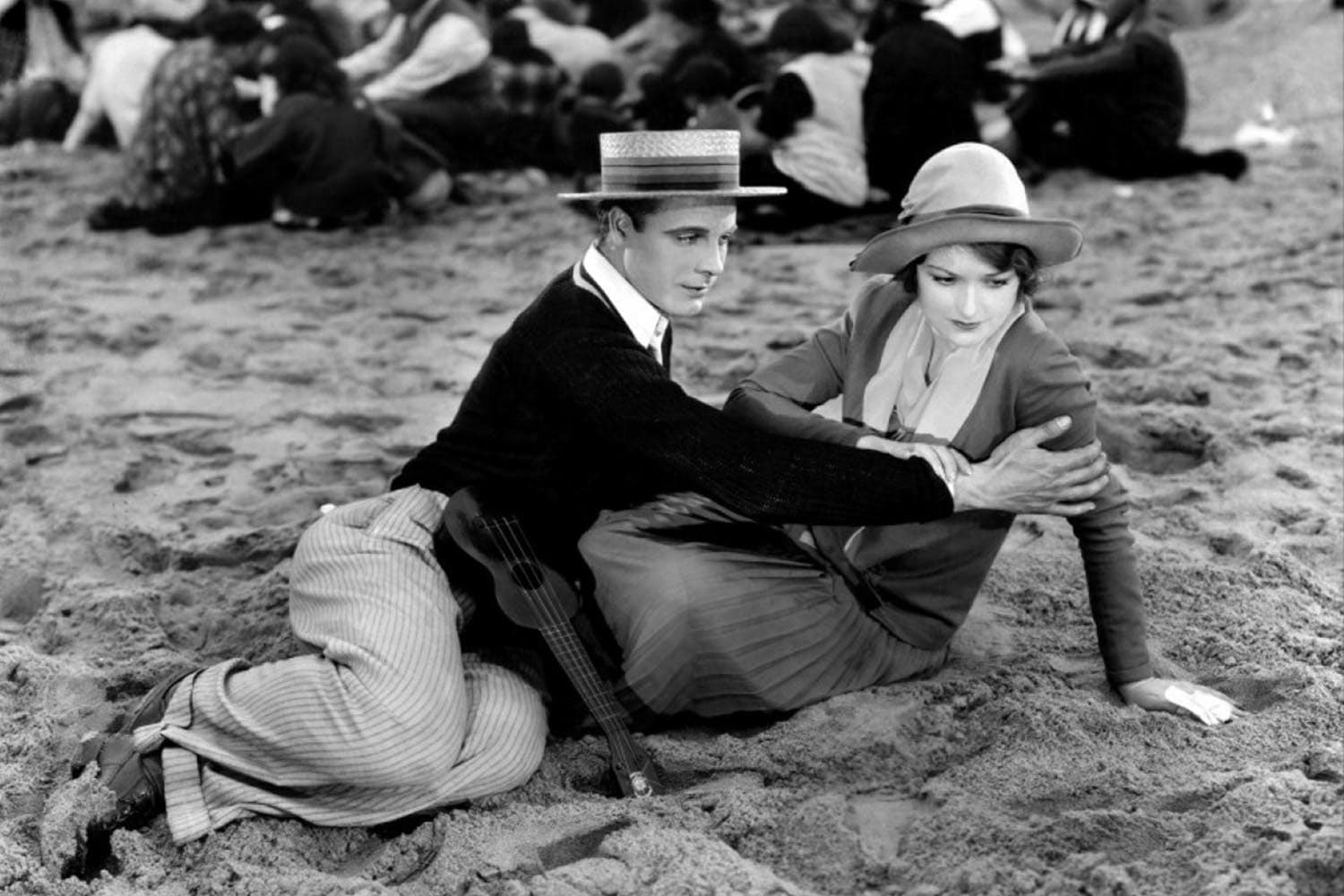
Closing night treated audiences to a landmark of American silent cinema: The Crowd, King Vidor’s 1928 paean to the struggling American everyman (and woman) grasping for their piece of the American dream. (The film arrived fresh from a new restoration from Blackhawk Films.) The story of a guy named John (James Murray), whose big ambitions get lost in the monotony of his job, and a young woman named Mary (Eleanor Boardman), a blind date who becomes his supportive but often frustrated wife, is at once intimate and epic.
Vidor takes us from the exuberance and bubbly fun of young love igniting on the Coney Island midway and the nervous excitement of marriage and honeymoon to routine and disappointment and the quotidian details of workaday life. The memorable scenes of John lost in the endless, orderly rows of anonymous workers, just a cog in a paperwork machine, or haplessly and hopelessly trying to halt the buzz of rubbernecking New Yorkers streaming down the street, echo back to the title. But John is more than just another face in the crowd, thanks to Murray’s amiable presence and relatable struggles, and Vidor offers a perceptive portrait of the toll of depression on John after a family tragedy. The lovely score by the Mont Alto Motion Picture Orchestra is scheduled to accompany the film on its upcoming disc release.
The San Francisco Silent Film Festival ran from May 6—10.
Since 2001, we've brought you uncompromising, candid takes on the world of film, music, television, video games, theater, and more. Independently owned and operated publications like Slant have been hit hard in recent years, but we’re committed to keeping our content free and accessible—meaning no paywalls or fees.
If you like what we do, please consider subscribing to our Patreon or making a donation.