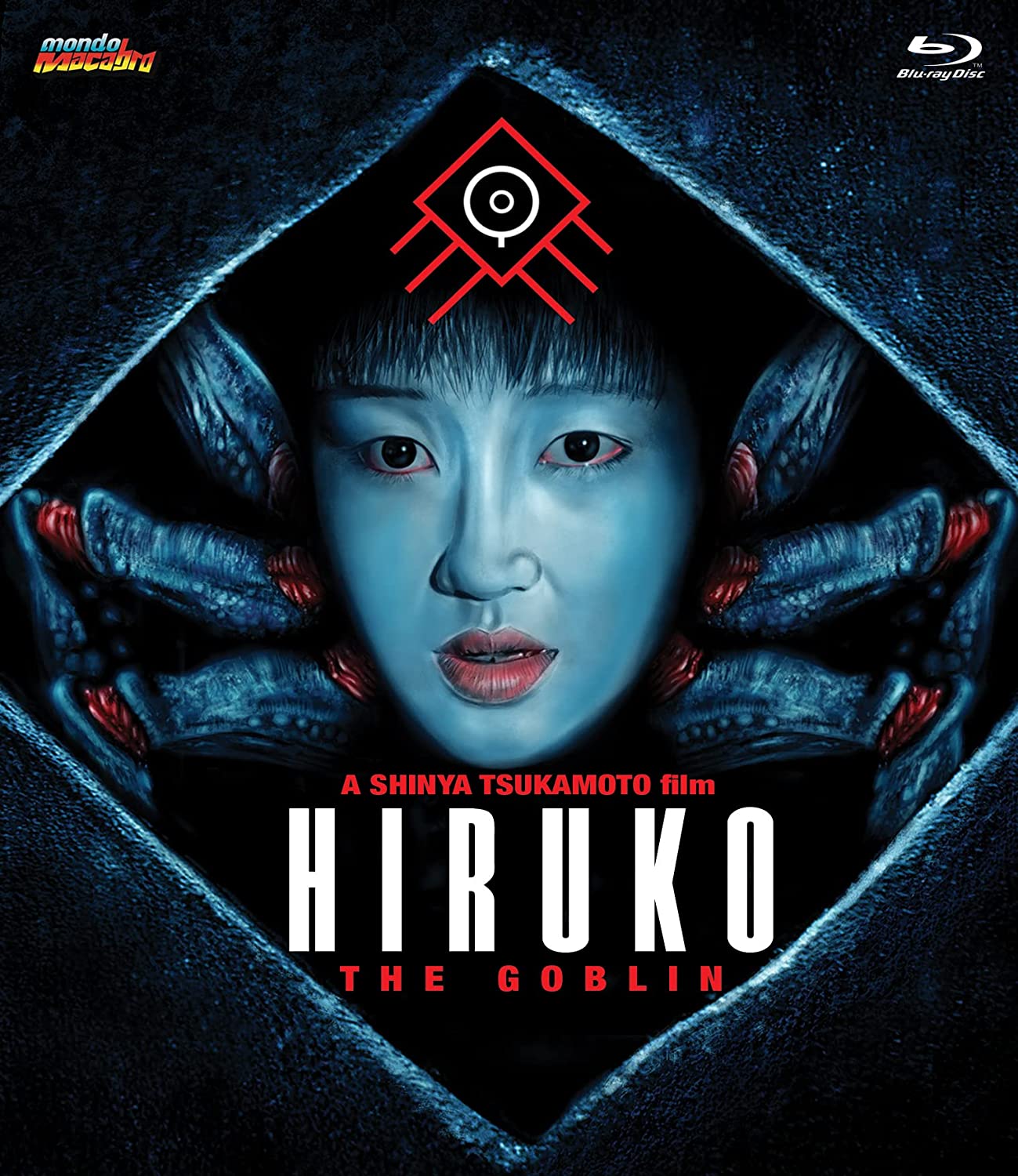
 Sandwiched between the futuristic tech-fetishism of his first two Tetsuo films, Tsukamoto Shinya’s sophomore feature, Hiruko the Goblin, roots its own body horror in Japan’s folkloric past. Set in the countryside, the film concerns the havoc wrought by a yokai spirit that possesses a schoolgirl, Reiko (Ueno Megumi), who then torments a classmate, Masao (Kudou Masaki), and the boy’s uncle, Reijirou (Sawada Kenji), an archeologist with an interest in the supernatural. As they investigate the girl’s bloody trail in order to find a way to banish the demon, increasingly grisly horrors befall our protagonists and their acquaintances.
Compared to the more thematically evocative material of the Tetsuo series, with their interest in Japan’s technological revolution and the implications of integrating machines with flesh, Hiruko the Goblin is at first glance almost all surface. There’s no central social commentary or transhumanist philosophy, only buckets of blood as Masao’s classmates are torn apart.
Severed heads abound, including Reiko’s, which soon turns ambulatory as it grows spider legs and insect wings akin to the monster in The Thing and regularly attacks people with a phallic tongue that coils and stabs. No one simply dies in this film, as their bodies are bent and twisted out of shape before erupting in blood, and eventually their corpses reanimate as gray-faced, insectoid heads that bob and wiggle as they tease our heroes. Masao himself also begins to suffer from strange ailments, most notably small, living faces that break out over his back.
In the absence of deeper meaning, Tsukamoto gives himself over to the propulsive stylistic bravado that he commanded behind the camera of Tetsuo: The Iron Man. Here we get POV shots of the demon rushing toward its prey in a manner similar to the so-called “Raimi Cam” disembodied tracking technique that Sam Raimi used for the first two Evil Dead movies.
Abrupt cuts to shots from sharp angles sustain a constant sense of claustrophobia even as the film regularly moves to larger and larger locations, from a narrow cave passage to school corridors to, finally, a vast underground network where Hiruko’s spirit dwelt. And in moments where Masao and Reijirou, overwhelmed by their fears, lose themselves in reverie, the predominantly dark and metallic color palette turns brighter as we’re dropped, say, in verdant fields, the characters’ mental state communicated by the blurred edges of the frame.
The film successfully fuses a number of styles and moods. The creature-feature horror rubs elbows with a bumbling buddy comedy, and the oppressively grim tone is complicated by strains of grief as Reijirou thinks of his late wife and Masao mourns the lose of his friends. There’s an earnestness to all this that elevates the film above shlock, and somehow the sight of the liberated souls of the dead, which resemble nothing less than giant sperm wiggling their way toward heaven, manages to be as moving as it is laughable. Hiruko the Goblin shows just how much Tsukamoto could do with a professional budget, particularly when it came to using special effects to expand the possibilities of distorting the human body beyond recognition.
Image/Sound
Sourced from a 2K restoration, this transfer does still betray some flaws inherent to the negative, particularly second-unit shots of the Japanese countryside, given their softness and instances of visible scratches. Nonetheless, the image is excellent overall, especially the dark, cramped interiors, where the black levels are always solid and the vibrantly aestheticized gore is rendered in exacting detail. Meanwhile, the mono track is a clean representation of the film’s boisterous and even mixing of dialogue, score, and oppressive sound effects.
Extras
Dutch critic Tom Mes contributes an audio commentary that can be more dryly factual than provocatively analytical but nonetheless offers a great deal of information about the cast and crew of the film and Tsukamoto Shinya’s larger filmography. New and archival interviews find the director reminiscing about the production, while a brief featurette on the special effects elaborates on the ins and outs of realizing the film’s spectacular-looking gore.
Overall
Mondo Macabro offers a solid HD presentation of Tsukamoto Shinya’s grisly, goofy second feature, which cemented his status as a new master of Japanese extremity.
Since 2001, we've brought you uncompromising, candid takes on the world of film, music, television, video games, theater, and more. Independently owned and operated publications like Slant have been hit hard in recent years, but we’re committed to keeping our content free and accessible—meaning no paywalls or fees.
If you like what we do, please consider subscribing to our Patreon or making a donation.