
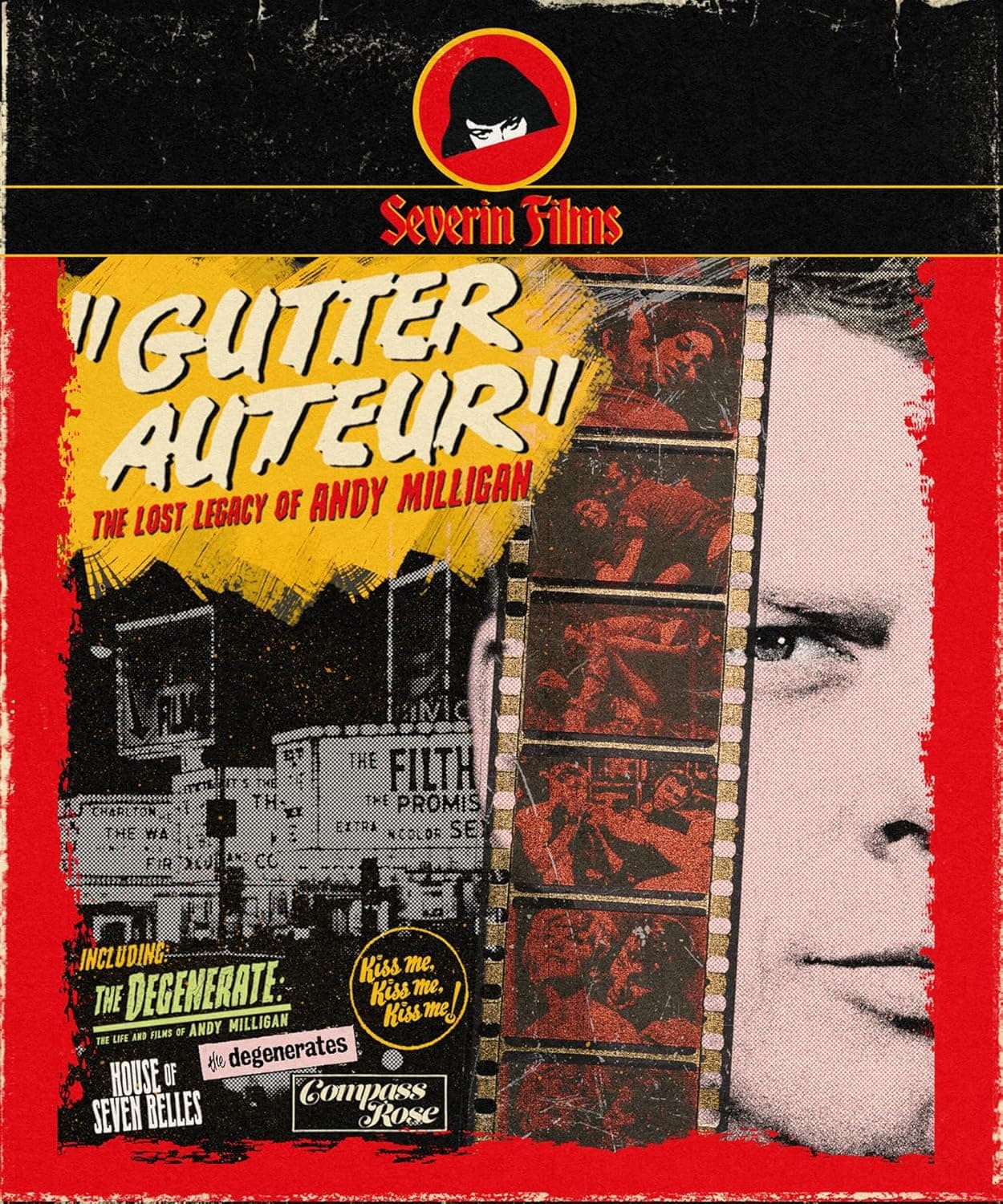
 Following 2021’s Dungeon of Andy Milligan, Severin Films’s Gutter Auteur: The Lost Legacy of Andy Milligan, which includes a feature-length documentary, as well as two recently discovered films and two rarely seen titles, is sure to be catnip for connoisseurs of the “Fassbinder of 42nd Street.”
The Degenerate: The Life and Films of Andy Milligan, from 2025, is a fascinating and ultimately quite moving tribute to the filmmaker that traces his life from his unhappy childhood in Minnesota to his death from AIDS in 1991. Along the way, we’re treated to some priceless early footage of Milligan acting on TV in the ’50s, before the film delves into his time writing and directing for off-off-Broadway theater, his involvement with exploitation producer William Mishkin, his frequent use of his Staten Island home as a multi-purpose location, and his ultimate relocation to Los Angeles in the mid ’80s. Testimony comes from members of Milligan’s core repertory company, other friends and business associates, and Jimmy McDonough, author of the essential biography The Ghastly One.
Milligan’s sole foray into science fiction, 1967’s The Degenerates, opens several years after a nuclear war has ravaged the U.S. Three soldiers (Robert Burgos, David Heine, and Vernon Newman) stumble upon a dilapidated and isolated farmhouse occupied by five sisters led by Violet (Bryarly Lee), a lesbian man-hater plagued by incestuous longings for her sister Rose (Susan Howard). The arrival of the men instigates an escalating battle of the sexes (a favorite Milligan theme) that leads to plenty of casualties.
Despite sadistically lording it over her sisters, Violet’s aversion to the menfolk proves warranted when one of them attempts rape to get what he wants. This results in an unforgettably brutal sequence that puts the film in another league entirely, a scene that deploys two of Milligan’s favorite flavors of ultraviolence: a pitchfork rudely inserted where it clearly doesn’t belong, and a makeshift crucifixion (shades of Martin Scorsese’s Boxcar Bertha).
Compass Rose, also from 1967, was never completed, likely owing to some truly atrocious audio issues. What remains is an intriguing double helix of a narrative. One thread deals with hustler Dewey (Anthony Moscini) getting on the wrong side of drug-addled actress Miss Gloria (Anne Linden), which culminates in a revenge-fueled sadomasochistic fever dream. The other is a surprisingly scabrous sendup of the “abstract theater” milieu Milligan knew so well, including some rare footage shot inside the Caffe Cino in the West Village.

The film’s withering highlight is the staging of a drag routine titled “The Soul of Linda Darnell” at the amusingly named Café de Fuhrer degenerates into a massive brawl. Drugs and relentless self-absorption, the film seems to suggest, are running the scene straight into the ground.
Released the following year, Kiss Me, Kiss Me, Kiss Me! definitely puts the psycho back into psychodrama. The film starts as a kitchen sink piece about a desperate dipso housewife (Natalie Rogers), bored with her brutish husband (Don Williams), who decides to put the moves on his best friend (Peter Ratray), before trying to torpedo the man’s budding romance with her husband’s sister (Joy Martin). Rogers dominates the proceedings with her portrait of a narcissistic and manipulative termagant, her outsized performance mirroring the character’s performative bent. Events, as they will in a Milligan film, soon spiral completely out of control, leading to a sordid orgy scene and multiple deaths.
Also unfinished, 1979’s House of the Seven Belles is a Southern Gothic potboiler set right after the Civil War that veers into horror, especially in its blood-soaked final 20 minutes. This film reuses the all-female family dynamics (and penchant for flower names) of The Degenerates, down to a scheming alpha female named Violet (Louise Schiumo). The narrative is extremely convoluted, perhaps inevitably given that it’s missing an opening, finale, and several scenes in the middle, but it’s rife with conspiracies, betrayals, rapine, and extreme violence. It’s a shame that Milligan hacked out an hour of an admittedly bloated 150-minute running time, footage that remains AWOL. Here’s hoping that, like two of the films in this fascinating and ridiculously entertaining set, that footage turns up in a vault or archive at some point.
Image/Sound
It’s hardly surprising that the AV quality of the films varies dramatically. The recent documentary, of course, looks just fine. The elements of the older films, often taken from archival theatrical prints, have been scanned and restored in 2K. The results, all things considered, are visually striking, despite the pervasive print damage. The moody monochrome of the 1960s films gives way to the livid color schemes of House of the Seven Belles.
Audio is another matter, a casualty of shooting on the optical soundtrack of a single-system Auricon camera. Compass Rose fares worst, with tinny dialogue, extreme distortions at times, and stretches left entirely MOS. Fortunately, all the films come with handy SDH subtitles.
Extras
Severin assembles over five hours of bonus materials for this set. An interview with Stephen Thrower, author of Nightmare USA, about each of the Andy Milligan titles are the most useful for a wealth of information on context and production histories. The Degenerates gets a commentary track from Milligan expert Alex DiSanto, who also turns up in a couple of other places. Elsewhere, we get compelling interviews with cast members, including a Q&A from the 2025 Tribeca Film Festival where the documentary premiered. There are some understandably deleted scenes from the doc that nevertheless have some intriguing things in them. An hour-long audio interview with Milligan from 1975 plays as a partial commentary on Kiss Me, Kiss Me, Kiss Me!, though it’s more of a career overview piece and isn’t at all specific to that film.
Overall
Severin’s Gutter Auteur box set gives us a thorough introduction to Andy Milligan’s life and work, as well as fascinating glimpses into a portion of his filmography previously thought lost.
Since 2001, we've brought you uncompromising, candid takes on the world of film, music, television, video games, theater, and more. Independently owned and operated publications like Slant have been hit hard in recent years, but we’re committed to keeping our content free and accessible—meaning no paywalls or fees.
If you like what we do, please consider subscribing to our Patreon or making a donation.


Great review! A correction: Anne Linden is not the star of COMPASS ROSE, she appears nowhere in the film, an unfortunate inaccuracy given emphasis in the boxed set extras despite visual evidence she is not in the film.