
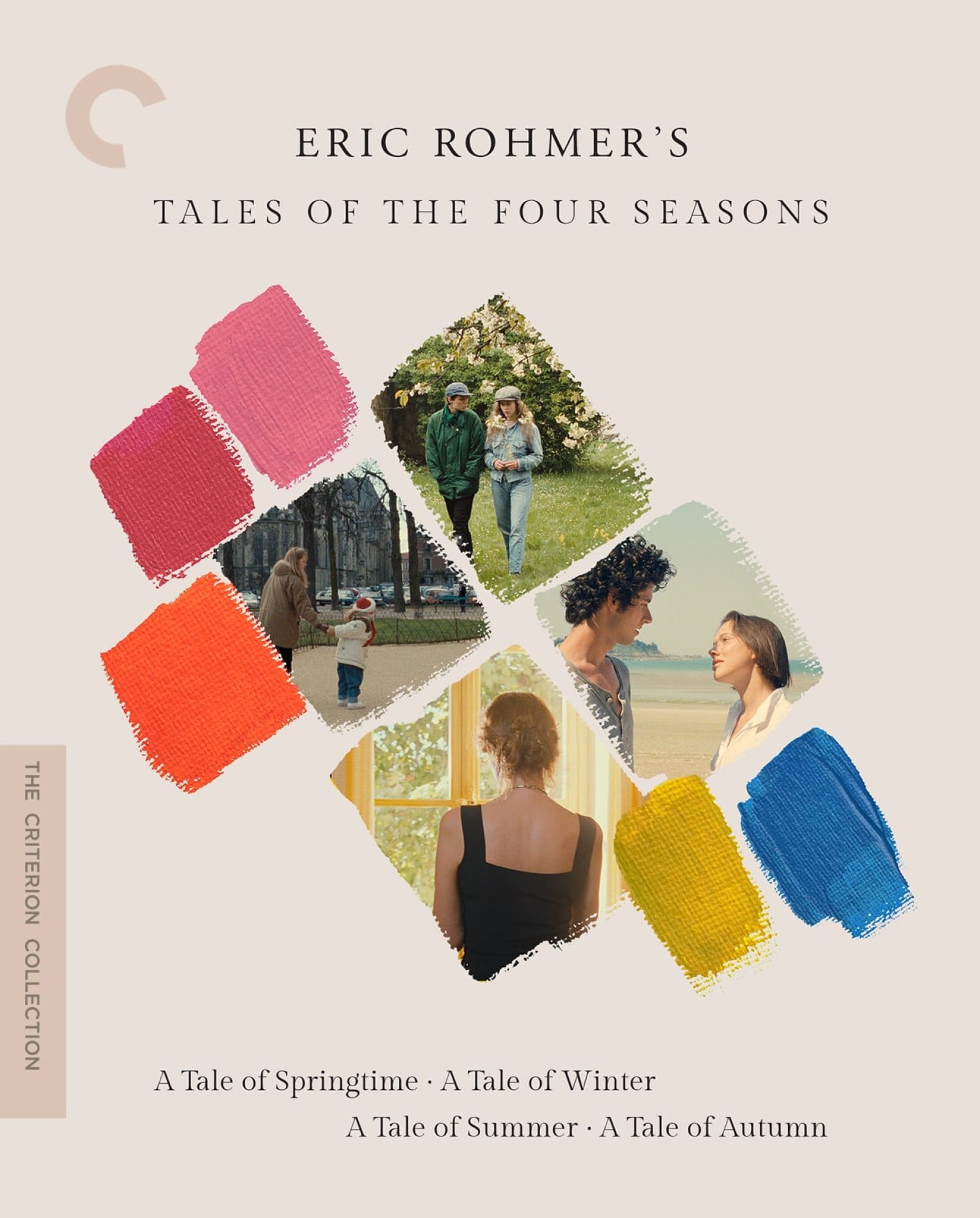
 Streaming now in various virtual cinemas in new restorations, Éric Rohmer’s “Tales of the Four Seasons,” the last of his three major film cycles, offers a fresh chance to consider the methods of one of cinema’s most quietly perceptive artists. Compared to his “Six Moral Tales” and “Comedies and Proverbs,” films that probed the strident yet misplaced confidence of young people as they attempt to find their place in the world, the “Tales of the Four Seasons” found Rohmer—70 years old the year that the first film in the series, 1990’s A Tale of Springtime, premiered—turning his attentions to middle-aged characters.
Perhaps for that reason, this is the most narratively driven cycle in Rohmer’s oeuvre, focusing on characters who may still show flashes of impertinence but generally have a far more solid grasp of self than the pseudo-intellectuals and flighty dreamers of his earlier work. This cycle foregrounds the romantic scheming that pervades Rohmer’s canon into a series of convoluted matchmaking games that act as a stealthy culmination of his prior film cycles and even his abiding interests as a critic and aesthete.
Some of these links are obvious, with Rohmer bringing back many of his favorite actors and including callbacks to the films in the “Six Moral Tales” and “Comedies and Proverbs” cycles. For one, Pascal’s wager, the philosophical debate that underpins Rohmer’s 1969 international breakthrough, My Night at Maud’s, is referenced in 1992’s A Tale of Winter, albeit with the wager’s theological concerns supplanted by romantic ones, with Félicie (Charlotte Véry) resolving to believe in true love and never get it than settle for anything less.
A Tale of Summer, from 1996, is the only film in the “Tales of the Four Seasons” series with a male protagonist and the only one fully focused on young characters, and it plays like a mirror image of 1983’s Pauline at the Beach, which followed an empathetic, wise-beyond-her-years teenage girl (played by Amanda Langlet). Here, the young lead is Gaspard (Melvil Poupaud), one of the few fully unsympathetic figures in Rohmer’s canon, and whose attempts to play the field strip Rohmer’s myriad romantic games down to their firmament of male insecurity.
Elsewhere, these films delve deeper into the director’s preoccupations. Rohmer, who co-wrote the first monograph on Alfred Hitchcock with fellow Cahiers du cinema critic turned filmmaker Claude Chabrol, long found ways to transpose the Master of Suspense’s style into the format of his talky dramedies. A Tale of Springtime is framed from the perspective of its protagonist, the newly single teacher Jeanne (Anne Teyssedre), that the narrative itself seems formless until it becomes clear that her overly friendly new acquaintance, the young Natacha (Florence Darel), is attempting to set the woman up with her father. Both that film and 1998’s A Tale of Autumn reflect some of Hitchcock’s themes in some of the downright Freudian undertones to the cross-pollination of platonic and romantic interests that the characters exhibit for each other.

Rohmer argued as a critic that cinema was the most totalizing art—the one most capable of synthesizing the others and of reflecting reality, and the films in the “Tales of Four Seasons” cycle represent some of his most visible attempts to wield architecture, painting, and literature as building blocks of film. Natacha’s apartment in A Tale of Springtime contains two giant, irremovable support pillars that hint at the futility of the girl’s fussy attempts to dictate the romantic futures of the adults in her life. In A Tale of Autumn, Rohmer and cinematographer Diane Baratier shoot the rustic vineyards of the Rhōne Valley with a supple glow worthy of the Impressionists (albeit with an almost surreal inclusion of a looming nuclear power plant tower in the deep background), while Félicie’s resolve toward her love life in A Tale of Winter is cemented by seeing a performance of Shakespeare’s A Winter’s Tale, itself a story about impossible fealty to an absent lover with an improbable but transcendent happy ending.
Compared to the more narratively open-ended “Six Moral Tales” and “Comedies and Proverbs” cycles, these four films tend to reach more definite conclusions, as in Gaspard running away from the mess he’s made in A Tale of Summer. If the “Six Moral Tales” found its characters attempting to live by convoluted moral codes and winding up stymied by their intransigence and the “Comedies and Proverbs” confronted its own protagonists with the chaos of real life, the “Tales of the Four Seasons” exist in a meeting point between the two, wherein characters who minutely plot their lives ultimately reconcile themselves to the things outside their control.
Even so, Rohmer offers up some of his most tender finales with the films in this cycle, be it the magical improbability of A Tale of Winter’s reunion or the gentle reconciliations and hope of A Tale of Autumn. He would make three more films after this series, each a period piece, but there’s an unmistakably valedictory tone to these films that feels like a fond farewell to his decades-long interest in the vagaries of modern romance.
Image/Sound
Each of the films looks gorgeous on the Criterion Collection’s transfers, which have been sourced from 2K restorations first exhibited in 2021. The distinctive, season-appropriate color and lighting schemes of each film are perfectly rendered, be it the glowing yellows and browns of A Tale of Autumn or the pale whites of A Tale of Winter. Detail, texture, and grain distribution are consistent across the transfers, giving each movie a filmic look and exceptional detail. The mono soundtracks are all well-balanced and privilege dialogue while leaving ample space for music cues and the immersive ambient sounds of the many exterior shots.
Extras
Criterion’s set comes with two early Éric Rohmer shorts: 1956’s “The Kreutzer Sonata,” a surprisingly dark trial run for his more buoyant later commentaries on male insecurity, and 1967’s “A Farmer in Montfaucon,” a documentary about a vanishing way of life in France’s agrarian countryside. There are also new interviews with crew from the “Tales of Four Seasons” films, including cinematographer Diane Baratier, producer Françoise Etchegaray, sound engineer Pascal Ribier, and editor Mary Stephen. Each reaffirms the deceptive simplicity of Rohmer’s work, sharing informative details about the precise standards of their contributions. Also included are archival interviews with Rohmer by critics Serge Daney and Michel Ciment, as well as a 2005 documentary on the making of A Tale of Summer that reflects on the film’s production and place in Rohmer’s canon. A booklet essay by critic Imogen Sara Smith places the films into the broader context of the director’s filmography and illustrates how they perpetuate and complicate thematic and visual motifs that Rohmer employed throughout his career.
Overall
Éric Rohmer’s wistful, sumptuously beautiful “Tales of Four Seasons” cycle receives a gorgeous box set from the Criterion Collection.
Since 2001, we've brought you uncompromising, candid takes on the world of film, music, television, video games, theater, and more. Independently owned and operated publications like Slant have been hit hard in recent years, but we’re committed to keeping our content free and accessible—meaning no paywalls or fees.
If you like what we do, please consider subscribing to our Patreon or making a donation.



Did you watch the Summer documentary all the way through? The subtitles seem to broken (as in, they just stop) roughly an hour into the movie.