Maïwenn’s Jeanne du Barry is a work without a unifying thesis. Born Jeanne Bécu in 1743, Louis XV’s favorite mistress (played as an adult by Maïwenn herself) was a courtesan who was elevated to a countess, and to the scandalized horror of the French court. At first, the film seems primed to deliver a send-up of courtly ritual and hypocritical noble decorum, à la Sofia Coppola’s Marie Antoinette. But like the real Countess du Barry, it’s eventually caught up in the very pomp and splendor that it initially lampoons.
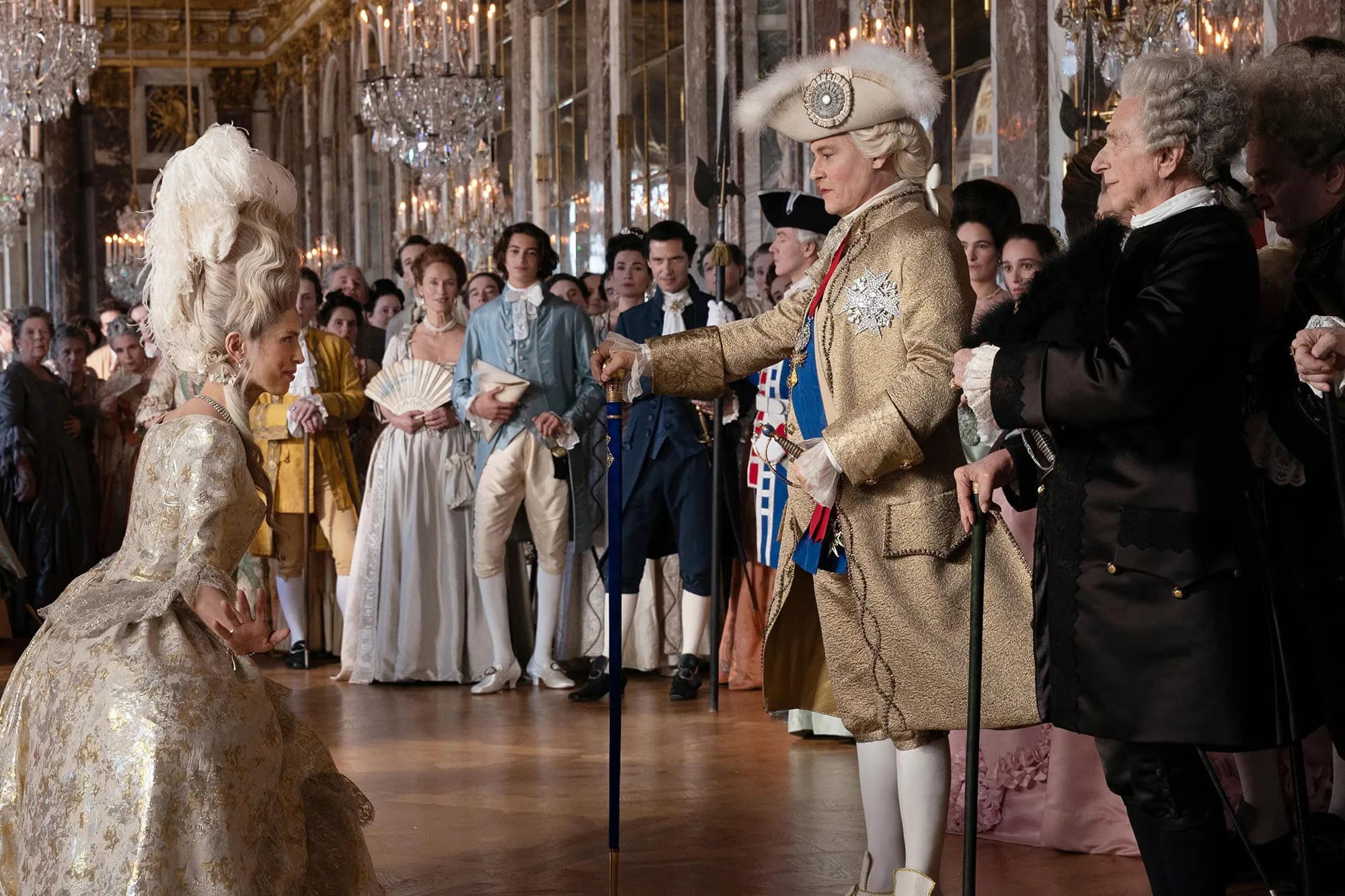
It’s in that initial, comical examination of court etiquette that Maïwenn’s film is at its strongest. When Jeanne, a courtesan favored by aristocrats who take her along to court, arrives at Versailles and is offered like livestock to Louis XV (Johnny Depp), we see through her eyes how the palace has turned every single action into a public display with elaborate rules.
Servants coach the woman in the precise way to bow to His Majesty, and a rule that no one must ever turn their back to the king leads to multiple farcical scenes of people backing out of rooms with a crablike scuttling motion. The film even details the insoluble contradictions of expectations surrounding the king’s mistresses, how he’s expected to have them but cannot sully his office unless the women have a noble title and, bafflingly, are married. Jeanne cannot help but laugh at such displays, and Maïwenn’s film heavily intimates that it’s her unguarded honesty toward the inanity of ritual that charms Louis in the first place.
But Maïwenn and co-screenwriters Teddy Lussi-Modeste and Nicolas Livecchi never build a larger critique on top of these observations, largely because they refuse to place Jeanne under a microscope. As the opening narration says of Jeanne being born to a common family and destined to live a worthless life, “Aren’t worthless women willing to do anything?” That promises a view of a woman who actively engineers a rise out of her circumstances, but at every turn Jeanne is seen as a passive, innocent bystander in her own life.

Jeanne doesn’t maneuver her way to court, as she’s simply brought there by her paramours, the Duke of Richelieu (Pierre Richard) and Count du Barry (Melvil Poupaud), and her flouting of etiquette is less a punkish gesture than a whimsicality freely indulged by the king as a means of alleviating the ennui of his regimented life. The film also sands away the countess’s negative attributes, such as her extravagant spending on the public’s dime, leaving the character a blank space in the middle of the frame, neither unwitting victim nor active schemer.
In the absence of either sly satire or earnestly reappraising character study, Jeanne du Barry defaults to a series of sumptuous images of Versailles’s grandeur, from the shimmering beauty of the Hall of Mirrors to the immaculately maintained gardens. Laurent Dailland’s cinematography takes more than a few pages from Stanley Kubrick’s Barry Lyndon, capturing the haze of dust that hangs in the air of vast social parlors or the flickers of amber candlelight illuminating the private chambers and hidden corridors used by the king and others for their illicit trysts. Nonetheless, the images lack the ironic counterpoint of substance that defines Barry Lyndon, making their depictions of life in Versailles a glittering end unto themselves.
The uncritical lens through which Jeanne du Barry views Jeanne reaches a nadir in the film’s coda, which entirely skips over the woman’s life in the wake of Louis’s death and her subsequent exile by Louis XVI. Only mentioned in passing is her execution during the French Revolution thanks to a denunciation by her Bengali slave, Zamor (Ibrahim Yaffa as a child and Djibril Djimo as an adult), who had been given to her as a literal plaything by Louis.
Outrageously, the narrator chalks up Zamor’s betrayal to spite. In reality, Zamor endured an adolescence marked by humiliation, becoming a card-carrying Jacobin who informed on his mistress. But because Jeanne du Barry indulges the ugliest kind of apologism for Jeanne’s ownership of Zamor, stressing her affection toward him and interest in his education, Zamor becomes yet another smoothed-over wrinkle in the film’s hollow portrayal of its subject.
Since 2001, we've brought you uncompromising, candid takes on the world of film, music, television, video games, theater, and more. Independently owned and operated publications like Slant have been hit hard in recent years, but we’re committed to keeping our content free and accessible—meaning no paywalls or fees.
If you like what we do, please consider subscribing to our Patreon or making a donation.