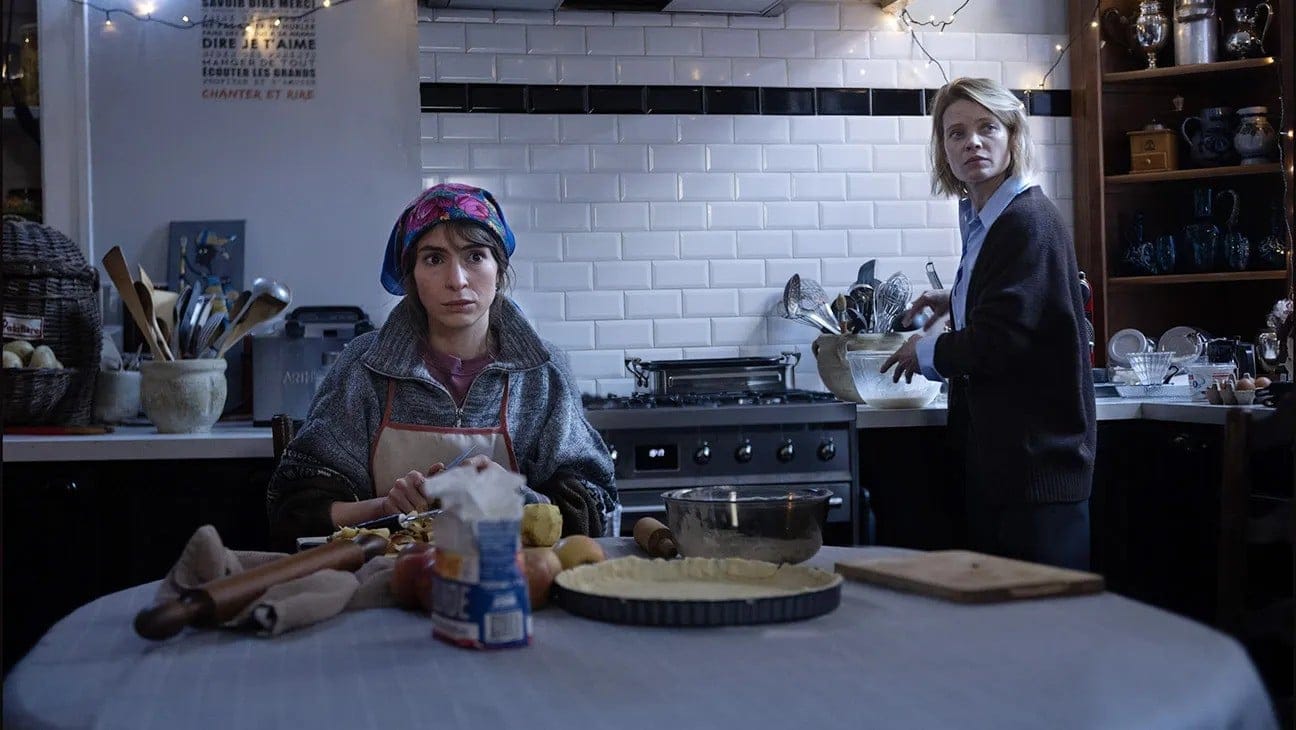
Radu Jude’s Diary of a Chambermaid is a self-proclaimed “variation on” Octave Mirbeau’s 1900 novel. The film follows Gianina (Ana Dumitrascu), a Romanian migrant worker employed as a housekeeper and nanny by a bourgeois bohemian couple, Pierre (Vincent Macaigne) and Marguerite (Mélanie Thierry), from Bordeaux. As she cooks, cleans, and cares for young Louen (Louen Bouteiller), Gianina looks forward to visiting Romania over the Christmas holidays to see her mother (Liliana Ghita) and nine-year-old daughter, Maria (Sofia Dragoman). The film’s diaristic structure doubles as a countdown to her departure.
Meanwhile, Gianina takes part in a community theater project that casts migrants as actors. What they’re rehearsing is, naturally, an adaptation of Mirbeau’s novel. Besides commenting on the source material, this adaptation within the adaptation allows Jude to take up his ongoing interrogation of history through reenactment, in this case by exploring how a provocation may be retold in order to scandalize anew, beyond its own historical moment. As to be expected from a director whose films have always openly grappled with Marxist tradition, history for Jude is never set in stone but continually reframed in light of the present.
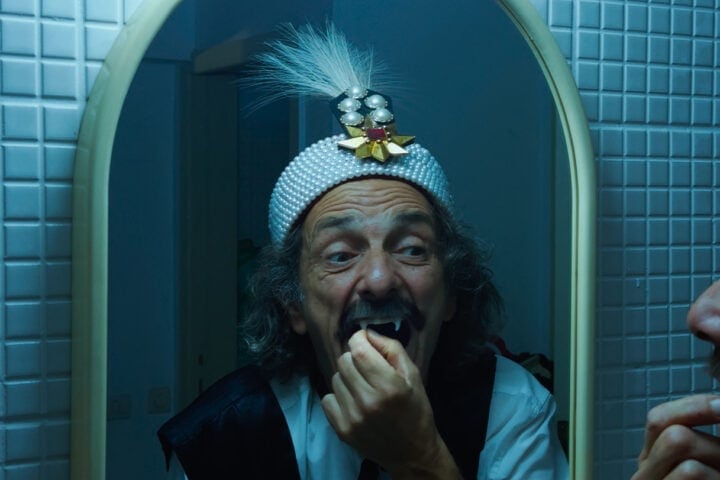
Jude’s Diary of a Chambermaid is an exuberant hodgepodge of genre modes, if not as aggressively anti-aesthetic as the bizarro A.I.-generated sequences in Dracula, or the homemade porno from Bad Luck Banging or Loony Porn. Much of the work we see Gianina engaged in is cleaning such long-standing cinematic metaphors as mirrors and windows. A casual self-reflexivity pervades the film, to point that characters state some of its themes outright, as in an early scene where Gianina visits Bordeaux’s famous reflecting pool while on a video call with Maria back in Romania. She says that there’s “a lot of beautiful buildings…and a lot of poverty especially among migrants from all over the world.”
Given the source material, a send-up of bourgeois hypocrisy is all but mandatory. The satire here is at its most caustic in a dinner-party scene where the guests demand Gianina’s opinion as an Eastern European on the war in Ukraine, even as she tops off their wine glasses. Unwilling to put her job at risk, she demurs. Meanwhile, they call her Janine and mistake Moldavia for Moldova. Jude has no love for the luxury radicalism of certain leftists, who agonize over having the “correct” position on the topic of the day but stop far short of taking concrete action.
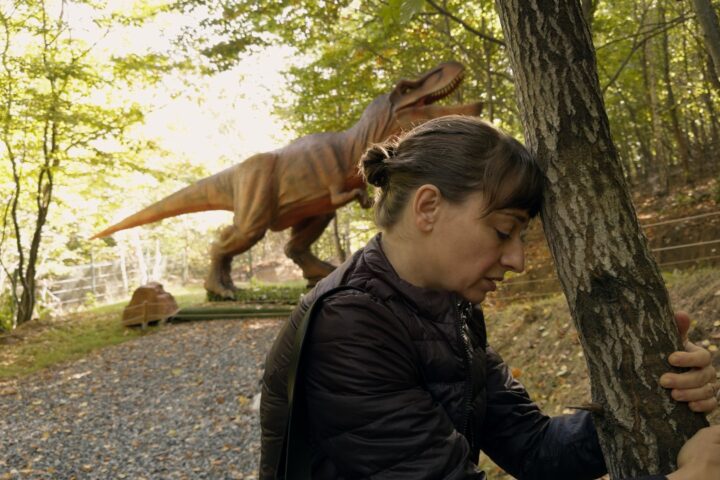
In contrast to the novel and its other film adaptations, most famously those by Jean Renoir and Luis Buñuel, Jude takes the emphasis off sexual power dynamics and marital disputes. More than anything, what Gianina’s employers extract from her is imaginative storytelling. This film’s centerpiece is a sequence where she tells a particularly morbid Romanian fairy tale. As she embroiders the story in voiceover, we get a lengthy montage of dilapidated structures and haunting Romanian landscapes—a stark contrast to the relative opulence of Bordeaux.
The influence of Brecht and Godard is plain to see, but any distancing effect is counterbalanced by Jude’s earthy black humor and especially by Gianina, who gives the film its strong emotional core. Forced to balance the demands of her own family with those of her employers, she curses them in Romanian under her breath, even as she shows a care for them that isn’t strictly mercenary. While Rude’s adaptation flirts with didacticism, its real theme—how motherhood, the vicissitudes of life, and even nostalgia for adversity are as much historical forces as architecture and class conflict—is concealed behind the bombast.
Diary of a Chambermaid transforms into a Christmas movie by the end, a seeming celebration of the spirit of generosity. And yet, as hinted by the closing shot of a Christmas ornament made to wink by a trick of the light, this storybook ending smacks too much of “happily ever after” to be taken at face value. And in an earlier scene, Marguerite praises Gianina’s storytelling ability but asks her to tack a happy ending on another of the fairy tales that the nanny tells Louen.
Jude is no stranger to choose-your-own-adventure endings, as we’ve seen in Bad Luck Banging or Loony Porn, and this film is, after all, a version among versions. Jude’s meta-ness is never just a postmodern gimmick, but a counter to the anesthetic brand of storytelling that powermongers have tried to dope us with since stories have existed. Like a magician who reveals how his trick was done, he challenges us not to be so easily appeased.
Since 2001, we've brought you uncompromising, candid takes on the world of film, music, television, video games, theater, and more. Independently owned and operated publications like Slant have been hit hard in recent years, but we’re committed to keeping our content free and accessible—meaning no paywalls or fees.
If you like what we do, please consider subscribing to our Patreon or making a donation.