With one foot planted in documentary exposé and the other in coming-of-age drama, Manas falls short of satisfying the demands of either genre. Character development takes a backseat to the film’s principal aim to raise awareness of child sexual abuse on the Brazilian island of Marajó, yet this very aim is let down by the insubstantial narrative.
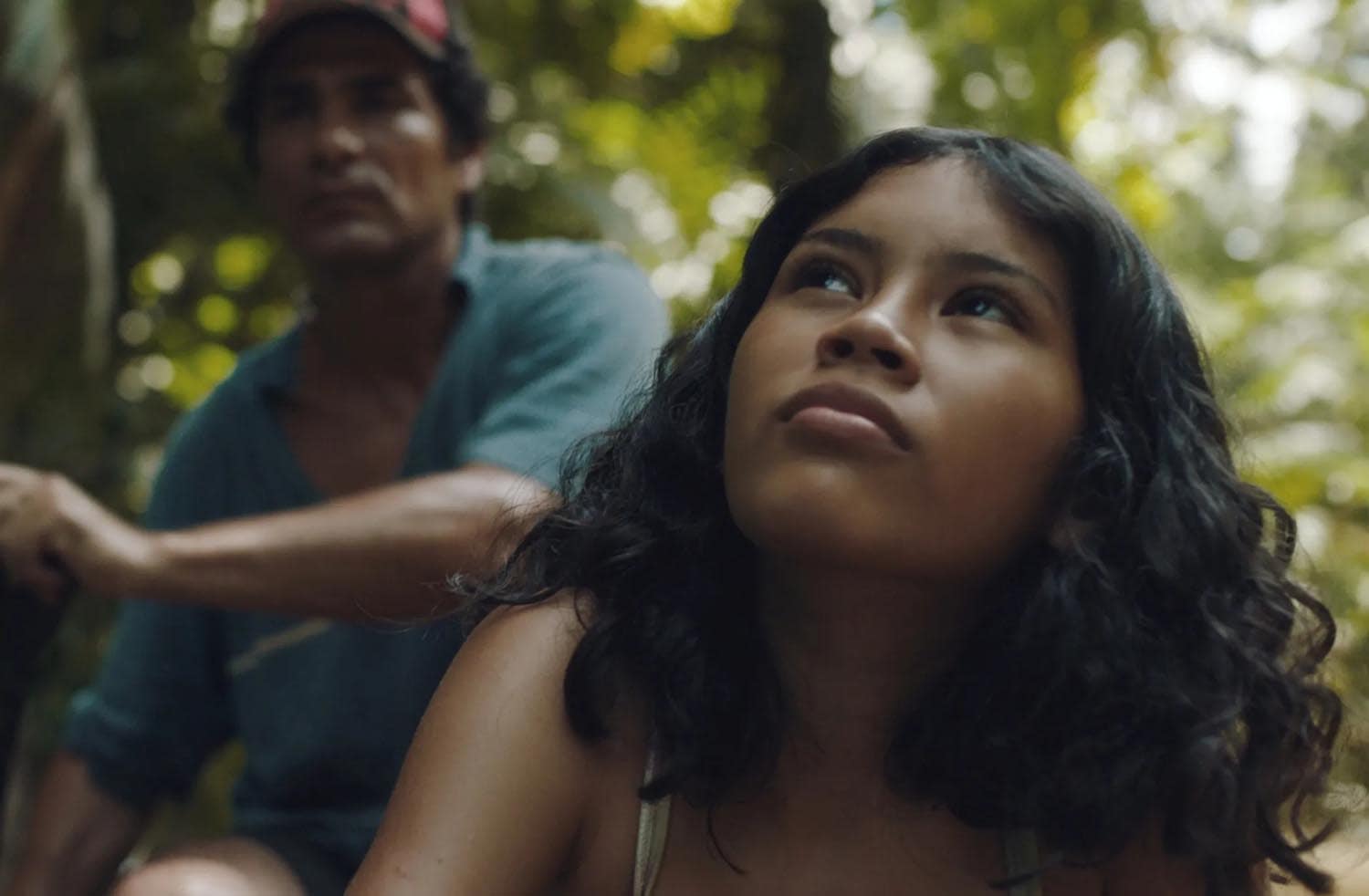
Directed by Marianna Brennand, Manas follows 13-year-old Tielle (Jamilli Correa), growing up on the riverbank with her pregnant mother Danielle (Fátima Macedo), her father Marcílio (Rōmulo Braga), and her siblings Carol (Emily Pantoja) and Danilio (Daniel Rodrigues). Marcílio starts bringing Tielle hunting in the jungle, exploiting their seclusion. Meanwhile, she joins her friend Cynthia (Samira Eloá) on visits to the river barges, the island’s only economic link to the wider world, where they are pressured into sex work.
Faced with the choice between abuse at the hands of her father and abuse on the barges, Tielle is catapulted mercilessly into the adult world. A police officer, Aretha (Dira Paes), attempts to extract her from the situation, but her efforts prove ineffectual. Tielle takes matters into her own hands when Marcílio begins taking her even younger Carol on hunting trips into the jungle.
Manas touches on the sociological aspects of the issue, albeit not as in-depth as a documentary could have done. For much of the film, it’s possible to assume that the story takes place several decades in the past; not until Tielle attempts to get a false ID under her older sister’s name do we see so much as a cellphone. The island’s culture is dominated by the church, which preaches obedience to family as the highest moral precept. The conditions are ready-made for abuse and exploitation. This outside-of-time-ness reflects not only the awareness of history that spells the end of Tielle’s childhood, but also Marajó’s conditions of isolation and poverty.
There isn’t much room in Brennand’s vision for contradiction or ambiguity. This is in large part a byproduct of perspective. It makes intuitive sense to center Tielle as a survivor, and Correa makes up for some of the script’s shortcomings with the pathos she brings to the role. But as a child, the character is largely at the whim of circumstance. While she’s seen sketching a couple of times, the intention seems less to show her creativity than to set up an unnecessary scene where Aretha asks Tielle to show her on a drawing where she was touched. Tielle has little to do in the film other than be victimized. She remains too much of a cipher to express the tension between knowledge and naïveté that coming-of-age stories hinge on.
There’s some potential for a character study of Danielle, who cares deeply for her daughters yet does little to protect them from her husband, or of Aretha, who, as a woman but also a representative of patriarchal state authority, strives to place Tielle out of harm’s way. But because their stories would be too thorny to reinforce the film’s message, these complexities are left unexplored. More so even than Tielle, they feel like archetypes as opposed to full characters.
Brennand favors the muted, foreboding light that presages a storm. Several shots in which the camera is half-submerged in murky water convey, by turns, feelings of concealment, freedom, and drowning. One arresting image isolates Danielle in the frame, flashing a rare smile over her shoulder at her daughter, as a tempestuous wind sets the blades of a windmill into a flurry behind her. Such shots stand out for being tethered to Tielle’s perspective. The majority, though, feel oddly impersonal, with a somber tonality verging on monotony.
Manas compels us to ask whether a film, and a fictional one at that, is really the most effective vehicle for raising awareness of this particular issue. As an art film, the intended audience doesn’t appear to be Marajó’s inhabitants themselves, whose stories were used, as an intertitle informs us, as the raw material for this narrative. And yet, judging by the film’s bold, even radical ending, Brennand isn’t asking anyone to step in on their behalf.
After Aretha’s intervention fails, Tielle puts the shooting skills she learned from her father to stop him, once and for all, from subjecting Carol to the same abuse. If sexual violence arises within the hierarchical structure of the family, only there can it be rooted out. It’s a shame that an ending with such radical implications rests on a flimsy foundation.
Since 2001, we've brought you uncompromising, candid takes on the world of film, music, television, video games, theater, and more. Independently owned and operated publications like Slant have been hit hard in recent years, but we’re committed to keeping our content free and accessible—meaning no paywalls or fees.
If you like what we do, please consider subscribing to our Patreon or making a donation.