“If it wasn’t for the hard work of a booster, most couldn’t go to the clubs that we’re used to,” rapped Boots Riley in his band the Coup’s 2006 song “I Love Boosters!” Two decades later, Riley again sings the praises of savvy shoplifters, now on film.
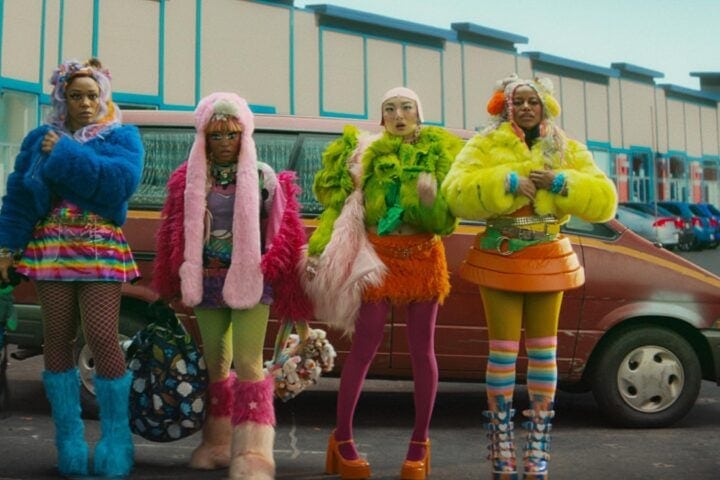
Riley might have dropped the exclamation point, yet the enthusiasm for what he sees as the booster’s “community service” is still unmistakable in his sophomore feature, I Love Boosters. This fantasia on leftist themes is an ecstatic tribute to a girl gang known as “Triple F” (which stands for “Fashion Forward Filanthropy”) as they bust up the Bay Area’s bougiest retailers. Their exploits begin to home in on a specific target, Demi Moore’s girlboss designer Christie Smith, whom group leader Corvette (Keke Palmer) admires and despises in equal measure.
But targeting the empire of Christie’s Metro Designer brand reveals just how far-reaching the tentacles of the capitalist class’s exploitative network can be. The scope and scale of I Love Boosters expand exponentially as the fashion industry’s global might flexes its power to crack down on Triple F’s coordinated theft. Riley’s film might bounce across mediums and genres, but the filmmaker’s maximalist, absurdist sensibilities remain a grounding force throughout. His ideologically inspired iconoclasm has the uncanny power to render the dynamics of contemporary labor relations both recognizable and surreal.
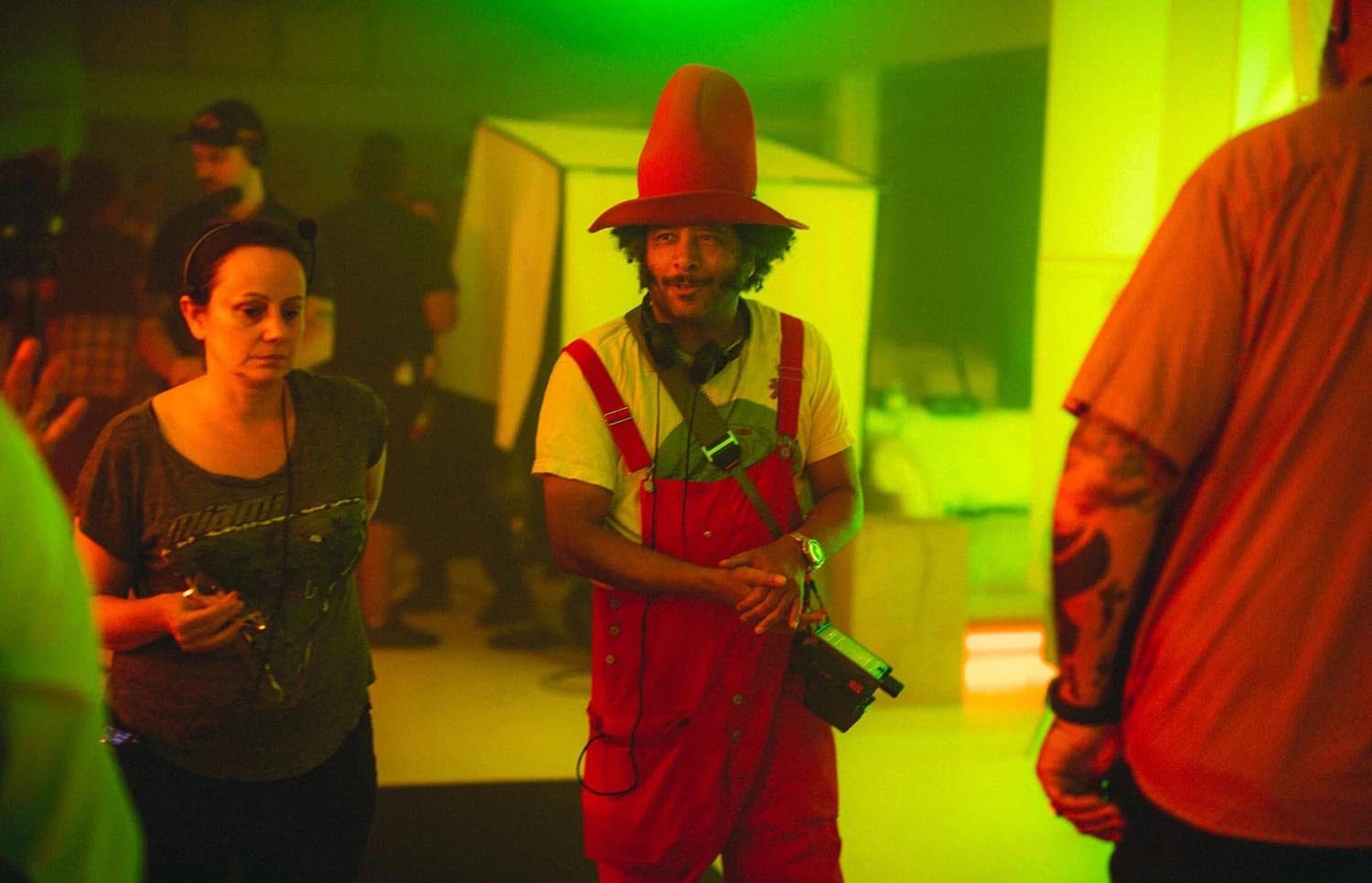
I spoke with Riley toward the tail end of a nationwide tour of I Love Boosters, which began in March with a world premiere at SXSW and—by his count—extended to 35 raucous screenings. Our talk covered how he views boosting as inherent to capitalism, why the task has traditionally been performed by women, and where he sees common ground with the villains of his projects.
I don’t know how plugged in you are, but there was just a big round of online discourse about “microlooting” and reframing how we think about the scale and direction of theft in our economy. How do you hope I Love Boosters contributes to these conversations about the invisible ways our economy is built on boosting?
I haven’t followed that discourse, but people have mentioned it to me. I know there have been some articles and stuff like that, so I don’t know if I can represent the different sides of the discourse correctly. I will say: I don’t think boosting is outside of capitalism. I think it’s part of it. I know that the way the capitalist class was able to come into being was through primitive accumulation. Any class, not just the bourgeoisie but also the ones before them, you have to start with a surplus of stuff in order to have power. You can’t just have the things that you have, like your house and all this stuff. They stole land. They stole labor. They stole minerals.
So, it’s not outside of the ethics of capitalism. As a matter of fact, it’s considered shrewd to get over on someone. Laws that stop people from getting over on other people are considered by libertarians to be egregious. I don’t think theft is outside of that. Do I think it’s a radical act? No. But do I think it’s something that, in this economy, people end up needing to do? Yes. And by this economy, I don’t mean this temporal economy. I mean, under capitalism.
You noted in your song “I Love Boosters!” that the task of boosting usually tends to be done by women…
I don’t know if it’s still that way. But, at the time, it was.

Well, all the boosters in your film are women, so I’m curious if you have any insights into why it tends to be gendered as a form of resistance to capitalism.
Again, it would only be guesses. I based this on particular women that I knew. Obviously, what happens in the film didn’t happen! But, also, it’s changed. For instance, in the Bay Area in the ’10s, which is like 10 years after I wrote my thing, a lot of the Rainbow Girls [a group that robbed luxury stores] were trans women. I think there’s a different kind of thing that has been happening. But, at the time when I wrote the song and for the 20 years before, there used to be booster squads of girls from different projects like Double Rock where they were all together.
Why was there a time when there were a lot of female nurses? There was a time when editing was all women, right? Certain things get thought of, maybe, and it becomes that sort of thing. I have a theory that, during my lifetime when it was popular, women would go a little bit more under the radar than men, especially for communities of color. That might be [it]. And maybe it had to do with the culture of shopping and who could blend in more.
The villains of your work are usually more institutional than individual in nature, so how do you approach writing a character like Christie Smith to ensure she doesn’t just feel like an avatar for ideology?
Well, a lot of my villains are saying shit I would say. When you talk about [characters like] Walter Goggins as the Hero [in Riley’s TV series I’m a Virgo], I’m giving them good arguments. Steve Lift [Armie Hammer’s C.E.O. character in Sorry to Bother You] might not be [me], because I wouldn’t be in that situation. But Christie Smith says stuff that I say about getting your vision across and how you do that. Don Cheadle’s character says some things that are true.
A lot of times, movements are trying to find a material basis for connection. That’s how you fight racism: People get into struggles together for this thing and understand how they need each other. But I have the guy with the pyramid scheme saying these things, because if I were going to do a pyramid scheme, I’d grab some of those arguments! We want to get to know someone, right? We don’t want to get to know 100 people. She’s not the only one. As a matter of fact, she works with a think tank. But I’ve got to have someone in the midst of that that we follow.
Since 2001, we've brought you uncompromising, candid takes on the world of film, music, television, video games, theater, and more. Independently owned and operated publications like Slant have been hit hard in recent years, but we’re committed to keeping our content free and accessible—meaning no paywalls or fees.
If you like what we do, please consider subscribing to our Patreon or making a donation.