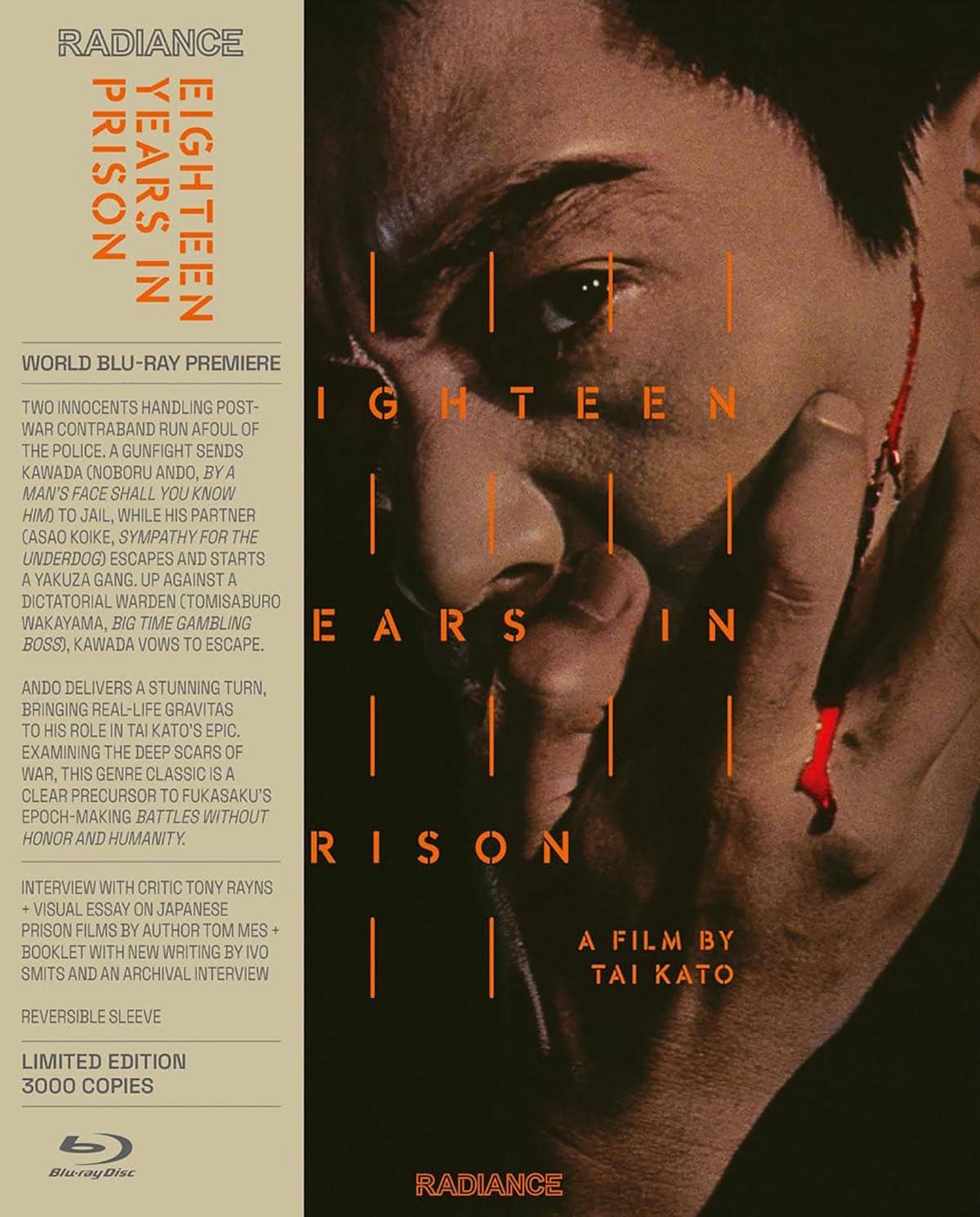
 The cramped and fragmented compositions of Kato Tai’s 1967 prison drama Eighteen Years in Prison speak to the stifling conditions of Japan in the years following its surrender in World War II. Opening in 1947 and spanning the course of nearly two decades, this unrelentingly bleak and violent film is deeply attuned to how a nation’s men seek to mend their collective wounded masculinity in the wake of a humiliating defeat on the world stage.
Even before Kawada (Andō Noboru), a former kamikaze officer, is imprisoned for stealing copper wire, one gets the sense that the filmmakers see little difference between life inside and outside of prison. American and Japanese officials alike are stealing food and supplies needed by the public, and the chaos and anxieties inherent to in post-war Japan can be felt in the ways in which the men here often collide with one another other as they make their way through the film’s constrictive spaces, suggesting rats in a crowded maze, all chasing the same piece of cheese.
Kawada and his friend Tsukada (Asao Koike) want to replace local black markets with a single, legal market run by families from their neighborhood. Even if this lofty goal is to be funded by money earned illicitly, it’s a potential means of restoring lawfulness to their community and prosperity to long-suffering families, many of whom lost their male providers in the war.
But when Kawada goes to jail, initially for five years, Tsukada gradually breaks bad, eventually deciding to create a red-light district while also working behind the scenes to prevent Kawada from being released from prison. For years, Kawada remains clueless of his friend’s betrayal as he goes on to fight for struggling vets behind bars—particularly the wild, young Kenichi (Kondō Masaomi)—and against the guards who rule their domain like fascist dictators.
The resulting drama is a illuminating study of a Japan divided, haunted by the brutality inflicted upon the nation’s people by war, as well as by their moral degradation in the wake of the economic miracle frequently rewarding the most ruthless. Kawada and Tsukada are on different sides of that divide but are never reduced to symbolic ciphers. Rather, the filmmakers present them as fully formed, tragic figures inevitably caught up in the sweeping changes of history.
While Tsukada is, in some ways, the film’s central villain, he’s but a cog in the amoral capitalist machine that tightened its grip on Japan through the 1950s—a survivor of “the ghost of a nation that lost the war.” In Katō’s film, most of the men really are ghosts of sorts, wandering about the cultural vacuum left by the devastations of war and its aftermath, trying either to reassert the fascistic, patriarchal pride and values of the pre-war regime or to sprint into an uncertain future, whose corrupted path is the only one visible after the fog of war has dissipated.
Image/Sound
Radiance’s HD transfer is rich in detail and features nuanced color balancing, with naturalistic skin tones and earthy colors befitting the film’s gritty look. There’s a slight amount of flickering and the occasional scratch present, but otherwise this is a strong visual presentation. The uncompressed mono audio nicely handles the oft-chaotic sound design in the numerous violent fights, shoot outs, and prison riots, and the dialogue is clear and crisp throughout.
Extras
In a new interview, critic and programmer Tony Rayns discusses Katō Tai’s career, paying particular attention to the films he made with star Andō Noboru. Most interestingly, he gets into how Andō volunteered for a suicide frogman unit during the war and later started a yakuza gang, all of which informed his screen persona. The disc also comes with a terrific video essay on Japanese prison films by author Tom Mes, who touches on early examples from the mid-to-late 1950s through to ’70s exploitation films like those in the Female Prisoner Scorpion series. The accompanying booklet includes an essay by Mes, who draws compelling connections between Katō, Kurosawa Akira, and Fukasaku Kinji, and an archival interview with Andō Noboru.
Overall
Radiance’s release of Katō Tai’s masterful 1967 prison film Eighteen Years in Prison shines a spotlight on the overlooked Japanese director.
Since 2001, we've brought you uncompromising, candid takes on the world of film, music, television, video games, theater, and more. Independently owned and operated publications like Slant have been hit hard in recent years, but we’re committed to keeping our content free and accessible—meaning no paywalls or fees.
If you like what we do, please consider subscribing to our Patreon or making a donation.