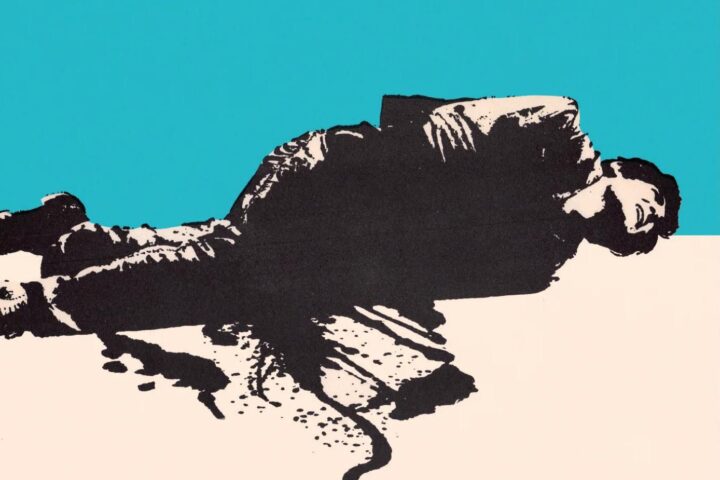
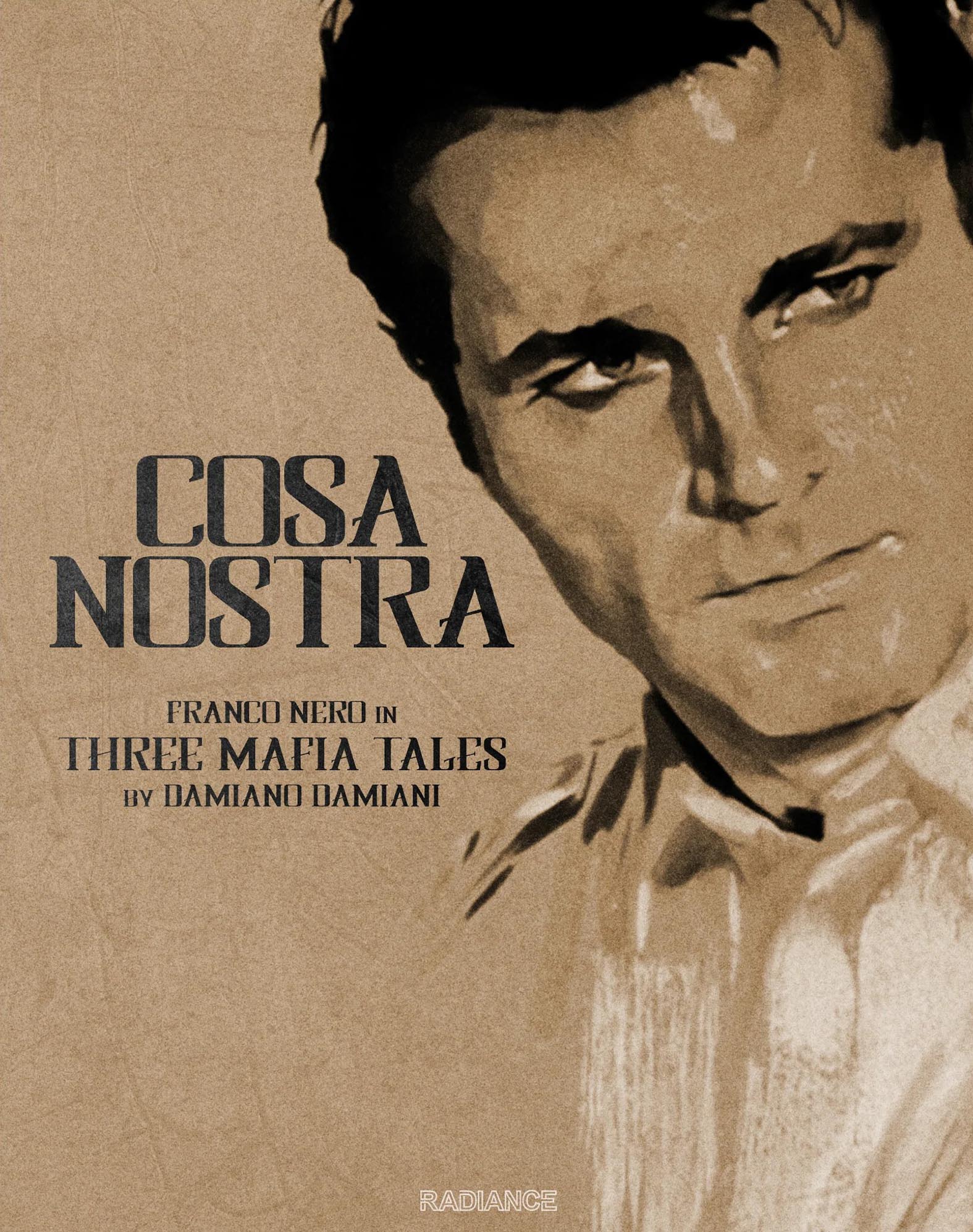
 If American filmgoers are at all aware of the work of filmmaker Damiano Damiani, it’s likely because of his deranged “Zapata western” A Bullet for the General, or else his bonkers horror sequel Amityville II: The Possession, which easily surpasses its more famous predecessor in sheer WTF factor. Neither of those films are necessarily indicative of Damiani’s serious-minded approach to the titles included in Radiance Films’s Cosa Nostra: Franco Nero in Three Mafia Tales by Damiano Damiani, but they do illustrate Damiani’s determination to pepper his works with pungent social commentary. The three films in this new box set may illuminate very different aspects of the mafia’s tentacular grip on Sicilian society, but they’re united in their bleak, often hopeless diagnoses of these social ills.
The Day of the Owl, from 1968, pits carabiniere Captain Bellodi (Nero) against mafia boss Don Mariano Arena (Lee J. Cobb) when a trucker hauling a load of cement to a highway construction site is murdered. One of the issues the film raises along the way concerns the shoddy nature of these public works, erected out of little more than “mud and dung” (as one character puts it), and thereby prone to collapse. So it should come as no surprise that the building contracts, the construction workers, and the choice of materials are all firmly under Arena’s thumb. The film also explicitly—and daringly for the time—emphasizes Arena’s complicity with the conservative Christian Democrat party that dominated Italian politics from 1946 until 1981.
Damiani’s film inhabits an intriguingly muddled moral middle ground. An outsider from the north, and something of a crusader, the seemingly upright Bellodi shows that he isn’t above using unconventional (not to mention unethical) means to turn low level mafiosi against each other. His methods include forging confessions, misleading witnesses, and tampering with evidence. One casualty of Bellodi’s quixotic quest to arrest Arena is Rosa Nicolosi (Claudia Cardinale), the wife of the sole witness to the shooting (who’s since gone missing). Bellodi alternately bullies and cajoles Rosa into providing evidence. At the same time, she endures shunning by the locals, who are ruled by the Sicilian code of silence.
The Day of the Owl underscores the connection between its antagonists by positioning their residences on opposite sides of the central piazza. This allows Damiani to indulge in one of his favorite visual motifs: the act of voyeurism. Here that’s exemplified by the way Bellodi openly spies on Arena with binoculars, a form of surveillance that’s ironically reversed in the film’s downbeat coda when Arena turns his own spyglass on the captain’s quarters, only to reveal that there’s a different man altogether occupying the room. Bellodi’s reckless idealism and unchecked hubris has brought about his downfall. Things return to the status quo. Nothing, The Day of the Owl suggests, can ever really change in such a corrupt environment.
The Case Is Closed: Forget It, from 1971, takes on the justice system. Architect Vanzi (Nero) is thrown behind bars when he’s accused of having committed a hit-and-run. The bourgeois Vanzi initially holds himself aloof from his uncouth fellow prisoners, though he does evince some sympathy for terminally ill Campoloni (Georges Wilson), the lifer who shows him the ropes. Conversely, the unhinged Biro (John Steiner)—a cold-blooded killer who figures prominently in the film’s most disturbing scene—takes an immediate dislike to Vanzi’s condescending attitude. Pretty soon, Vanzi has no problem taking advantage of his resources to upgrade his rations and, in a surprising move for a supposedly happy family man, procuring the services of a prostitute.
The film’s mafia angle only comes into focus during its second half when Vanzi moves into the cell of mistrustful Pesenti (Riccardo Cucciolla), who’s anxiously awaiting the time when he can testify against fellow prisoner and ranking mafioso Salvatore Rosa (Claudio Nicastro). Details about what Pesenti has on Rosa, however, are only vaguely sketched in throughout The Case Is Closed, so as not to get in the way of the rising action. At the same time, Damiani’s proclivity for voyeurism manifests itself in frequent shots of cell door peepholes, which the guards use to monitor the prisoners at all hours. So it’s ironic that no one happens to be looking when Biro and his gang barge into Pesenti’s cell and “suicide” him while Vanzi looks on helplessly.
This tragic episode prompts The Case Is Closed’s climactic moral dilemma: whether Vanzi will keep quiet about what he’s seen in order to guarantee his release from prison. As the rather cynical title of Damiani’s film should indicate, that, in fact, proves to be the case. The Case Is Closed ends with Nero playing against his usual heroic type, however flawed that may be, as Vanzi shows no regret over his decision, even in the face of indignant interrogation by Pesenti’s daughter, Sabina (Renata Zamengo). For Damiani, Vanzi represents the middle class’s ruthless instinct for self-preservation regardless of cost or consequence.

How to Kill a Judge, from 1975, goes self-reflexive with its story of Giacomo Solaris (Nero), a socially conscious filmmaker whose most recent film, Inquest at the Courthouse, implicates a Palermo magistrate, Alberto Traini-Luiz (Marco Guglielmi), in judicial misconduct. An early scene shows the judge watching Solaris’s movie, indicating the play of reality and fiction in Damiani’s film, not least of which since it was inspired by the actual murder of a judge who Damiani had based a character on in his 1971 film Confessions of a Police Captain. What’s more, Damiani shoots Inquest at the Courthouse in a broadly expressionistic style—all wide angles, bold colors, and histrionic sets—that’s markedly different than his usual docudrama technique.
Damiani’s film spends a lot of time introducing its sizeable cast of characters and outlining their various interrelationships. The judge’s untimely assassination sends ripples out among the city’s political bigwigs as well as its midlevel mafiosi, who are, as in The Day of the Owl, closely linked with the construction business. As How to Kill a Judge progresses, it begins to zero in on the fraught relationship between Solaris and the judge’s widow, Antonia (Françoise Fabian): Antagonistic at first, as you might expect, it eventually settles into an uneasy détente after Solaris comes to her assistance on several occasions. What’s particularly fascinating is the way the film ultimately conflates the political and the personal in its ballsy resolution.
Like its predecessors, How to Kill a Judge concludes with the restoration of order, which, as in The Day of the Owl, means the sway of conservative politicians and the continued infiltration of the mafia into every aspect of Sicilian society. For Damiani, the reach of organized crime is so multifaceted, which accounts for the title of his groundbreaking early ’80s television show The Octopus. Like any expert ethical diagnostician, Damiani knows just the right sort of questions to ask. He also knows better than to offer any but the most tentative of answers. In the three films collected here, those answers practically reek of despair and an abiding sense of futility.
Image/Sound
All three films come with brand new 2K restorations sourced from the original camera negatives, and the results are quite impressive, even given The Case Is Closed: Forget It’s deliberately drab and often murky look. All three films boast vibrant colors are vibrant and sturdy grain levels. When it comes to audio, Day of the Owl is available in two different cuts, with the Italian-language version running about six minutes longer. Both versions sport Master Audio 2.0 mixes, whereas the other two films come with Italian and English LPCM 2.0 tracks.
The English dub of How to Kill a Judge contains bits that switch to Italian, a viewing experience familiar to anyone who’s watched the longer cut of Dario Argento’s Deep Red. Generally speaking, the Italian dubs sound more robust, which especially counts when it comes to the engaging scores by Giovanni Fusco, Ennio Morricone, and Riz Ortolani. Then again, by going with the Italian option you miss out on Lee J. Cobb’s blustery delivery in The Day of the Owl, as well as Franco Nero dubbing himself in How to Kill a Judge.
Extras
Radiance’s extras go a long way toward providing the context necessary to understanding the social commentary embedded in Damiano Damiani’s work. Each film comes with a new interview with Franco Nero, who reminisces about his relationship with Damiani, relates production anecdotes, and talks about the reception and legacy of the individual films.
Two archival making-of documentaries offer contributions from cast and crew members talking about The Day of the Owl and The Case Is Close: Forget It, respectively. A 2017 episode of the Belgian TV show Hep Taxi! features Claudia Cardinale discussing her life, loves, and film work from the backseat of, yes, a taxi. In the featurette “Identity Crime-Sis,” Italian crime film expert Mike Malloy anatomizes the Italian crime genre into three strands—action-focused, star-driven, and highbrow—and explores the influence of The Day of the Owl on the third variety.
Elsewhere, filmmaker Howard S. Berger contributes an eloquent video essay covering Lee J. Cobb’s career here and abroad, and indicates how the specter of his naming names to HUAC haunted his later work. Critic Rachael Nisbet provides a thorough overview of Damiani’s life and work, while author Alberto Pezzotta zeroes in on his crime films and their pervasive influence. Filmmaker David Cairns offers an incisively close reading of How to Kill a Judge. Last but hardly least, there’s a copiously illustrated 120-page book featuring essays on the films, an appreciation of their scores, an archival interview with Damiani, a short bio of Franco Nero, an article on the Italian cinema politico movement, and a critical overview of all three films.
Overall
This box set draws some much-needed attention to Damiano Damiani’s often overlooked work.
Since 2001, we've brought you uncompromising, candid takes on the world of film, music, television, video games, theater, and more. Independently owned and operated publications like Slant have been hit hard in recent years, but we’re committed to keeping our content free and accessible—meaning no paywalls or fees.
If you like what we do, please consider subscribing to our Patreon or making a donation.