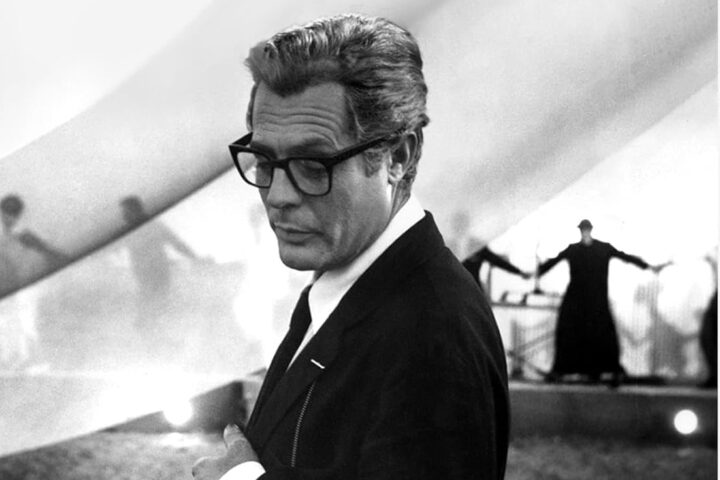
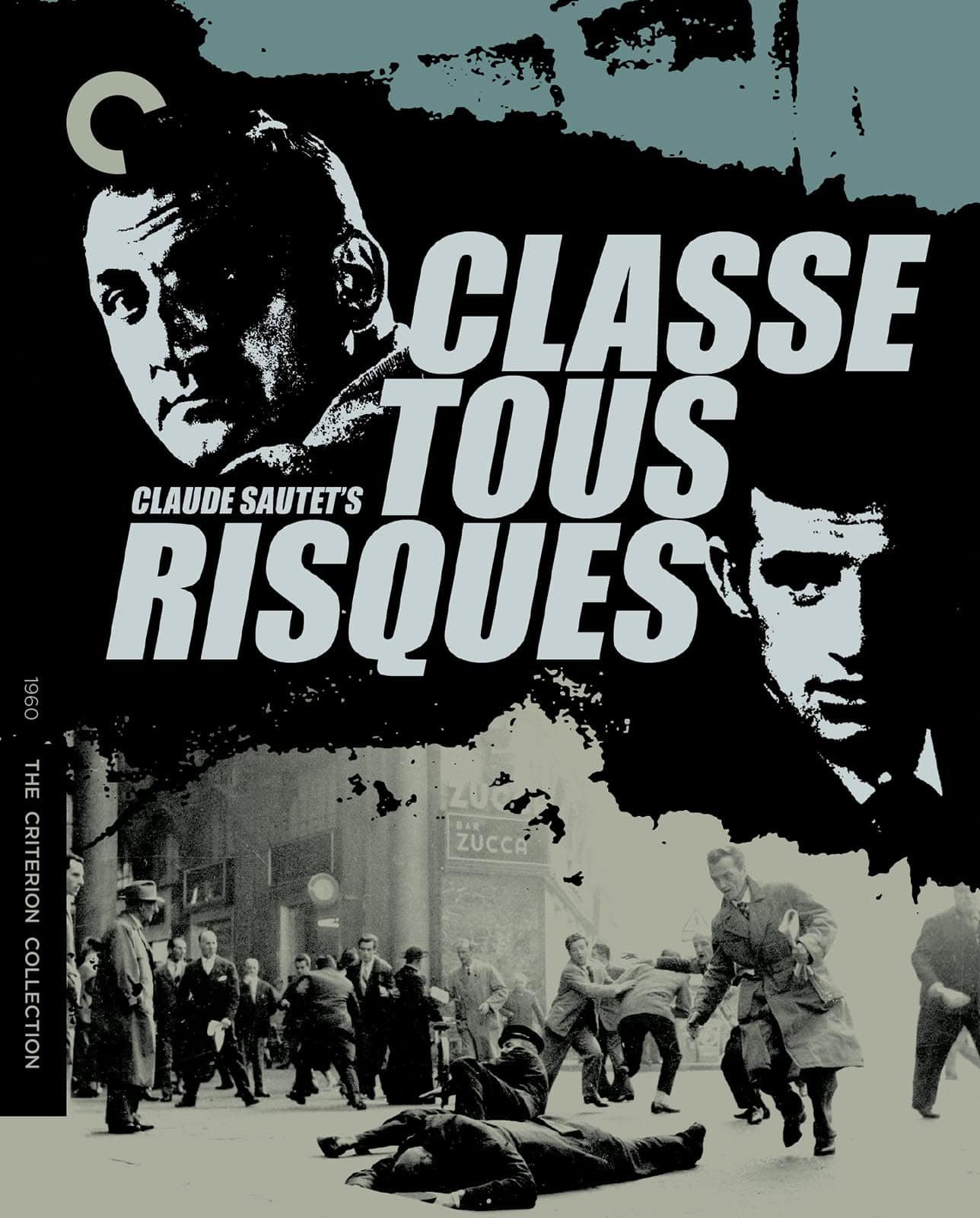
 Following hopeless fugitive Abel Davos (Lino Ventura) as he sneaks his way from Milan to Paris with wife (Simone France) and children in tow, Claude Sautet’s first major film adopts some of the mood and energy from American crime movies but—like a handful of French films before and after it—tries to endow the genre with a conscience. Responsibility to friends and family humanizes even the most heartless, and Classe Tous Risques takes as its subject the masculine codes of honor that are upheld and broken by those who dare to live outside the law.
Sautet is notable for his aversion to ostentation. Having begun as a highly respected assistant director in the 1950s, known for fixing the weak spots in a script and taking the reins from inept filmmakers (François Truffaut once called him the “mender of French cinema”), he made a name for himself as a skilled and competent craftsman. Against the two great superstars of the French New Wave, both of whom made their debuts right around the time Classe Tous Risques was released, he had neither the stylistic flair nor the youthful preoccupations to hold his own.
What anchored Sautet’s films wasn’t the Nouvelle Vague’s cinephilia or ideology, but rather the ordinary human concerns he found at the center of big genre constructions like the criminal underworld or the comic ménage a trois. For him, even the fantasies of genre were subject to the cruel disappointments of real life. And looking back at what I’ve seen of this unsung oeuvre, what strikes me are the affinities linking works as disparate as his first gangster film and the not-quite-romantic dramas for which he later became famous.
Consider the lovely César and Rosalie, which was a hit for Sautet in 1972, and the intriguingly understated, mostly unarticulated passion of Nelly and Monsieur Arnaud, which in 1995 became his swan song. Both films introduce an amiable, well-liked man (Yves Montand in the former, Michel Serrault in the latter) in the autumn of his years falling in love with a young woman. And both are leisurely paced and visually sunny but also characterized by midlife male frustration. This fascination with aging—with the male’s stumbling transition from one self to another, milder, less free self—can be found in Classe Tous Risques, where Davos must face up to the responsibilities of a grown man just as the sins of his youth are catching up with him.
In contrast to the sympathy Sautet extends to the men in César and Nelly, the women remain about as enigmatic as the trio of female characters in Classe Tous Risques. Defined by the vagueness of their whims, they’re gauzily emotional, steely and unknowable, as if Sautet were paralyzed by the thought of having to enter a woman’s psychology. Accordingly, the representations of and attitudes toward love in these films are uniformly ambivalent, and remarkable for being neither condescending to that emotion nor confined by its intensity. When Davos—almost at the end of his rope—takes time to fall in love with a random chambermaid, the plot twist serves as nothing more than an evanescent moment of grace, requiring minimal dramatization and no further explanation. Even at the end, love is possible, though it’s clear that it won’t absolve anyone’s sins or compensate for the greatest human weaknesses.
While Sautet’s films profess to be grounded in and conflicted over adult fears and dilemmas, there’s still something inexplicably remote about them. In César and Rosalie, the lack of intimacy we feel toward the characters allows us to buy into the central love triangle’s frequent and absurd rearrangements. But in Classe Tous Risques’s case, this remove becomes an impediment, keeping the film just out of reach of the ranks of Touchez Pas au Grisbi, Rififi, and Bob le Flambeur, even in the moments when it thrills and moves us.
In the effort to avoid melodrama—a difficult act to pull off with those children in jeopardy—Classe Tous Risques sometimes feels stiff and stifled rather than suave. There’s no scene here comparable to the grudging tenderness of Jean Gabin and his best friend sharing a hotel room, or the twinkle in Roger Duchesne’s eyes when he acts as a father figure to a duo of street kids—no scene that gives us a feel for the genuineness of the gangster’s heart of gold and the depth of his family crisis, while also revealing the thug’s capacity for brutishness.

Davos is great for his role and instantly relatable, his iconic face exuding more life-size decency than movie-size courage or charisma. But here he’s largely incapable of communicating the sorrowfulness of a Humphrey Bogart or the humor of a Gabin—qualities that make a cliché-ridden genre come alive with inner drama. It’s Jean-Paul Belmondo, with his mixture of toughness, seduction, and angelic innocence, who emerges as the film’s most alluring element as Eric Stark, even as Sautet’s elliptical style keeps the character mostly inscrutable. As the hapless hero’s saving grace, Belmondo (fresh off a star-making turn in Breathless) offers the perfect foil to Ventura. More or less at peace with the contradictory extremes of criminal life, he’s as suave as any of the great men of noir, and separate from all the film’s middle-aged hand-wringing.
Sautet’s vision was able to recognize human fragility without turning soft, and was willing to accept the ultimate dissatisfaction in relationships and social life. Where the rules of love fail the characters in Sautet’s later romances, the unforgiving nature of adult society and the irresoluteness of male friendship are what lead Davos to his inescapable destiny. These darker, more personal undercurrents can easily go unnoticed when Classe Tous Risques is lumped with other pre-New Wave crime flicks, and when César and Nelly are marketed to appeal to the middle-brow tastes Truffaut famously ridiculed in his rants against “la qualité française,” along with the kind of movies that now get exiled to Blockbuster’s foreign section.
If a director as subtle and sophisticated as Sautet still fails to inspire much excitement, it’s because he was always, in the words of Jonathan Rosenbaum, aesthetically conservative, even as he tried to breathe new life into tired old formulas. His Classe Tous Risques isn’t as cold-blooded or urgently told as the finest Hollywood noirs, or as boldly atmospheric as a Jean-Pierre Melville film, or even as entertaining as Alberto Lattuada’s wonderful Italian gangster comedy Mafioso, just recently released on Criterion, which shares the same juxtaposition of the demands of domestic, private life with the relentless pull of the underworld.
But one trick that Sautet quietly pioneered in both Classe Tous Risques and his later romances is sure to leave a deep impression on anyone interested in taking a closer look at the parallels in his work. His great trademark is a harsh narrative brevity: deaths and separations and ends of relationships coming so unceremoniously that they reveal the swiftness with which life’s changes can occur. In Sautet’s world, as in ours, people depart without warning, without proper goodbyes. And at the end of Classe Tous Risques, Davos, too, has vanished like an afterthought of the camera, perhaps no luckier or more tragic than the rest of us.
Image/Sound
The Criterion Collection’s transfer of a new 4K digital restoration of the film looks magnificent, with the image remaining consistently sharp and boasting impressive depth. The image detail is particularly impressive, as evidenced by the minute fascial textures in close-ups. Meanwhile, grain is tight and even, retaining a pleasingly filmlike look, with Dolby Vision HDR allowing for a wide range of grays and strong black levels. The uncompressed mono audio is robust enough to give action sequences a nice punch, while the dialogue is crystal clear throughout.
Extras
The meager extras included have all been ported over from Criterion’s 2008 DVD, starting with brief excerpts from the 2003 documentary Claude Sautet or the Invisible Magic. Sautet discusses his work as a first assistant director, and how working with subpar directors and bad scripts gave him the confidence to direct. In a separate interview, Classe Tous Risques author and co-screenwriter José Giovanni talks openly about his time on death row and how one of the inmates he met inspired the character of Abel Davos, played by Lino Ventura in the film. There are also a handful of archival interview clips with Ventura, who gives his thoughts about being typecast as a gangster, his need for realism in the films he chooses to act in, and his fondness for playing loners. Rounding out the package is a booklet that includes a 1962 tribute by Jean-Pierre Melville, an interview with Sautet, and archival essays by filmmakers Betrand Tavernier and N.T. Binh that praise Sautet’s refined, stripped-down style.
Overall
While it’s slim on extras, Criterion’s new release of Claude Sautet’s doom-laden debut feature boasts an absolutely gorgeous new 4K transfer.
Since 2001, we've brought you uncompromising, candid takes on the world of film, music, television, video games, theater, and more. Independently owned and operated publications like Slant have been hit hard in recent years, but we’re committed to keeping our content free and accessible—meaning no paywalls or fees.
If you like what we do, please consider subscribing to our Patreon or making a donation.