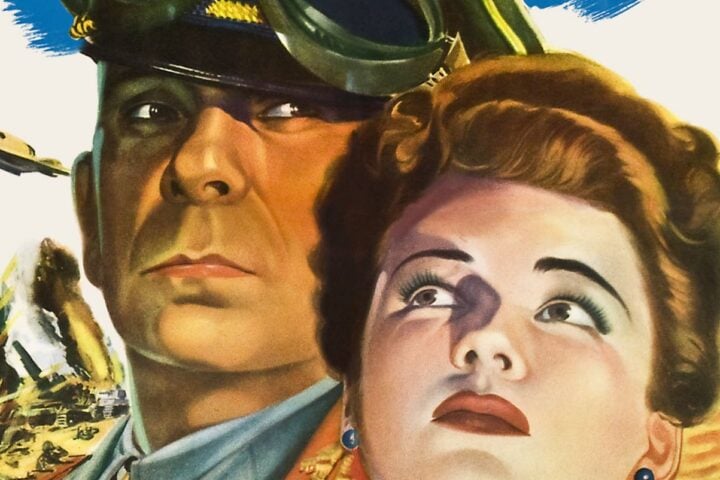
Jules Dassin’s Brute Force scrambles the trajectory of the traditional noir film, which is often driven by lust and the fear of downfall. By contrast, this seminal 1947 production is set in a prison and features characters who are already paying for their indiscretions. Rather than standing front-and-center as individualistic antiheroes, they co-exist collectively as a rogues’ gallery of convicts, with occasional flashbacks that offer several ostensible noir narratives in miniature, in which the men break the law for glamour, money and women, or take risks for more noble measures—differing actions which all lead to a cramped cell with unlikely parole or escape. Brute Force is driven less by fear than by resignation and stasis, which collectively threaten to ignite wrath.
This wrath has another ingredient: the hypocrisy of the prison and society at large, which favors, as in real life, the proletariat sector for punishment. The enforcer of this prison, Chief Munsey (Hume Cronyn), pits the prisoners against one another so that he may hurt them for acting out according to his manipulations. He’s an overcompensating sadist, a small man with a Napoleon complex, which is pitilessly underscored in an early image that contrasts Munsey with Joe Collins (Burt Lancaster), a supernaturally statuesque prisoner. As Munsey taunts Collins in the prison yard, it’s obscenely obvious that Munsey’s Nazi-esque uniform is all that allows him to threaten his prey without retaliation. Society trumps natural selection in this case, and no one is more alert to this irony than Munsey, who revels in the role reversal. It’s the craving for such power that drove him to the prison industry to begin with, as a good-hearted, drunken doctor, Walters (Art Smith), poignantly insists late in the film.
Munsey might not be the warden, whom the filmmakers also despise, but he’s the prototype for many cinematic wardens, who are usually portrayed in American prison films as cowardly politicians with a bloodlust they gratify from afar, via their henchmen. By contrast, Munsey isn’t afraid to get his hands dirty—a tendency that gives him stature even if the character is contemptible. Munsey’s essentially understood to be a member of the proletariat himself, though he’s cannier than the protagonists and ruthless about ascending the social ladder. Dassin, the famed producer and journalist Mark Hellinger, and screenwriter Richard Brooks were all leftists, and they project onto Munsey their resentments of the authoritarian societies that were recently quashed in World War II (in which they served), and which were then rising in the United States in the form of various hard-right anticommunist measures. (Dassin was blacklisted in 1949 during the production of Night and the City.)
Though the politics of Brute Force can seem pat now, the notion of a prison as a corrosive extension of a corrupt society packed considerable heat, especially given production codes that forbade criticism of authority. Yes, Brute Force has a sentimentality that seems to be baked into the prison genre, and to the point that you may find yourself asking: Couldn’t just one of the prisoners have committed an authentically awful crime that challenged the filmmakers’ ideology? But the film’s sense of place, of violence, and of profound bitterness remain unshakable, even compared to the many modern productions that it has clearly inspired.
Dassin’s direction is terse, compact, and matter of fact. The geometry of the prison, the passage of time, and the gradations of power among the prisoners and guards are established via elegant long takes, and much of the film is an ongoing feast of close-ups and bodies, crouched among one another, that suggest some uncanny fusion of realism and cubism. Dassin captures both the constriction of this life and the weird comfort that the prisoners must find in order to function, especially in the shots of Collins and his fellow cellmates hunched over a card game while plotting escape. And while his methods are more severe, one can imagine Robert Bresson drawing on this film’s iconography for his extraordinary A Man Escaped.
Collins and his men aren’t entirely soft-soaped either, as they kill one of Munsey’s informers with surprising mercilessness in a set piece that’s staged by Dassin with an unsettling mixture of expressionism and docudramatic flair. The setting of the killing is a prison factory, and the sounds of metal pounding metal are symphonic, suggesting a death dirge. A distraction is staged, drawing the guards, while Collins’s friends stalk the man with blowtorches until he falls into a machine press. At that moment, they embrace the lure of dehumanized mass power—of the fascism that also intoxicates Munsey and his men.
This lure is also evident when Munsey beats a man unconscious with a phallic club, explicitly deriving sexual pleasure from his power. Dehumanization, even if it’s more understandable, also figures into the film’s even more violent climax, as the prisoners revolt against Munsey and his collaborators, moving in enraged, geometric waves that echo the corridors of their hell. Munsey mans a machine gun on top of the central tower of the prison, finally asserting his latent will to kill openly, even while his power goes up in literal flames. It’s difficult to find imagery of such comparably brutal, resonant, graphic power in other Hollywood films of this time—Howard Hawks’s Scarface might come closest—and the mixture of blunt savagery and symbolic suggestion retains a nightmarish pull. These images transcend any singular theme to tap the subconscious fears of oppression and subsequent destabilization that rise to the forefront of the mind, especially as society flirts again with fascism.
Image/Sound
As text at the beginning of the film and in the liner notes inform us, the new 4K digital restoration of Brute Force used elements from multiple sources, “primarily a 35mm nitrate fine-grain master positive from the British Film Institute and a safety duplicate negative.” The results are very impressive, especially in terms of image depth, which is of intrinsic importance to a film concerned with establishing a sense of confinement. The floors, walls, and bars of the prison really pop here. Facial details and postures are also superbly rendered, and are equally invaluable in conveying character relationships, reflecting Jules Dassin’s intense interest in actors and propensity for fashioning direct and pared imagery. (The blacks, especially shadows, are also quite sharp.) The monaural soundtrack is generally detailed and healthy, particularly supporting the many subtle diegetic sounds that establish the drudgery of the prison’s work details, such as the machine pressing factory and the drain pipe.
Extras
These supplements are all archival, though they still provide valuable context on the creation on reception of Brute Force. Most valuable is the audio commentary by film historians James Ursini and Alain Silver, coauthors of The Film Noir Reader and The Noir Style, that was recorded for the 2007 Criterion Collection DVD of the film. Ursini and Silver offer a general overview of the careers of Dassin and especially of producer-journalist Mark Hellinger, who was syndicated in hundreds of newspapers and hired by Warner Bros. and later Universal Pictures to bring his voice to a variety of projects, including Robert Siodmak’s The Killers and Dassin’s subsequent The Naked City, the latter of which he narrated.
The commentary also covers Hellinger’s leftist politics, which were shared by Dassin, who co-founded the Actors’ Laboratory Theatre, which included Brute Force actor Hume Cronyn and many other performers who appeared in the film. These politics would get many of these artists in trouble as anti-communist fervor gripped the country, both with the government and, in the case of Brute Force, with Joseph Breen, the head of Motion Picture Association of American Production Code, who objected to the film’s violence and anti-authoritarianism. Some of the letters between Hellinger and Breen, whose passive-aggression chillingly parallels the behavior of Brute Force’s chief villain, are included in the disc’s liner notes.
In another featurette, produced in 2006, criminologist Paul Mason discusses the tropes of prison movies while alluding to the relationship between the media and the prison complex in real life—an idea that could’ve been plumbed at greater length. In an episode from the Criterion Channel series Observations on Film Art, film theorist and historian David Bordwell compares the various acting styles on display in Brute Force, complementing some of the thoughts that Ursini and Silver proffer in their commentary. The theatrical trailer, a stills gallery, an essay by film critic Michael Atkinson, and an archive Saturday Evening Post profile of Hellinger round out the package. Atkinson’s discussion of the meaning of noir in our society is a must-read with several unforgettable sentiments, such as “the American dream as such is a tissue of propaganda, a lie invented for crowd control.”
Overall
The supplements may not be new, but they’re still meaty, and the 4K restoration accentuates the brutal, beautiful punch of an essential noir.
Since 2001, we've brought you uncompromising, candid takes on the world of film, music, television, video games, theater, and more. Independently owned and operated publications like Slant have been hit hard in recent years, but we’re committed to keeping our content free and accessible—meaning no paywalls or fees.
If you like what we do, please consider subscribing to our Patreon or making a donation.