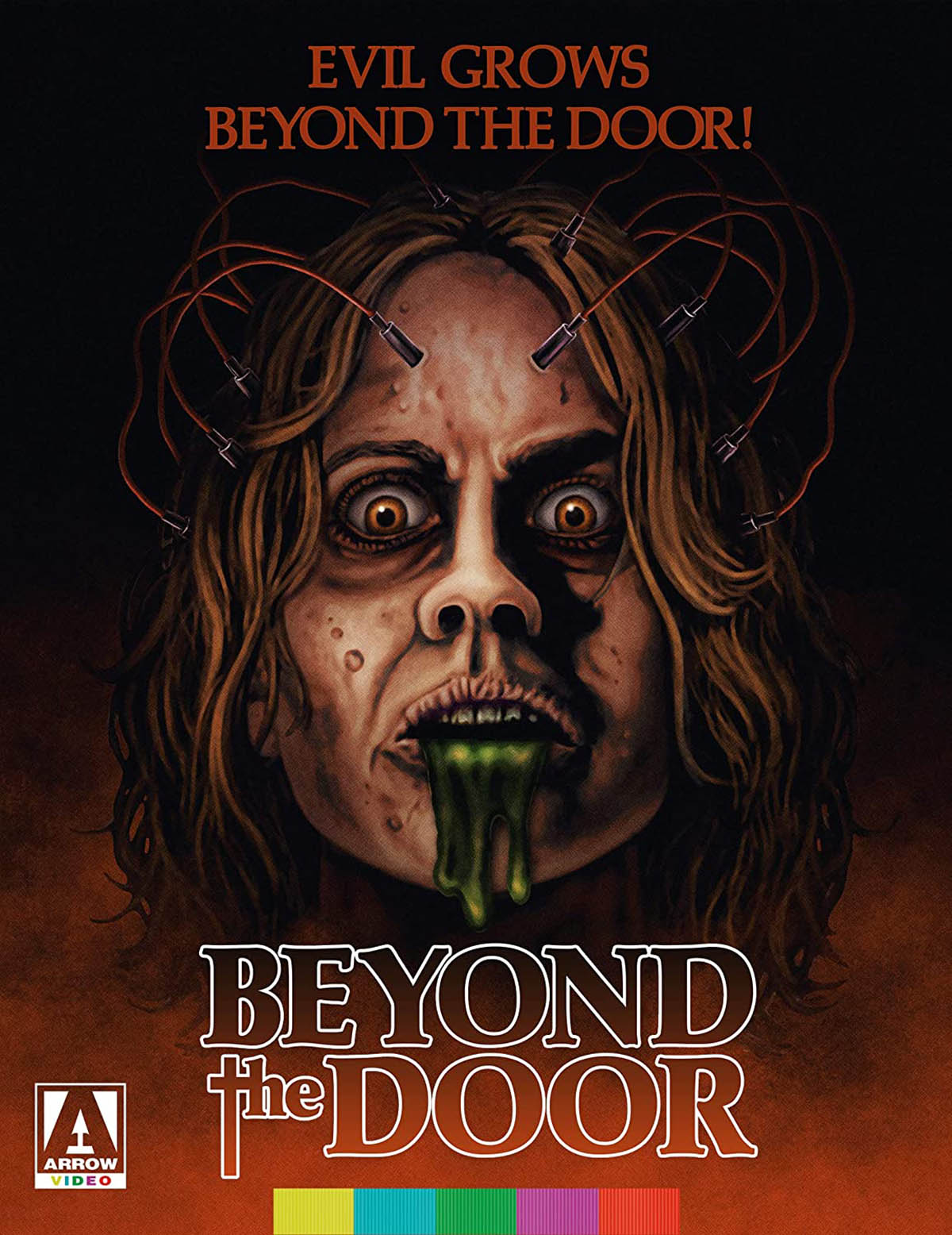
 Routinely dismissed as a shameless rip-off of William Friedkin’s The Exorcist, Ovidio G. Assonitis’s Beyond the Door is actually an unhinged spin on the parental satanic panic of Roman Polanski’s Rosemary’s Baby, with iconic elements (levitation and regurgitated pea soup) lifted from Friedkin’s film. But its narrative arc owes little to either classic, boasting all the demented throwaway gags and surreal non sequiturs you expect from ’70s-era Italian exploitation films. That’s evident from the opening, in which a requisite naked satanic sacrifice is both presided over and narrated by Old Nick himself. This scene then abruptly dissolves into a music studio where a jazz-funk combo lays down a sizzling track titled “Bargain with the Devil.”
The family unit at the center of the film is quickly sketched in, their personality traits largely defined by their quirks. Music executive Robert Barrett (Gabriele Lavia) spends most of his time at work in the studio, leaving his wife, Jessica (Juliet Mills), to deal with their two children: Ken (David Colin Jr.), who’s typically seen slurping Campbell’s pea soup through a straw straight from the can (his obsession extends to a Warholian painting of a soup can that hangs over his bed), and the older Gail (Barbara Fiorini), who carries around multiple copies of Erich Segal’s Love Story and comes on like a cross between a foul-mouthed sailor and a blissed-out hippie, much like the female protagonist of Segal’s novel.
Jessica’s unanticipated pregnancy is announced in close proximity to Ken’s birthday party, establishing an initially subliminal connection between the boy and the spectral events that will soon unfold, a proximity the film continues to mine throughout. As if on cue, Jessica’s child develops at an alarmingly fast rate, accompanied by the usual hallucinations and poltergeist activity, along with some incidental attrition suffered by Robert’s prize aquarium. In these scenes, Beyond the Door seems closer to Carrie in its link between female sexuality and psychic phenomena than to Rosemary’s Baby and its pervasive aura of parental paranoia.
Two of Beyond the Door’s most memorable set pieces have absolutely no connection to any previous film. In the first, Robert is harassed by an itinerant gang of street musicians, including one fellow who plays a wooden flute with his nose. Shot on the hilly streets of San Francisco, this scene just goes on and on, taking up what seems like two solid minutes of screen time, until it becomes absolutely hilarious in its sheer superfluity. The other scene sees the children threatened by glowing-eyed dolls (presaging Poltergeist) until their entire bedroom starts tilting and shaking, an impressive bit of special effects work from Wally Gentleman, who had previously worked on Stanley Kubrick’s 2001: A Space Odyssey.
In its final act, Beyond the Door comes to most closely resemble The Exorcist. But the finale actually throws viewers a double curveball. The diabolical plan of a mysterious figure, Dmitri (Richard Johnson), seen haunting the edges of the film for much of its running time, proves to a Luciferian lure to trap his soul. In the final twist, it turns out that young Ken may have been the diabolical orchestrator of these uncanny happenings all along. One of the most interesting aspects of Beyond the Door has to do with the ways the storyline both hews close to, and radically diverges from, its supposed “source material,” as well as the evocative echoes of other films, prior and subsequent to its release, that crop up along the way.
Image/Sound
Arrow Video presents two different cuts of Beyond the Door on this home-video edition, each housed on its own Blu-ray disc. The extended uncut version has undergone a 2K restoration from the original camera negative. It looks excellent for the most part, especially during the daylight street scenes filmed on location in San Francisco. Darker scenes, like the opening Satanic ritual, tend to have some chunk evident in their grain levels. Colors are vibrant throughout, with the brightly lit scenes revealing a decent bit of clarity and fine detail. The shorter U.S. theatrical version has sections unique to that cut spliced in from a 35mm print, so there’s a change in image quality evident in those scenes, but the transfer looks more than passable overall. The booklet contains a warning about an optical freeze-frame technique that the film uses sporadically, and pretty unpredictably, throughout the film: Rest assured, it’s not your disc freezing up on you. The LPCM mono track is a workhorse, and nicely foregrounds composer Franco Micalizzi’s protean score, apt to switch up from sizzling jazz to heavy funk to bizarre flourishes like the aforementioned nose-flute at the drop of a hat.
Extras
This is another staggeringly packaged release from the folks at Arrow. The Blu-ray case fits into a slipcase alongside a hefty, perfectly bound book, replete with essays, production stills, and a two-sided foldout poster. There are also six collector’s postcards tucked away inside the case. The bountiful roster of extras sprawls across two discs. There are two commentary tracks and several archival interviews with cast and crew carried over from the 2008 Code Red DVD. There are also a handful of substantial new interviews with director Ovidio G. Assonitis, cinematographer Roberto D’Ettore Pizzoli, composer Franco Miccalizzi, camera operator Maurizio Maggi, and actor Gabriele Lavia. Taken together, these special features offer an information-packed portrait of the production from inception to reception. The biggest extra new to this set is the feature-length documentary Italy Possessed: A Brief History of Exorcist Rip-Offs. In addition to covering Assonitis and his film, this doc includes talking-head commentary from filmmakers Sergio Martino, Alberto De Martino, Pupi Avati, and Marcello Avallone, as well as remarks from Luigi Cozzi, who’s currently proprietor of the Dario Argento-owned Profondo Rosso store that features prominently as a backdrop throughout. The doc covers a lot of ground when it comes to individual films, even though it never attempts to summarize the trend beyond the overly reductive “Exorcist rip-off” epithet of its subtitle.
Overall
Stick a straw in that Campbell’s soup can and settle in for the bonkers Beyond the Door.
Since 2001, we've brought you uncompromising, candid takes on the world of film, music, television, video games, theater, and more. Independently owned and operated publications like Slant have been hit hard in recent years, but we’re committed to keeping our content free and accessible—meaning no paywalls or fees.
If you like what we do, please consider subscribing to our Patreon or making a donation.