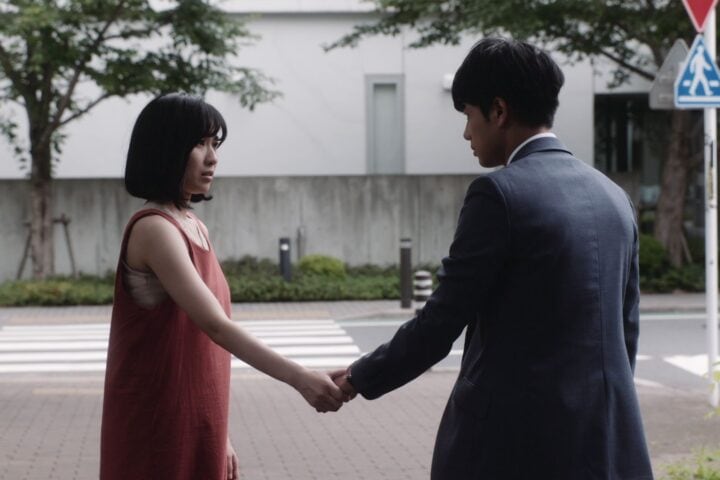
There seem to be matters of social, economic, and political importance swimming in the undercurrents of Fukada Kōji’s sophomore effort, Hospitalité, though they are never in a hurry to be clearly identified. The inherent bizarreness of globalization, the fickle nature of capitalism, and how the modern Japanese family comes into confrontation with these forces often feel like themes directly tied to the film, but the way it unspools befits Monty Python as much as it would Marukami Haruki in its avoidance of frank and manipulative timeliness. There’s even a hint of Beckett in the film’s absurdist melancholy, but there remains an essential humanity to this tale of a disconnected family splintered several times over by the appearance of a larger-than-life, blithely confrontational tenant and his implacably foreign wife.
Essentially timeless, Hospitalité’s conceit unfolds as a broad parable for post-industrialist Japan. Set largely in a small downtown Tokyo duplex that serves as both home for the Kobayashi family and headquarters for Kobayashi Printing Co., the film opens as patriarch Mikio (Yamauchi Kenji) is opening his house to his recently divorced sister (Hyodo Kumi). The family pet, a parakeet, has flown the coop as well, but the placidity of the family dynamic seems largely unchanged. The ripples in that veneer do not completely show themselves until the unexpected arrival of Kagawa (an excellent Furutachi Kanji), a direct yet somewhat humble man who talks and charms his way into a room in the Kobayashi household and a job as Mikio’s right-hand man after Kawaga matter-of-factly informs Mikio that his printing company received a large investment from his father.
Natsuki (Sugino Kiki), Mikio’s better and negligibly younger half, is blindsided by the arrival of the new tenant, who loudly fornicates with his white wife (Bryerly Long), who herself reports to be from Brazil but seems suspiciously of unknown origins. Kagawa’s epic hump sessions stirs up Mikio, but Natsuki is uninterested, as emotionally removed from the situation as her step-daughter (Ono Erika) is from her; the film’s most consistently offsetting joke is when young Eriko refers to Natsuki as “Teacher.” The family’s plainly bourgeois exteriors deteriorate quickly thereafter, their lives devolving into a stew of extramarital affairs, secret relatives, past divorces, hot musicians, houseguests, blackmailing plots, and one bitchin’ conga line.
No matter what its allegorical weight may be, Hospitalité holds its own as a work of brilliant storytelling, going through its strange and alluring machinations with unwavering focus. A dry dark comedy with designs on philosophical and sociological inquiry, Fukada’s film, which the director also penned, is nothing if not the product of a singular, profoundly peculiar mindset, consistently reminiscent of popular comedies and dramas and yet completely devoid of obvious influences. The fact that it was shot on digital doesn’t factor into the nuance of the story or Fukada’s form in any noticeable way, but there is an undeniable artistry to the film as a whole; the unmistakable signature of a particular filmmaker can be seen both in the framing and the resolutely commendable performances. A malleable intensive on the fragility of conformity, Hospitalité carries its own termless relevancy, making any dubious metaphors or moments of symbolism at once constantly tempting and totally useless.
Since 2001, we've brought you uncompromising, candid takes on the world of film, music, television, video games, theater, and more. Independently owned and operated publications like Slant have been hit hard in recent years, but we’re committed to keeping our content free and accessible—meaning no paywalls or fees.
If you like what we do, please consider subscribing to our Patreon or making a donation.