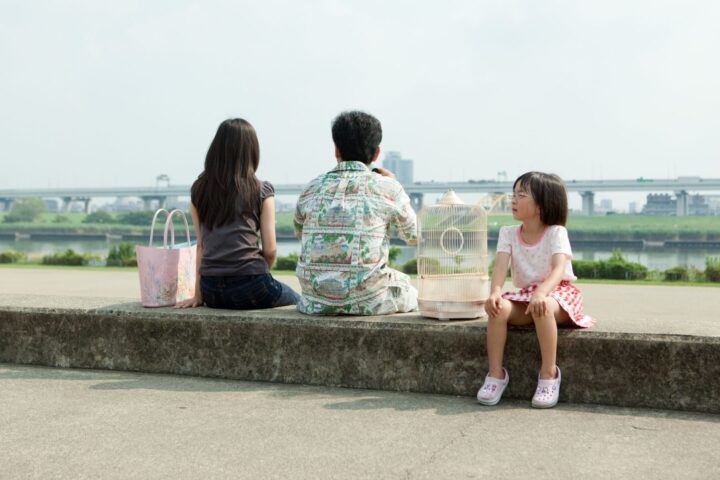
Kiyohara Yui’s Remembering Every Night is so relaxed that it’s easy to feel that it was less written and shot than casually observed. The film follows three women at various stages in life as they navigate the sprawling Tama New Town residential area in Tokyo over the course of a single day. Though their paths intersect occasionally, the women’s stories lack the connective tissue that typically defines network narratives, with the biggest shared trait between the women being their general listlessness in going about daily routines. Nonetheless, their quotidian behaviors subtly reveal personal and larger social portraits of contemporary life in Japan, and certain aspects of that life affect the characters in different ways.
One of these threads is the role that Japan’s conservative social values play in shaping women’s lives. We first meet Chizu (Hyodo Kumi), the eldest of the main characters, as she heads to an employment center in search of work. Though only 44, Chizu confides in a friend that she was pressured into resigning from her last due to her being an unmarried middle-aged woman. Though she speaks of this calmly, a slight note of outrage seeps into her otherwise cheerful tone.
Elsewhere, thirtysomething gas meter reader Sanae (Ohba Minami) stumbles across an elderly man (Okujno Tadashi) while making her rounds and learns from a PA announcement that he’s a dementia patient who sometimes gets lost on walks. Both gender-based obligations and a deference to age compel Sanae to help the gentleman return home, leading to a quietly comic detour in which she escorts him to what may or may not be the correct address.
Sanae’s ad-hoc caretaking is one of the more visible signs running throughout the film that one sees far more elderly people milling around than young adults, perhaps a subtle reflection of Japan’s status as one of the vanguards of the developed world’s collapsing birth rates. Even the youngest of the film’s main characters, a 22-year-old student named Natsu (Mikami Ai), spends her time around older people, including the mother of a friend who’s since passed away.

Tama New Town was the largest residential project of Japan’s economic miracle of the 1960s and ’70s. Its mixture of housing, schools, parks, and retail centers testifies to the nation’s optimistic outlook on its future at the time, but now Japan has been mired in recession for decades, and a neighborhood called “New Town” is older than any of the leads. Retirees habitually reminisce to the younger women about the good old days, recalling the zone at its peak when families first moved in and the streets teemed with children. With rare exception, the youngest person seen walking around the same area today is Natsu.
Still, if an ambient sense of rudderlessness among Japan’s young and middle-aged people subtly emanates from its three leads, Remembering Every Night remains bright in its outlook on human interaction and the quiet unremarkability of life. The three women regularly get caught up in small adventures that never really lead to any narratively sound conclusion, merely a digression that livens up their day. Chizu attempts to help some kids grab a ball they kicked into a tree but she cannot reach it. Sanae’s escapade with the dementia patient tapers off when she uncomfortably excuses herself from possibly taking him to the wrong house. Various daily tasks bring small annoyances and pleasures, all of which are captured with supple, sunlit warmth by cinematographer Iioka Yukiko, who brings the same quiet studiousness to these anticlimactic micro-stories that she did to Hamaguchi Ryūsuke’s Wheel of Fortune and Fantasy.
Iioka and Kiyohara rarely embellish any of these small moments. Indeed, maybe the single most remarkable aesthetic moment in all of Remembering Every Night involves a simple focus pull to shift between Natsu practicing dance moves in a park and Chizu walking by in the deep background, stopping to watch the young woman, then gradually mimicking her moves.
But for a film rooted in such intimate gestures as toying with a novelty mug that plays a jingle or getting lost in memories with old photographs, Remembering Every Night is captured almost exclusively in long shot, forcing one to consider moments of small individual importance as just one thread of a larger tapestry of a community. In the film’s lack of showy visuals or insistent subtext is a gentle evocation of contemporary Japanese life in its pleasures and frustrations. In a way, it recalls the city symphonies of silent and early sound cinema, though perhaps the more fitting musical connection would be the gentler, studious sound of a piano étude.
Since 2001, we've brought you uncompromising, candid takes on the world of film, music, television, video games, theater, and more. Independently owned and operated publications like Slant have been hit hard in recent years, but we’re committed to keeping our content free and accessible—meaning no paywalls or fees.
If you like what we do, please consider subscribing to our Patreon or making a donation.