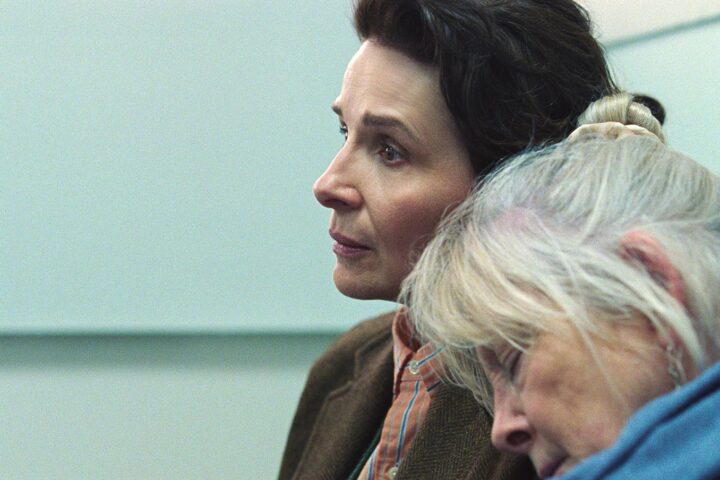
One of the best—and most beloved—actors of her generation, Juliette Binoche was at the Crosby Street Hotel last October to talk about Certified Copy, her latest film and the first made by Abbas Kiarostami outside Iran. If she ever tries directing, as she says she might, she’ll draw on what she learned while working for world-class directors like Krzysztof Kieślowski, Olivier Assayas, Michael Haneke, and Hou Hsiao-hsien. Binoche, who had some interesting things to say about how Hou and Kiarostami work, came across in person as she does on screen: smart, engaged, self-confident, empathetically responsive to others, and prone to joyful bursts of laughter.
You’ve talked about how different it was to work with Hou Hsiao-hsien, who likes to cede an enormous amount of control to his actors, than with Michael Haneke, who wants to control as much as possible in his movies. Where does Kiarostami fall on that scale of no control to total control, and what was it to work with him?
With Abbas, the frame is so controlled. The frame is really his art form. I think, because he’s a photographer, when he has the vision of the scene he has the scene. And after that he lets things happen. What he’s really keen on is controlling the pace in between shots, so when he cuts to another scene, the pace has to be right on the money. We re-shot one piece just because I was walking too fast, coming from one room to the next one. He’s very picky on those details because, for him, it really makes the movie. But the [internal] emotional world…I would say he really left me free.
There was one moment in the café scene, when the Italian bartender asks the man a question and then he turns to me and he says, “What shall I answer?” and I have a certain reaction. In this moment [in one of the takes] I lost control: I kind of laughed and cried [at the same time]. Abbas was taken aback by my reaction, and in the end, in the editing room, he took another [take]. It was so interesting for me, because we had an argument about it. I said, “Why don’t you take this scene? Because that really is a moment that happens in life. It’s not controlled at all. It’s life taking over.” He said, “Well, it’s not believable…” I really felt like it was the same kind of dilemma that the two characters have, man and woman: the controlling of the man and the emotional, you know, claiming of the woman. So there was a sense of collaboration and freedom of discussing what needed to be done—or not.
But, you know, the woman is actually him [Kiarostami]. He raised his children on his own, because in Iran when a couple gets divorced, the man has the children, not the woman. So I didn’t feel like he was on the other side of the river, not at all. He understood each point of view. But he can feel and see that men have a tendency of protecting themselves through, you know, logic and intellectual skills, as women take the risk of exposing themselves. And he says, at the end of the day they’re right, because they take the risk of feeling more vulnerable, of feeling needy. Not protecting yourself.
Did you improvise any of the dialogue, or was it very tightly scripted?
Very scripted. Some moments [were improvised]. Like when I was driving—you bump into things you didn’t expect.
Like that woman in the street?
Yeah [laughs].
Your bio mentions a Spielberg part you were offered in Jurassic Park and had to turn down because you were committed to another film at the time. Would you like to work with Spielberg some day?
Yeah, yeah, I would love to. But he’s not that interested in women. He’s not a feminine director, I think—as Abbas is, completely. I think [Kiarostami] is in need of understanding women, or getting close to them. Spielberg feels like he’s more into action, more male-oriented—capturing the world, or thinking about the world, or political subjects.
What do you think of James’s theory that copies can be as legitimate as originals? I was thinking, while watching the movie, about how that applies to movies themselves. Particularly to this one, since it’s about two actors pretending to be people who are pretending to be a couple, yet emotionally it all feels very real, like scenes from a marriage. So first, how do you define what’s real and what’s a copy? And what does that mean in terms of this movie?
I think in the film the dilemma of copy/original is just to find a pretext to put those two [characters] together, so I don’t think you have to hang onto it. Of course, the theme is attractive, because as a director, between reality and fiction you always have those big questions.
For me, I prefer the word “recreating” rather than “copying.” As an actress, I do one take, two takes, three takes, maybe more. Am I copying the first one? Am I copying the second one? You can talk that way. Or you can say, “I don’t know anything about what happened. I want to recreate [each take anew] and see what happens, not knowing, like life.” Like I’m with you now, I don’t know what I’m going to say. I’m recreating. This question I’ve probably been asked before, but I don’t know what I’m going to answer. Calligraphy is a very wonderful sort of parallel. They’re copying, recopying the same thing, but the way they do it is to get chi so it’s actually becoming an art form in itself.
You said working with Hou Hsaio-hsien in Flight of the Red Balloon brought out a new side in you as an actress, I think because of how you were asked to improvise on that set. Could you explain how that experience changed you?
I think it really changed my life to work with Hou Hsaio-hsien. The fact of giving the entire freedom and responsibility to the actor to direct, write, edit is huge, you know? I found it so generous. When you get into a scene [with Hou], it’s only description. You don’t have dialogue. When you’re free in a room, it’s breathtaking, because you could do anything. A French writer I got to play in a film said the future actor will be the one who writes, directs, and acts together. She said this actor-creator has to have culture, be a complete artist. I felt like Hou Hsaio-hsien gave me that experience. After that, I wanted to do the dance, I wanted to do the painting—the exhibition, and travel around. It gave me freedom in a different way.
Does it also change your acting in a tightly scripted movie like this one?
Because I had been doing 100 shows of the dance and traveling in 11 different countries, the fact of being still in front of a camera for 10 minutes was kind of difficult—the stillness when you have to go through a lot inside. My tendency would be to express, to go for it, because that’s what I had been doing in the dance thing. So, suddenly being so tight in a frame, I actually experienced that emotionally inside. There were takes when I felt: I’ve been roller coasting there. It’s been a totally different experience acting-wise. Especially the scene in the café, where, after some takes, I felt like, wow, I’ve seen some landscapes [laughs] I’ve never seen before.
Do you think that’s why your emotions welled up so unexpectedly in that scene?
The rhythm of the emotion, when you can somehow let it happen and ride it, it’s orgasmic, I have to say, acting-wise.
Since 2001, we've brought you uncompromising, candid takes on the world of film, music, television, video games, theater, and more. Independently owned and operated publications like Slant have been hit hard in recent years, but we’re committed to keeping our content free and accessible—meaning no paywalls or fees.
If you like what we do, please consider subscribing to our Patreon or making a donation.