

Adapted from Louise Penny’s popular murder mysteries featuring Chief Inspector Armand Gamache, Three Pines finds the intrepid Gamache and his team of investigators trying to solve a series of grisly crimes that have stunned a small village in Quebec. But while Three Pines boasts the mysterious murders, puzzling clues, and various other requisite tropes of a compelling detective tale, flat dialogue and wooden acting mean that Gamache is unlikely to be joining Marple, Holmes, and Benoit Blanc in the pantheon of on-screen sleuths.
Gamache, played by Alfred Molina, is initially called out to the town of Three Pines to investigate the murder of a rich, reviled woman whom the locals aptly compare to Cruella de Vil. Her killing is followed by two other murders within the sleepy town while the inspector also tries to solve the case of Blue Two-Rivers (Anna Lambe), one of several young Indigenous women who’ve vanished on the police department’s watch.
On paper, the qualities that define Gamache—intelligence, attentiveness, and quiet fortitude—are well within Molina’s wheelhouse, but the character lacks sufficient specificity. We know he’s a good detective and man mostly because other characters say so, but beyond a few fleeting glimpses of a troubled childhood, it’s hard to tell who Gamache actually is.
Every episode of Three Pines is abundant in oddly prosaic dialogue, with the characters prone to pseudo-profound metaphors (“When does the lifeboat become the prison ship?”) and barely cogent aphorisms (“Never let your emotions sway you from what you know in your gut”). By the time one character solemnly advises another that “Houses don’t kill, people do,” it feels as if we’ve strayed into the terrain of Welsh hip-hop.

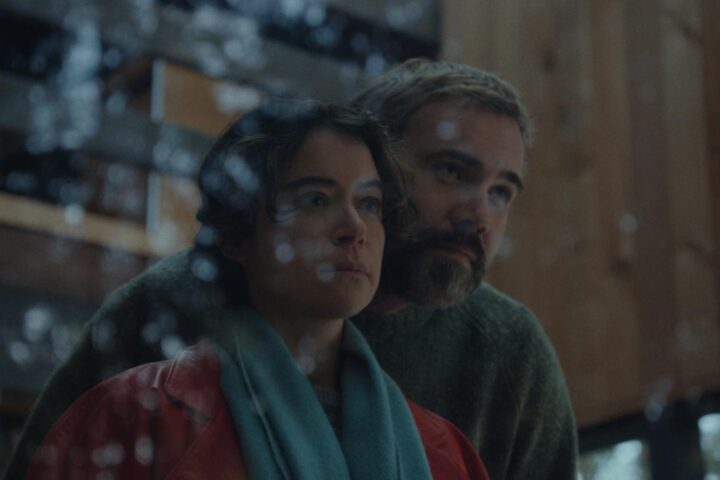
The cinematography mines the wintery setting for some lovely images, as in a striking sequence in which Gamache gazes out across a field of human shapes buried beneath the snow. Elsewhere, though, oddly wide shots keep two or three characters standing awkwardly in frame while another monologues, a visual choice that combines with some rather lackluster acting from the supporting players to give the whole thing the appearance of an amateur stage play.
Clare Coulter has lots of fun as a foul-mouthed, duck-raising, wild woman poet, while Sarah Booth is endearing as the clutz-ish rookie cop, but many of the other performers are robotically stiff even when they’re delivering the show’s most melodramatic dialogue. That stiffness becomes particularly distracting in the back half of the season, when we move to a case concerning a rich family whose members hardly feel like acquaintances, let alone blood relatives.
Most of the relationships in Gamache’s own life feel similarly shallow. He continually looks for advice from a colleague, Pierre Arnot (Frank Schorpion), who we’re told is an old friend, but each interaction seems to exist only to nudge the plot forward. There’s nothing to suggest that these are two men have worked alongside each other for years, no dimension to their exchanges beyond the one required to advance the storyline of Three Pines. Almost all of the show’s most important relationships are explicitly stated—which is to say, in the most undramatic of ways.
The cases themselves are loosely connected by overlapping characters, while the attempts at a thematic through line fall flat. The series pokes at ideas about how trauma is passed on, both within families and entire communities, but it’s the sort of one-to-one comparison work that’s used too frequently in contemporary media to reduce a human being to a single, simple mechanism. That, in a nutshell, is the problem with Three Pines. It’s a mystery series which works almost like a Magic Eye picture in reverse: The more you focus your attention on it, the less there is to see.
Since 2001, we've brought you uncompromising, candid takes on the world of film, music, television, video games, theater, and more. Independently owned and operated publications like Slant have been hit hard in recent years, but we’re committed to keeping our content free and accessible—meaning no paywalls or fees.
If you like what we do, please consider subscribing to our Patreon or making a donation.


It kills me that Gamache can’t even get a Frankenstein reference right. Alluding to Shelley’s novel, he states that the villagers killed the monster. The writers have confused the novel with the movie. In the novel the monster is last seen escaping across the Arctic.
Seriously! The Frankenstein gaffe was disturbing. I, more or less, gave up right there in the first episode. Whatever the screenwriter was thinking, I have trouble believing that neither Molina nor the director had read Shelley. So, they just put that line out there knowing how discordant it was…??
Same. I was wondering if this series was deep or shallow but then he delivers that howler of a line about how the villagers at the end of the book killed Frankenstein.
Somehow, that little speech got through many screenwriters, directors, and script editors to make it to the episode.
Anything that stupid is not worth watching more of
I love the wintery scenes. I love the novels. This show is disappointing, Doubt I’ll continue watching.
I adore these books. Have read them all. It seems that the writers tried to take some parts of what made the books so good- for example, some of the insights and wisdom about humanity, without taking the time to fill in the back story or really develop the characters at all. The entire first book is condensed into two episodes so it’s not surprising they didn’t have time to develop the characters. And yes the acting isn’t great. I would venture to say it’s bad directing. It’s really unfortunate because the books are wonderful. Go read them!
It helped that I’ve read the books (which I love). I’ll continue watching Three Pines to see how it evolves. I like Molina’s portrayal. Can’t wait to see more episodes.
I agree with you. I think it’s too soon to write this series off
Louise Penny is a brilliant writer. Have loved all her books. This tv series does not
do her justice. The writers should not have tinkered with her original plots.
I love the books but the series is flat and the characters are not fleshed out. I am hoping for more as the episodes progress. My main comment. Viewers read the books!
Wonder why they started with her second novel, and watered it down. The book was devastating, especially the portrayal of the daughter and the damage that horrible mother did to her. The show did not really reflect that at all. The kid seemed creepy, not tragic.
I like Molina as Gamache. They’ve made Beauvior too old, but the actor does a good job nonetheless. I’ll hang in. It’s better than that awful movie they attempted to make of her first novel several years back.
Love the first two episodes. brings you in and we are hooked. Good characters and with respect to the missing and murdered Indigenous women embraces an important reality in our society.
Loved the books!! Not enough..too dull.
We enjoyed the first two episodes and we liked Gamache’s subdued character. We do not agree with other comments about bad acting and directing. We were entertained and will definitely watch more episodes. isn’t that what it is about?
The series has only just begun. The characters have to find their feet, get to know the part they are playing and become comfortable with it, then we will all see the Gamache et el and all the players from the books we all love so much. Give the series a chance.
I have no dog in this fight. I haven’t read the books. The first two episodes were OK. I do wonder how the reviewer can rate this TV series 1 star though. Has he not run into 90%+ of the other TV shows out there? If Three pines is truly 1 star, I argue that the average TV show ranks about -2 stars.
Disappointing compared to the books but better than most tv shows. Much of the acting is very stiff. Much of the staging goes for atmosphere rather than being real.
I agree that the closer one looks the less there is to see (wouldn’t there have been footprints in the first episode to help expose the killer?), but who the heck cares!!? I love, love the sweetness and intentions of the characters, including the murderers to date. I love the atmosphere, the visuals, the music and singing. While some of the “isms” are indeed cliche or incorrect, some are breathtakingly beautiful (a man sleeping around is not respectful of his wife but stealing her time). Will someone please expand on the symbolism of the bear in the road. So, I squint, enjoy the beauty in the episodes and leave a well constructed who-done-it to one of the other authors mentioned. Ahhhhh, lovely escapism at its soothing finest.
Episode 6 is horrible. Isabelle Lacoste is made to look like an incompetent Officer.
A good series that went bad with an overused scene of a police woman making a stupid mistake of leaving her mobile phone in her car while picking up the Chief Inspector. The desperate person leaves and then gets caught by the crooked police and is poisoned. This made me angry as this was expected. I am no longer watching the remaining episodes. Terrible ending of the episode.
Spot-on! Episode 8 is even worse in terms of one idiotic rookie police mistake after another, even by Gamache – which ends up getting him shot.
This is a great review. I’m currently watching the rich family murder mystery episodes and the acting (or script) is so bad I stopped in the middle to google if I was going crazy and was the only one thinking this of if it really *is* that bad. Someone noted on Reddit that it felt like they were watching a Hallmark movie, and while I’m not sure overall it’s that bad, there are some really embarrassing performances. I can’t tell if it’s the direction, the script or the actors; either way it’s embarrassing.
I have not read the books, so I cannot make any comparisons. I do understand the comments of those who have as I was completely disappointed with the Jack Reacher movies with Tom Cruise after reading the books!
What A disappointment. The books are good. The series is embarrasing. what possessed Louise Penny to sell out to this group? She certainly doesn’t need the money.
Perhaps the same thing that had her “co-write” a novel with Hillary Clinton.
It pays well, I’d have to assume.
I did a search for “Three Pines terrible dialog” and came up with this review which I completely agree with. I am unfamiliar with the books but I certainly would not read them now as I was unable to make it through the second episode.
Read the books this adaptation is terrible
Disappointed. I kept watching because I wanted it to work but kept thinking…”Why isn’t this working?” Have always admired Alfred Molina. But the one actor who stood out to me in this was Tattoo Cardinal. Her character seemed the most alive and frankly the most interesting. She has inherent energy. Others seemed to be sleep walking. Perhaps the weather influenced folks. It looks to have been freezing.
This is one of the most spot-on reviews I’ve ever read. Well done. You said everything I wanted to say so I’ll leave it at that.
My wife watches this.
I can’t take more than 5 minutes at a time.
Along with the wooden and stereotypical performances, they shoehorn a bunch of indigenous content into the stories. It doesn’t fit. Presumably the producer/director feels they need current, topical stuff in the show, but like most artificial and contrived political commentary it not only falls flat, it helps to ruin the show.
The final straw was I walked into my wife watching the 4th episode. And a car was stopped on the road by a grizzly bear. In the eastern townships of Quebec.
There are no grizzly bears in Quebec, except for perhaps some in captivity.
Mind-numbingly bad.
I turned it off after about 60 seconds. Gamache is “French,” i.e. Quebecois. If Molina played Poirot, surely he could have conveyed this, but better–why not hire a Quebecois actor? This is such an important part of his character that the series apparently fails to convey, as is his gentlemanliness. When Gamache comes out in a rage dropping G-D like he’s in the Bronx, that’s when I turned it off; though the books have a fair amount of swearing, Gamache is the exact opposite of the angsty hothead portrayed in the first frames of Episode 1. I really don’t understand why you’d make a TV series of books if you can’t even get the basics of the protagonist correct. It looked like they just lifted your typical brooding, angsty big-city cop out of any New York- or LA- or Chicago-based police procedural and dropped him, completely out of context, into the culturally complicated milieu of rural Quebec with the token Indigenous plot to encourage us, I suppose, to suspend disbelief. What an insult to Canada.