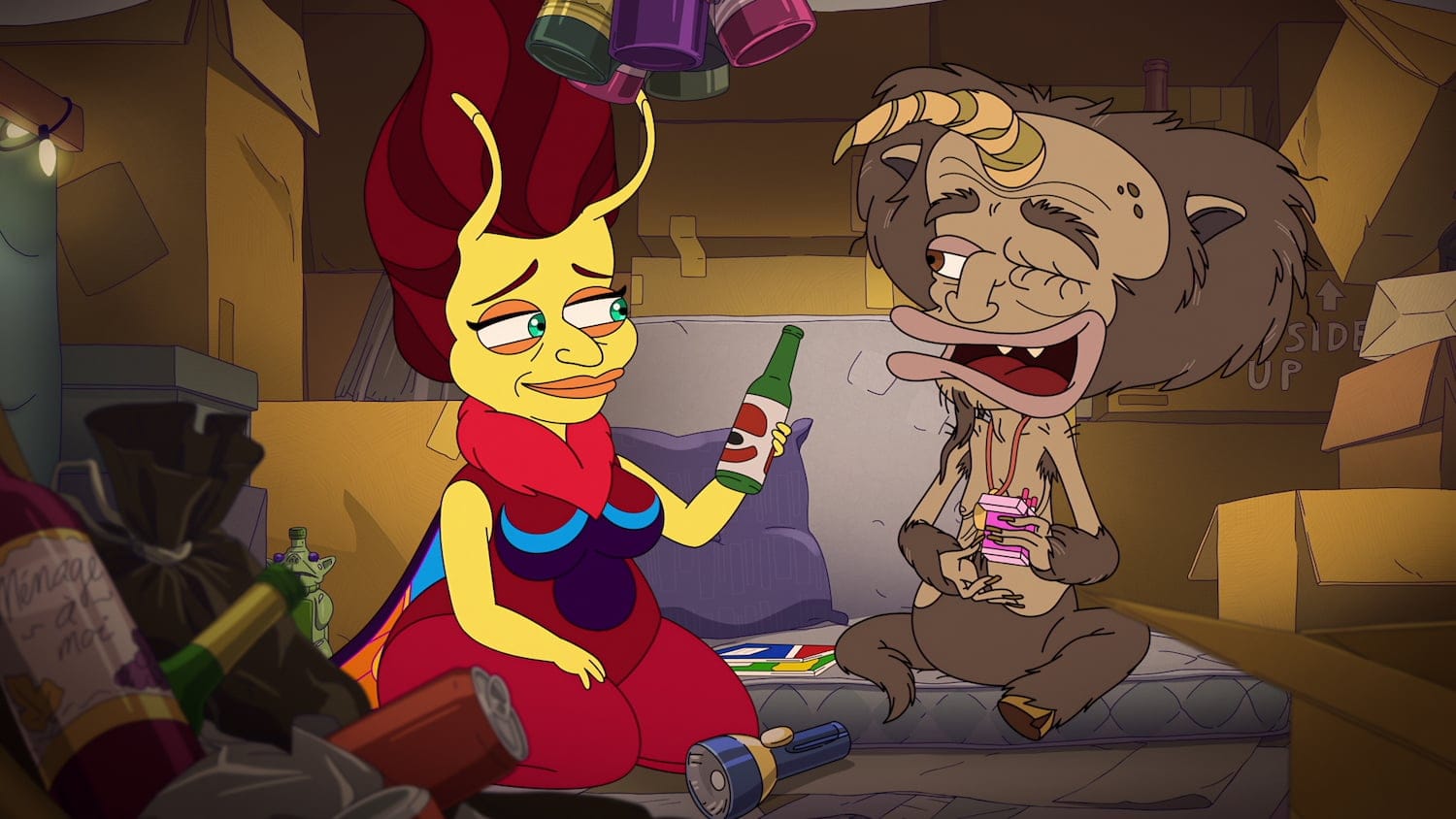
The first season of Netflix’s ribald Big Mouth introduced us to Hormone Monsters, personifications of the human sex drive that appear to complicate the lives of the animated comedy’s adolescent protagonists. As the series continued and the purview of its coming-of-age satire expanded, viewers met further embodiments of human impulses and moods: the Shame Wizard, the Depression Kitty, the Anxiety Mosquito, and so on.
Now, Big Mouth’s unlikely spinoff, Human Resources, proposes that these various forces coexist apart from their human clients in a kind of astral-realm corporate bureaucracy. As crossover character Maury (Nick Kroll) puts it in a meta comment at the start of the first episode, the series is “Big Mouth meets The Office.” But whereas Big Mouth could be described as a series of comically explicit high school health class videos, Human Resources aims to be something more like a polymorphously perverse workplace comedy.
Centering human impulses rather than the humans they influence is a questionable enterprise for a 10-episode arc. True, much of the fun of Big Mouth is in the verbal acrobatics that the Hormone Monsters perform with words like “cum” and “fuck.” But the core of that show has always been the human adults-in-formation who have to negotiate between the Monsters’ world of pure id and a reality where egos matter and genitals aren’t detachable. Surprisingly, Human Resources proves that there’s both comedy and poignancy yet to be mined from the impulse-creature conceit, even if it can’t fully expunge the aura of being an arbitrary spin-off.
Besides Maury, other carryovers from Big Mouth include Connie the Hormone Monster (Maya Rudolph), Lionel the Shame Wizard (David Thewlis), and Walter the Lovebug (Brandon Kyle Goodman). They’re joined by an expansive cast of newcomers: Pete, the sentient Logic Rock played with pleasant, straight-laced neutrality by Randall Park; Rosie Perez’s brash, diminutive, and undersexed Ambition Gremlin; and Lupita Nyong’o’s Shame Wizard, who seduces Lionel at one point at the “International Creature Convention.”
Inasmuch as there’s a main thread to the season, it follows Emmy (Aidy Bryant), whose role is to encourage and facilitate human love. She’s a hedonistic slacker at work, until she suddenly rises from assistant to the lead Lovebug for expectant mother Becca (Ali Wong) when Sonya (Pamela Adlon), Emmy’s boss, is hauled off by authorities for an unknown dereliction of her duties. The series plays out the complex emotions of new motherhood through Becca and Emmy’s mutual discomfort in their new roles, with Emmy’s imposter syndrome and lack of professionalism doubling Becca’s surprising ambivalence toward motherhood.
Essentially transplanting us into a raunchy reimagining of Monsters, Inc. allows Human Resources to create a kind of narrative modularity, where storylines dealing with various periods of adult life weave in and out of the working lives of Emmy and her colleagues. Episodes tend to jump between the ongoing projects being handled through the offices, paralleling A- and B-plots around a unifying theme with a self-awareness that’s familiar from Big Mouth. “Where’s Walter?” Emmy asks in the Lovebug conference room in the episode “It’s Almost Over.” To which Flanny (Chris O’Dowd) replies, “Oh, he’s got the A-plot this episode.”
There’s a certain fatigue that can result from such insistent winking at the viewer, though the throwaway archness is often accompanied by moments that can be genuinely affecting. One episode pulls out the old self-conscious product placement joke by having a character dangle a bag with a Taco Bell logo in the center of the image—a joke that was already tired when Arrested Development interrupted Ron Howard’s voiceover narration to trumpet the merits of Burger King. But the obnoxiousness of having Becca be an ardent Taco Bell lover is tempered by what the episode in question, “Love in the Time of Postpartum,” actually says about the value of having a partner who knows what kinds of care you need.
On one hand, Human Resources is a show whose reveling in its own cheapness—as a cash-in on a popular brand, as a show that makes dick puns whenever it lacks for a joke, and as a de facto Taco Bell commercial—doesn’t quite excuse that cheapness. On the other, it stages some truly insightful and moving explorations of the complexities and difficulties of being horny, of giving birth, of getting old, of loving the Phoenix Suns. Which is to say, of being human. There might not be too much more substance to squeeze out of this concept going forward, but Human Resources proves that the Big Mouth universe has a surprising amount of stamina.
Since 2001, we've brought you uncompromising, candid takes on the world of film, music, television, video games, theater, and more. Independently owned and operated publications like Slant have been hit hard in recent years, but we’re committed to keeping our content free and accessible—meaning no paywalls or fees.
If you like what we do, please consider subscribing to our Patreon or making a donation.