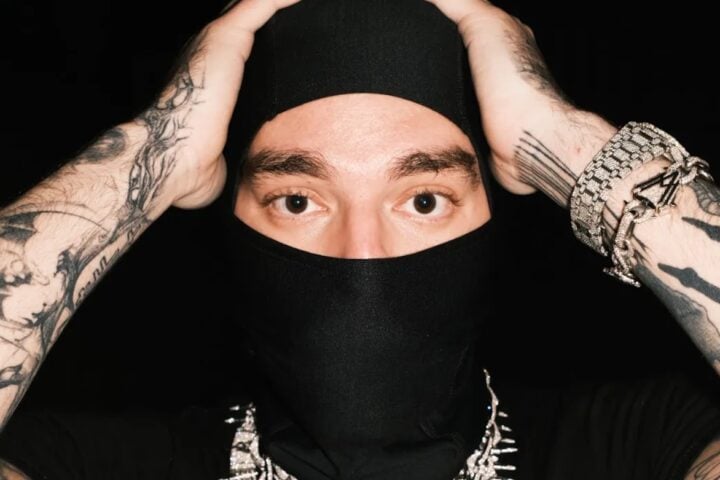
Yeat’s AftërLyfe is a continuation of the Portland rapper’s increasingly formulaic approach to album curation. At 22 tracks, it’s composed of demonic-sounding material with little attention paid to sequencing, and features a select few guest appearances—including two, Kranky Kranky and Luh Geëky, that are just Yeat himself slightly pitching his voice up or down an octave—that break up the slowly mounting monotony.
There are a few too-infrequent dips into calmer waters, with experiments like the psychedelic “Now” and the house-influenced “Nun id change” serving as interesting diversions, and an underwhelming soft-rock ballad, “Mysëlf,” to boot. But for the most part, AftërLyfe functions in a similarly amorphous, long-winded manner as last year’s 2 Alive and 2021’s Up 2 Me.
“Ridin’ with my demons, I can’t take nothin’ back/Ridin’ with my demons, they my deadliest friends,” Yeat snarls on “No morë talk,” AftërLyfe’s ominous opening track. It appropriately establishes the album’s menacing mood, and it’s one that’s rarely eased off for the remaining hour-plus runtime. This all results in an equivalent—and, by this juncture, totally expected—amount of bangers and frivolous padding. (Yeat’s all-killer-and-no-filler EP from last year, Lyfë, remains the gold standard for what one of his projects should strive for.)
Still, whenever a monstrous beat is thrown his way, there are few in Yeat’s lane who can rise to the occasion quite like him. “Slamm,” the title of which sounds like “shlam” for the way Yeat contorts his phrasing of the word, is an efficiently furious show of mean-mugging, while “Sum 2 do” finds him spewing a litany of unintelligible gibberish for the first 10 seconds before pivoting to an extended chorus with such fervid enthusiasm that it hardly matters what he’s saying.
Even when he’s not in attack mode, Yeat exudes a casually nihilistic attitude that can be intoxicating when placed in the right context. For example, on “Shhhh,” he claims, with little enthusiasm, that “bullets make you spread, make you dead, cut yo’ head,” as if there are plenty of other things he could be doing with his time than threatening some nameless adversary.
That same level of apathy radiates off of the verse-less “Mëan feen,” where, over two especially long choruses, Yeat flippantly brags about his Apple Bottom jeans by playing off their similar namesake to Applebee’s and walking around with a glock in his designer bag. Say what you will about the repetitive nature of Yeat’s pen game, but he can occasionally string along an outlandish alliteration or paint a surreal image of deranged drug use like nobody else (“7 Nightz” finds him “geeked up” on molly and Percocet for “around seven nights straight”).
Tamer tracks—like “Watch,” where Yeat whispers out the majority of his half-cooked bars, or the lethargic “Back Up” and “Type Monëy”—display how one-dimensional his style can get when the material is spread too thin. Yet, despite these flaws, AftërLyfe confirms that in a sea of blatant copycats, Yeat remains a true original—albeit one who’s in desperate need of an editor.
Since 2001, we've brought you uncompromising, candid takes on the world of film, music, television, video games, theater, and more. Independently owned and operated publications like Slant have been hit hard in recent years, but we’re committed to keeping our content free and accessible—meaning no paywalls or fees.
If you like what we do, please consider subscribing to our Patreon or making a donation.