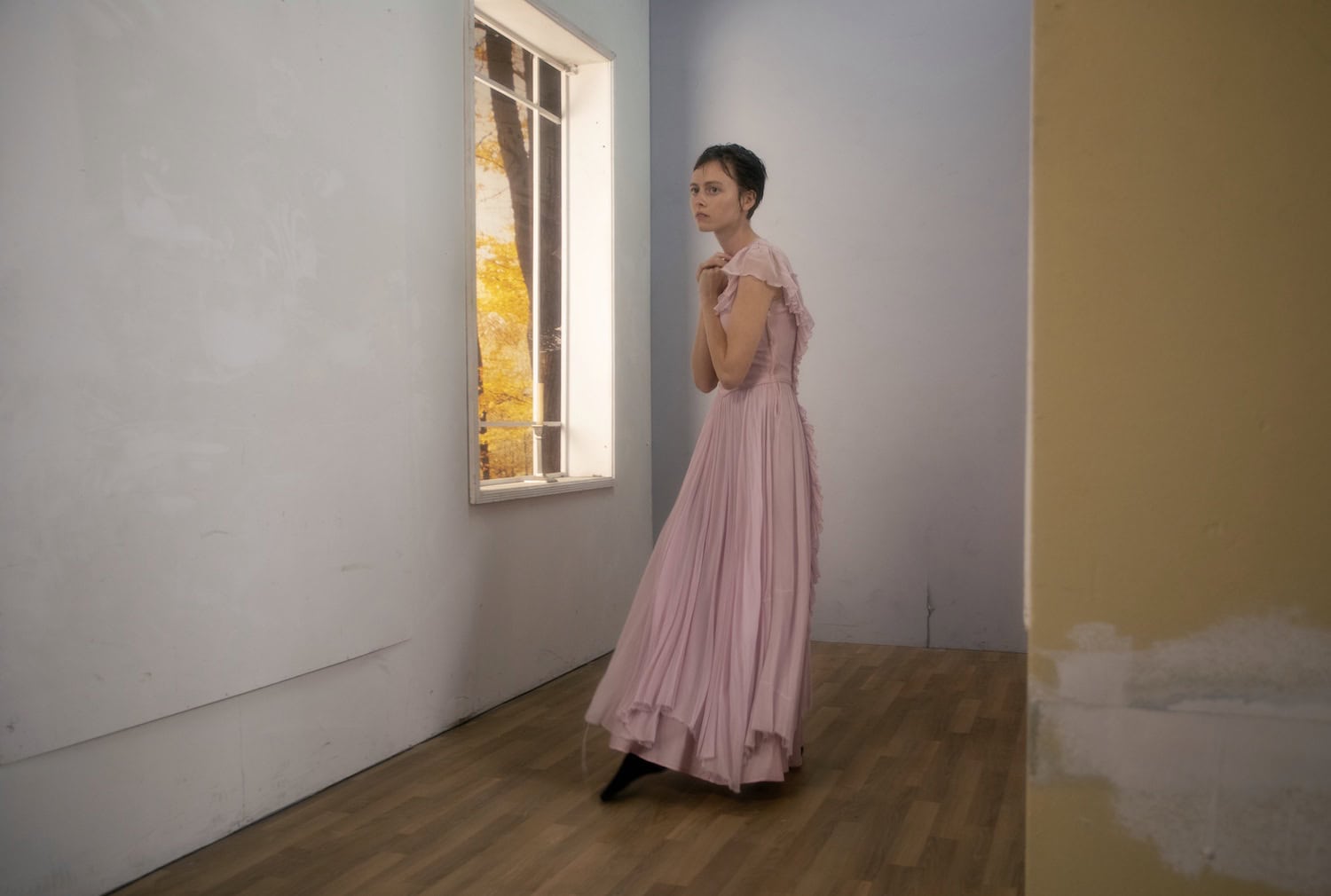
While comparisons to Phoebe Bridgers and Julien Baker are perhaps inevitable, singer-songwriter Helen Ballentine—who performs under the deceptively speed metal-esque moniker Skullcrusher—shares more in common with lesser-known ambient dream-folk acts like Grouper and His Name is Alive. On Quiet the Room, Ballentine elaborates on the musical ideas she sketched out on her 2020 self-titled EP and last year’s Storm in Summer, harnessing the same ethereal melancholy that made those releases stand out.
The gentle, reverb-y guitar strums of the album’s opening track, “They Quiet the Room,” feel instantly familiar, and as Ballentine’s soothing vocal layers come to the fore, her gift for evocative lyricism shines. “I know you had more to say, did you feel afraid to tell me?/The words still sit on your tongue, they quiet the room,” she sings, eschewing the blunt specificity of many of her contemporaries.
Enhanced by mournful strings and Ballentine’s faint, distorted voice, “Building a Swing” is corroded by gnarled piano chords and a wash of static, recalling the knotty tenderness of early Sebadoh. On the spectral “Whatever Fits Together,” the singer sifts through painful recollections: “I left home in the summer/I cried in the stairway/When I hugged my brother/I tried to hide my face.” She continually adds elements—a delicately plucked banjo, a lively tambourine—to the haunting arrangement before ending ambiguously: “Do you ever look back?/Does it all fit together?/If we’re here does it matter?”
Quiet the Room boasts some lo-fi eccentricities as well. The eerie babbling of “Whistle of the Dead” wouldn’t sound out of place on an early Alex G release, while the soft finger-picking of the brief “Could It Be the Way I Look at Everything?” provides a fitting prelude for the whimsical “Outside, Playing,” a track blemished ever so slightly by tape hiss and unintelligible voices, evoking a happy childhood being invaded by a complicated, contentious world.
Despite its often-startling beauty, Ballentine’s songwriting can’t help but feel derivative at times. “Sticker” veers too close to the depressive slowcore of Giles Corey, and when the wistful arrangement of “It’s Like a Secret” disintegrates like a tape being devoured by a stereo, replaced by blaring white noise, it’s hard not to be immediately reminded of the messy experimentalism of the indie group the Microphones. Still, Quiet the Room isn’t without its unique charms—the ominous drones of “Lullaby in February” cast indie folk into the gloomy depths of dark ambient—and Ballentine offers copious moments of hushed self-reflection and aching sadness.
Since 2001, we've brought you uncompromising, candid takes on the world of film, music, television, video games, theater, and more. Independently owned and operated publications like Slant have been hit hard in recent years, but we’re committed to keeping our content free and accessible—meaning no paywalls or fees.
If you like what we do, please consider subscribing to our Patreon or making a donation.