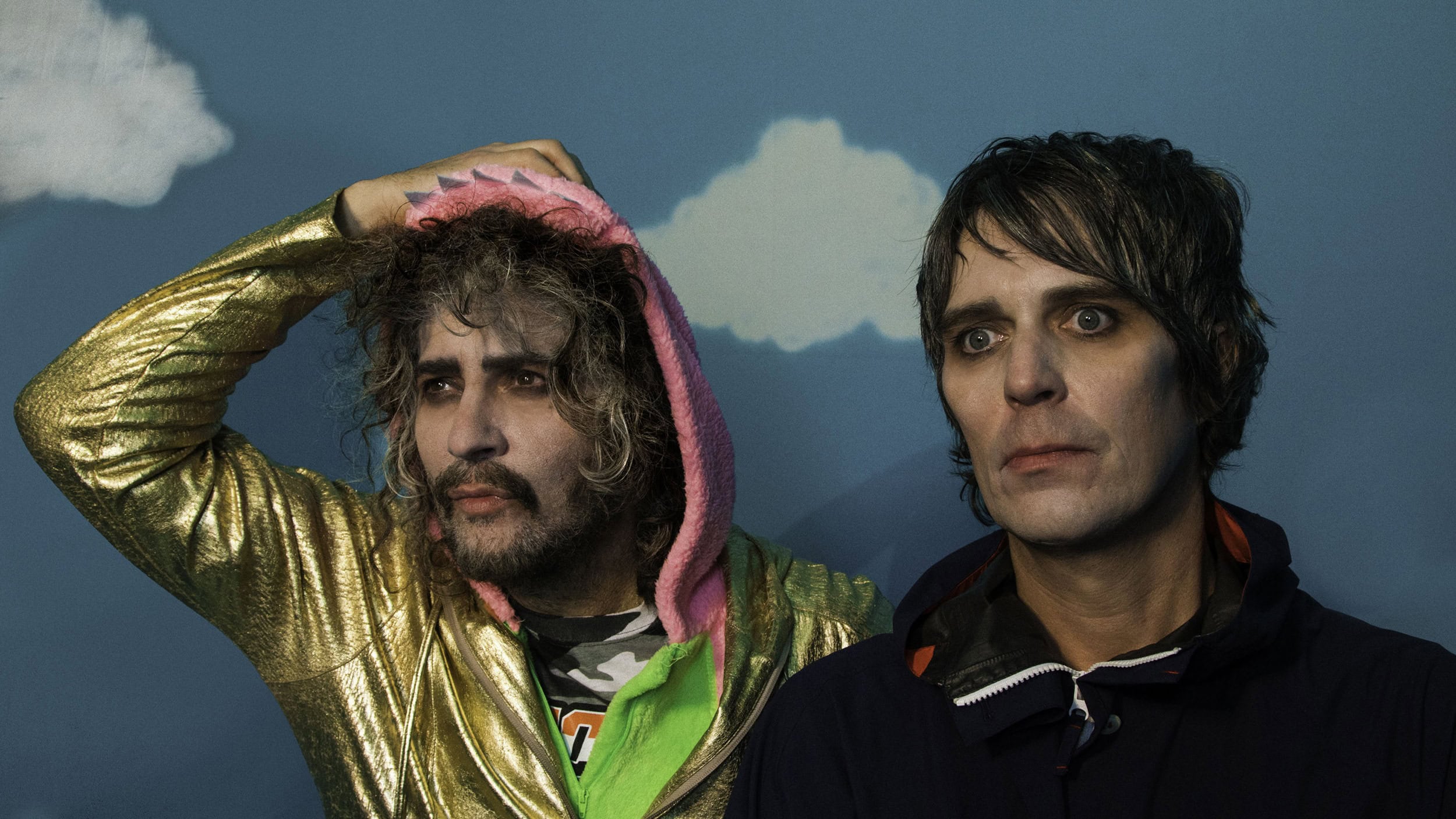
Despite what the Flaming Lips’s kaleidoscopic, neo-psychedelic musical fantasies might suggest, Wayne Coyne spent much of his life deliberately avoiding drugs after witnessing his older siblings—absent access to healthier countercultural outlets in ’60s and ’70s Oklahoma City—fry their brains. He apparently conquered that fear around 2012, when he began going through what, from the outside, looked a lot like a midlife crisis—separating from his longtime partner, partying with Miley Cyrus, and bragging about all the acid and molly he was doing. Over the next several years, his once comfortingly wide-eyed explorations of weighty philosophical themes turned distressingly bleak, while the Flaming Lips’s timeless pop melodies and intricate orchestrations ceded to droney noise.
Refreshingly, then, the band’s 16th album, American Head, builds on the return to form that last year’s half-tossed-off King’s Mouth promised. And all it took was Coyne getting back in touch with the part of himself that grew up terrified of his brothers not waking up from their next binge. So while there are copious drug references throughout the album—among the song titles are “At the Movies on Quaaludes,” “Mother, I’ve Taken LSD,” and “You n Me Sellin’ Weed”—they’re all characterized with a sense of awed, even fearful detachment. The album features some of the most personal, slice-of-life lyrics that the fancifully minded singer has ever written: Nearly every song can be traced to a real story about Coyne or his “older brothers and their drug-dealing biker friends,” as he puts it in the album press notes.
Even the silly “Dinosaurs on the Mountain”—which boasts lyrics like “I wish the dinosaurs/Were still here now/It’d be fun to see them playing/On the mountains”—has roots in a specific childhood memory, of gazing up at the mountains from the back of a station wagon. “You n Me Sellin’ Weed” directly references Coyne’s experience as a teenage pot dealer, a phase that may have made him feel “like king of the world” but still left him wishing for “a spaceship coming for us/To take us away.” The raw human element to these stories is underscored by Coyne’s small, quavering alto, which—some Vocoder and pitch-shifting notwithstanding—is largely freed from the shrouds of the studio effects of recent releases.
This is the classic Flaming Lips formula: combining childlike whimsy with sober realizations of all the sadness in the world. The band’s recent work has too often veered to one extreme (the dippy King’s Mouth) or another (the utterly grim The Terror). And though the current incarnation of the Flaming Lips has been together since 2014, and thus responsible for these various digressions, the band has undertaken a sonic overhaul here that matches the emotional, sentimental tenor of Coyne and Steven Drozd’s new compositions.
With a couple of exceptions—like the dark, driving “Assassins of Youth” and the psychedelic “You n Me Sellin’ Weed”—there’s essentially only one kind of song on American Head: the starry-eyed acoustic power ballad. The days when the band would alternate their sweeping, emotional ballads with fuzzed-out rockers and experimental pop songs may be gone, but this album’s relatively clean mixes—populated with acoustic strumming, mellotrons, and melodic, Beatles-esque guitar lines—hearken explicitly and effectively back to the more meditative moments of the band’s golden age in the early-to-mid ’90s.
One exception is “Mother, Please Don’t Be Sad,” which belongs in the pantheon of classic Flaming Lips tearjerkers alongside “Do You Realize??” and “Waitin’ for a Superman.” The song is based on a story Coyne has told before, most memorably in the documentary Fearless Freaks. Decades ago, he was working as a fry cook at a Long John Silver’s when armed gunmen burst into the restaurant to rob the register. While lying on the ground, assuming this was the end, his thoughts turned to his mother. “It’s only me that’s died tonight/There’s so much you still have,” he assures her on “Mother, Please Don’t Be Sad.” He reminds her to let the dogs out, to take comfort in the love of the still living. It’s quintessential Coyne: a simultaneous reminder of humanity’s fragility and a celebration of its resilience.
Since 2001, we've brought you uncompromising, candid takes on the world of film, music, television, video games, theater, and more. Independently owned and operated publications like Slant have been hit hard in recent years, but we’re committed to keeping our content free and accessible—meaning no paywalls or fees.
If you like what we do, please consider subscribing to our Patreon or making a donation.