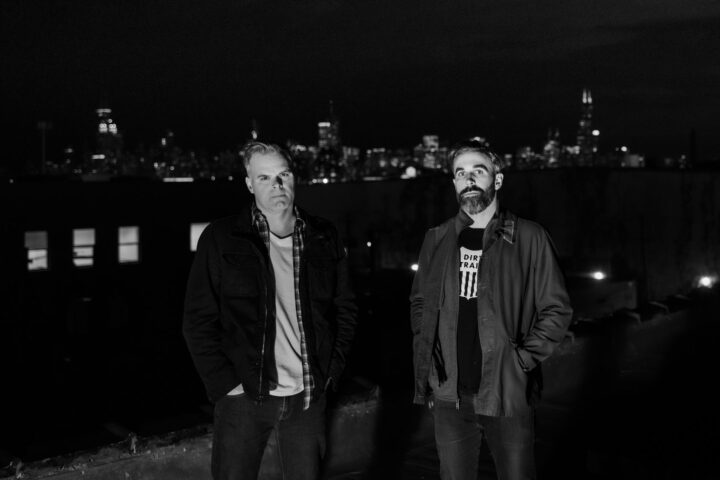
Despite its peculiar, even revolutionary approach to the acoustic singer-songwriter format, This Machine Kills Artists, the solo debut from the Melvins’s Buzz Osborne—a.k.a. King Buzzo—generated buzz (pun intended) almost exclusively among the band’s faithful. Now, as if to encourage a second look at his pursuit of heretofore unrealized sounds, Osborne has delivered Gift of Sacrifice, another album that veers off the beaten path.
On This Machine Kills Artists, Osborne plowed through 17 propulsive numbers that rarely broke the three-minute mark in the process of reimagining the acoustic guitar as a primarily rhythmic, at times almost percussive, instrument. In contrast, Gift of Sacrifice offers mostly lengthy atmospheric tracks that achieve a dark, pensive beauty, in large part due to the added presence of Mr. Bungle bassist Trevor Dunn, who’s featured throughout the album. “Delayed Clarity” begins with a series of brooding, heavily strummed acoustic chords to which Osborne eventually adds a gorgeously melancholic guitar lick. Two minutes into the song, Osborne begins to sing, and Dunn uses his standup bass to create—with the help of substantial delay effects—an eerie, swirling soundscape that submerges the track’s vocals in a psychedelic fog.
In the course of inventing their own brand of overpowering sludge metal, the Melvins have been often overlooked for their experimentation, but Gift of Sacrifice—with “Delayed Clarity” as its centerpiece—often spotlights Osborne’s masterful ability to explore strange worlds of sound by slowing down the pace and emphasizing texture over melody. “Housing, Luxury, Energy” reverses the structure of “Delayed Clarity,” with another set of brooding, heavily strummed chords accompanied by simultaneous tracks of Dunn’s arco patterns, including a scraping, atonal noise. Over more than six minutes, the song intensifies to the point where Osborne’s baying vocals and thunderous strumming produce an overwhelming maelstrom. The common thread of Osborne’s two solo albums is the transference of metal’s sonic density to the acoustic realm, and with this track and most of Gift of Sacrifice he’s especially succeeded, with Dunn providing thick foundational tones for extra heaviness.
Motifs of our oppressive, delusional, and arrogant ways seem to pervade Gift of Sacrifice. The surprisingly catchy “I’m Glad I Could Help Out” possesses a creepy, lurching rhythm aided by Dunn’s plucked bass notes as well as Osborne’s lyrical portrait of endurance through persecution: “They came to terrorize/The wisest of the wise/You have to survive/Before you can do anything.” While possessing only a rough intelligibility, the lyrical fragments on “Science in Modern America” appear to paint an all-too-relevant portrait of intellectual and moral decrepitude: “Forget everything and face nothing” is one such fragment, and it speaks volumes as to how Osborne views a world ruled by ignorance and cowardice.
The biggest surprise on Gift of Sacrifice is “Mock She,” perhaps the first “Hey, foxy mama” song that Osborne has ever written. It’s certainly the album’s breeziest offering, even as various elements undermine any straightforward sentiment it might express. After all, Osborne’s idea of a come-on is “Hey, baby, if you do what you’ve been told/My insulation’s gone, girl/You make me overload.” And as if to further suggest the breakdown of the authoritarian, mechanical narrator, his voice eventually disintegrates in a metallic gurgle while Dunn’s frantic bassline becomes increasingly atonal and arrhythmic.
Gift of Sacrifice flirts with such chaos, though sometimes in a compartmentalized manner: Three tracks, including the opener and closer, are short instrumentals that might have been elongated for further immersive and exploratory effect. Otherwise, the album is an off-kilter musical gift born of Osborne’s sacrifice of conventionality for weirder, wider possibilities.
Since 2001, we've brought you uncompromising, candid takes on the world of film, music, television, video games, theater, and more. Independently owned and operated publications like Slant have been hit hard in recent years, but we’re committed to keeping our content free and accessible—meaning no paywalls or fees.
If you like what we do, please consider subscribing to our Patreon or making a donation.