
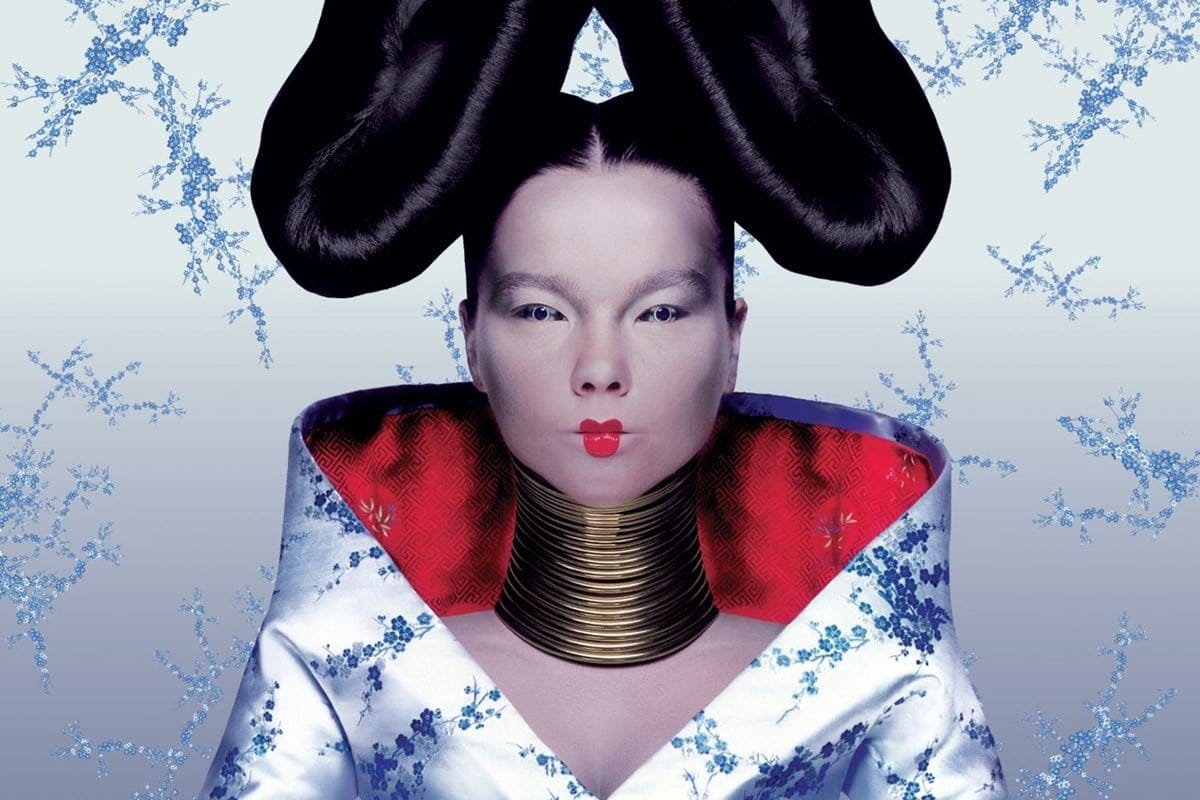
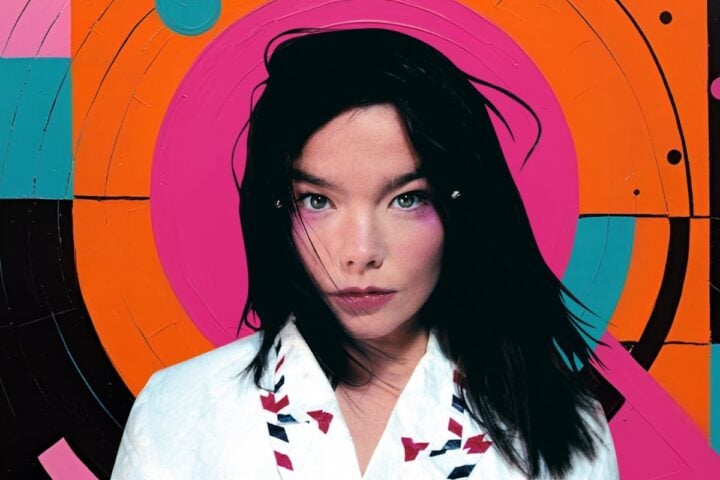
When Slant counted down the 100 Best Albums of the 1990s in 2011, Björk’s Post landed in the runner-up spot, bested only be the Icelandic chanteuse’s follow-up, 1997’s Homogenic. It was a fitting conclusion; the only artist capable of one-upping Björk’s era-defining presence was, well, herself. As I wrote at the time, if Post flattered the decade’s penchant for eclecticism, Homogenic snapped all its trends into sharp focus.
But more importantly, the album saw her transcending her Whitman’s sampler box of musical styles by unifying her free-range interests, thereby looking toward the future in a way that felt like nothing else being made in pop music at the time. It was classical futurism, or “glowstick chamber music,” given deeply passionate heft from both the angular string arrangements of the Icelandic String Octet (assembled by Björk) and the filthy, distorted, skittering beats of Markus Dravs and LFO’s Mark Bell (the former of whom rarely gets the credit that the latter does but who received a shout-out from Björk in her new podcast album retrospective, Sonic Symbolism).
With Debut and Post, Björk cast her net widely on a song-by-song basis; with Homogenic, each individual song achieves heterogeneous poly-sonic range, and still somehow the album comes together as a cohesive whole, rather than an ingeniously curated program of flavors. In the 25 years since its release, Björk’s biggest successes have continued down the singular path that Homogenic forged. And, as I mused over a decade ago and still believe today, it’s no exaggeration to muse that the century of Schoenberg, Debussy, and Prokofiev culminated in Homogenic. Eric Henderson
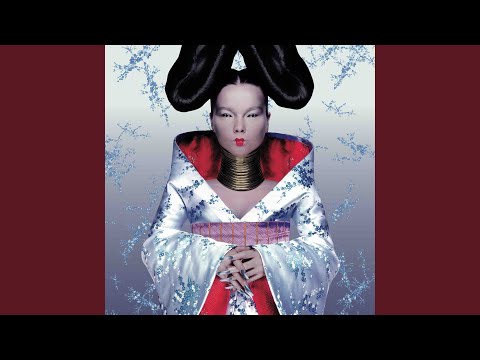
10. “Immature”
The simplest lyric of any of Homogenic’s songs, and also the most vulnerable. “Immature” may be a breather between the unapologetic assault of “5 Years” and the even more unapologetic poptimism of “Alarm Call,” but it’s a valuable and necessary one. Surrounded by some of what a friend mercilessly but somewhat accurately tagged as some of Björk’s most hectoring lyrics, “Immature” is the album’s most insistently self-accusatory moment. “How could I be so immature to think that he could replace the missing elements in me?” Okay, that the self-reflection comes in the form of a cold-as-ice dismissal of the “he” in question is maybe just a tiny bit hectoring. Henderson
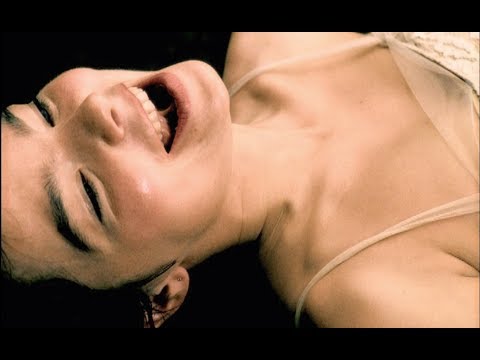
9. “Alarm Call”
While much of Homogenic is playful in form and style, “Alarm Call” is the album’s most overtly cheeky track. In it, Björk shares her feelings on music, liberation, and Buddhism (though less favorably), creating a song that’s as much about politics as it is about itself. Featuring some of her fiercest growls and most playful production flourishes (like remote alien squeaks), “Alarm Call” could not be a more jarring predecessor to “Pluto,” the album’s explosive apex. While these contrasts belie Homogenic’s title, they display Björk’s fearless creative range and, beyond that, the effortlessness with which she can plumb her opposing emotional poles. Eric Mason

8. “Pluto”
The explosive payoff to the “I’m so tired of cowards that say they want then can’t handle” gauntlet that “5 Years” throws out, “Pluto” is unpitying, both in terms of its aural fireworks and its backstory. Conceived in response to the videotaped suicide of a crazed fan (who had earlier attempted to kill Björk when he found out she was dating drum-‘n’-bass pioneer Goldie), “Pluto” wastes no time plunging the listener into a whirling dervish of psychotic pinball noises. Already cranked to 11 from the first few bars, the track then plunges like a runaway elevator into the depths of a techno hell, with only Björk’s heavily distorted vocals about needing to “explode this body” off of her to provide any recognizably human presence. Barely, lest you forget that whenever Björk performs this track live, she dances. A lot. Henderson

7. “Unravel”
Hailed by Thom Yorke as his all-time favorite song, “Unravel” is the soft beating heart of an album otherwise encased in the hardest of igneous rock. Forever linked in my mind with the contemporaneous film by the director who would very soon recruit Björk as his leading lady, “Unravel” seems tethered in spirit, if not temperament, to Breaking the Waves. Crooning to a lover who’s gone away—presumably not to hunt and gather—Björk’s gentile parable characterizes both physical and emotional distance as the devil, but given everything we know about the singer and carnality, it’s possible that the opposite is true. What would you call the need to immediately summon, through fucking, a “brand new love” but an opportunity? Truly Björk’s kind of hymn. Henderson
RELATED STORY
Every Björk Album Ranked

6. “All Neon Like”
Not unlike in jazz, singing to dominating electronic beats can render vocalists ancillary and inessential in comparison to the driving force of the instrumentals. Björk, though, has no such problem on “All Neon Like,” which begins with nearly a minute’s worth of the artist’s voice, blunt yet expansive, isolated with only some flute-like noises sparking curiosity. Once she utters the titular phrase, magnificently fuzzy synth notes start to sound off, along with a hiccuping drum beat that seems to mimic a gadget attempting to power off after each syncopation. As the song wears on, Björk describes symbolic acts and gestures performed reciprocally for a lover. As her vocals delay behind the song’s meter like a dragging veil, “All Neon Like” comes into view as documentation of the transference of energy. After she belts, “And the luminous beam! It feeds you!” for the second time, the drums drop out and shimmering synths idle in place, indicating the travel of light has stopped. Soon enough, the track’s march forward, along with its characters’ expulsions of energy, revs back up again. Charles Lyons-Burt

5. “Bachelorette”
Björk’s dark tango, “Bachelorette,” is a melodramatic overpouring of pent-up romantic misfortune that takes the beats and strings of the earnest “Jóga” and turns them mouth-wateringly sour. “Bachelorette” starts at a 10 in intensity and only rises from there, its unforgettable habanera-esque timpani beat sounding opposite Björk’s panicked belting. The song teems with vivid, morose symbolism, opening with the indelible image of a fountain of blood and continuing a story of mistrust and isolation that began with “Human Behaviour” and “Isobel.” Mason

4. “All Is Full of Love”
Homogenic’s magnificent closer, “All Is Full of Love,” is to “Pluto” as Vespertine’s “Frosti” is to “Pagan Poetry”—which is to say, the comedown from an explosion of Björk’s passion. The album version, a tentatively paced ambient pop song, is an equally meditative and climactic celebration of love, whereas the music video version, accompanied by images of kissing robots that still look sleek in 2022, pursues the harder, trip-hop approach of much of the rest of Homogenic. “All Is Full of Love” is the beating heart of Björk’s discography and a bold conclusion to an album rife with turmoil and defiance. She leaves us with warmth, placing love back in the center of the frame and reminding us of just what motivates her and her unparalleled art. Mason

3. “Hunter”
The drum-machine patter that ripples in hyperspeed and sustains throughout “Hunter,” Homogenic’s marvelous opening statement, cheekily recalls a kind of military-execution drumroll. Coupled with the mounting tension of the Icelandic String Octet’s violins, “Hunter” is a thrilling and formidable establishment of the new direction Björk had chosen to traverse for her third album, adopting a sound that was more foreboding, chilly, and dangerous than her prior two releases. “I’m going hunting/I’m the hunter,” she asserts with a slithering, self-empowered autonomy, and the subsequent nine tracks—as well as Björk’s innovative projects since—never see her look back. Lyons-Burt

2. “5 Years”
“5 Years” may be the most ambitious and beautiful example found on Homogenic of Björk’s wont to take traditional pop structures and melodies and transform them into something nearly unrecognizable. The song’s ripped-paper percussion and soaring strings take over in its final third, ably expressing the singer’s anguish due to a capsized relationship, with the synths sounding like distorted explosions. Some of the song’s arrow-sharp barbs—“I dare you/To show me your palms/I’m so bored with cowards”—are also among the finest in a catalog stuffed with affronts to undeserving men. Lyons-Burt
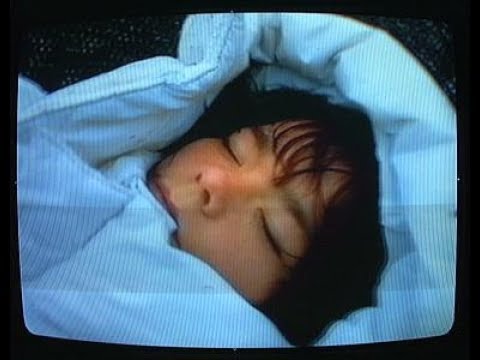
1. “Jóga”
Björk’s tribute not only to love but to the Icelandic landscape may be her most representative work: a truly tender but sweeping ballad undercut by a thrillingly off-balance beat. The song’s characteristically forward-thinking, trip hop-infused meeting of orchestral grandeur and churning electronica solidified Björk as an art-pop visionary with an omniscient and unifying view of genre. Like “Hyperballad,” “Pagan Poetry,” even the lamenting “Stonemilker,” “Jóga” is propelled by a wistful sense of possibility, and a feeling that in a vast, cold expanse, finding someone to love is as anomalous as a volcanic eruption. Mason
Since 2001, we've brought you uncompromising, candid takes on the world of film, music, television, video games, theater, and more. Independently owned and operated publications like Slant have been hit hard in recent years, but we’re committed to keeping our content free and accessible—meaning no paywalls or fees.
If you like what we do, please consider subscribing to our Patreon or making a donation.



Glad that “5 Years” made #2.
Not sure what I expected but it’s a nice surprise.
“Hunter” would have been #1 for me. I wish I could say I loved “Bachelorette” but it’s the only one of the 10 that I do not love. “Immature” would rank above “Bachelorette” and “Alarm Call” (but I do adore “Alarm Call”) for me.