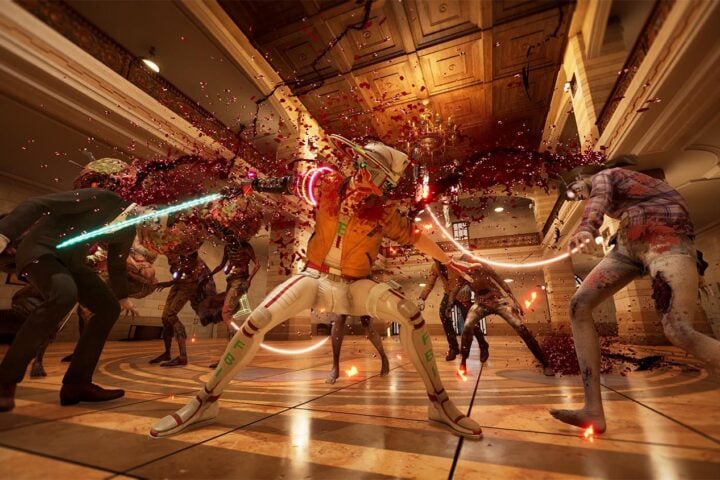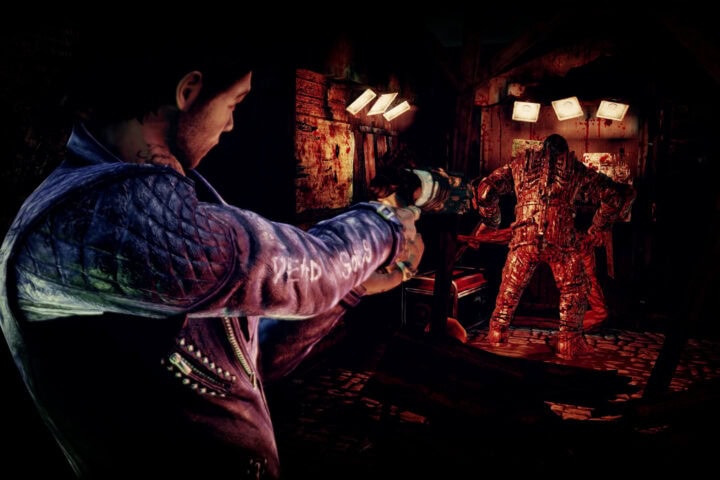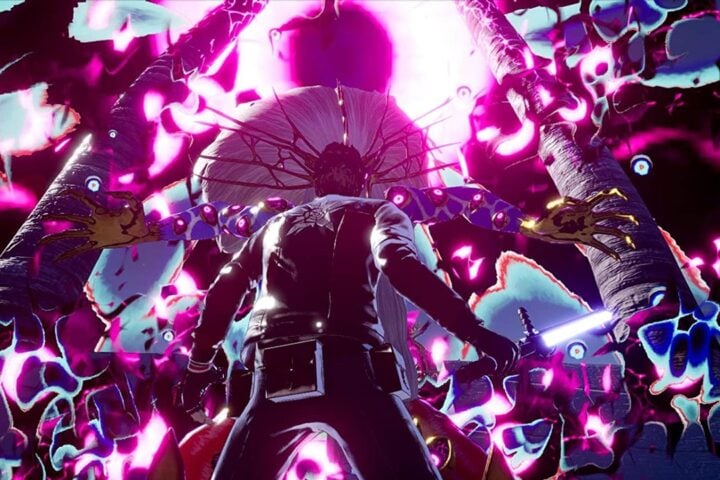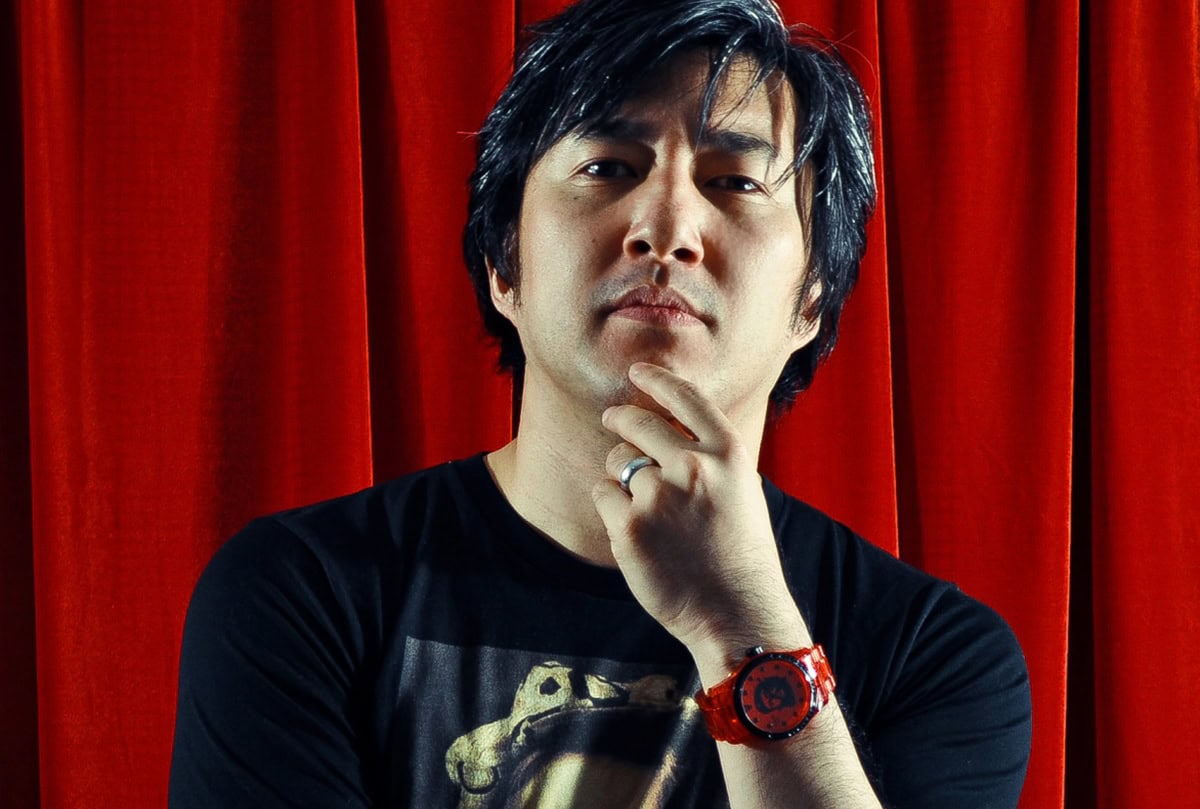
February’s release of the eclectic, gory hack-and-slash Romeo Is a Dead Man marked a small milestone for Grasshopper Manufacture. Founded in 1998 by writer, director and game designer Suda Gōichi, also known as Suda51, the Tokyo-based studio has since worked with various publishers to put out a steady string of hit games, pushing the aesthetic boundaries of the medium with diverse influences from cinema, literature, comic books, and music, all united by Suda’s signature surreal and morbid pop stylings.
Romeo Is a Dead Man, the studio’s first original self-published game on major platforms, feels like a convergence of Grasshopper’s early and late styles and a reclamation of Suda’s full, earnest creative voice after years of publisher-driven struggles. The game is an unapologetically mid-budget action title that elevates its chunky mash-and-shoot combat with hordes of strange and philosophical NPC dialogues, oddball minigames, cinematic boss fights against charismatic monstrosities, and a dazzling array of visual aesthetics.
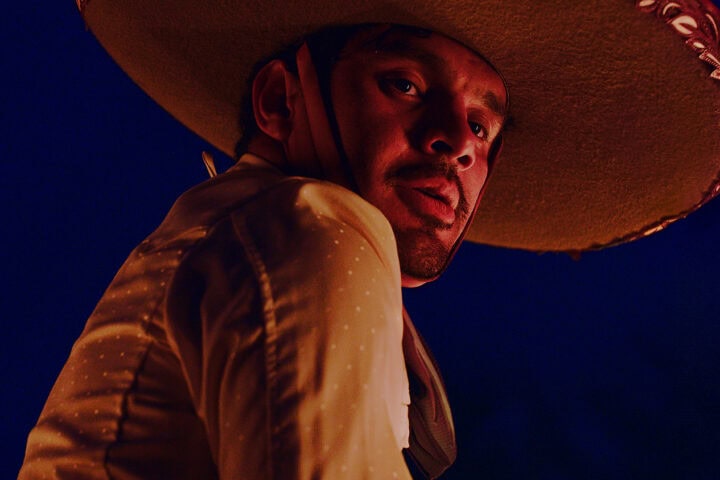
On top of harkening back to the smaller, quirkier, more unpredictable Japanese action titles of the 2000s, the game also captures something truthful about the media-intoxicated brain rot and paranoia of the 2020s. Its naïve, lovestruck conspiracy theorist protagonist, killed by demon invaders and resurrected as a masked superhero by his Doc Brown-like grandpa, finds himself on an unexpected path to esoteric enlightenment, wandering the outer reaches of spacetime while slaying mindless masses and time-traveling super-criminals in his small-town American backyard, all in pursuit of his elusive interdimensional femme fatale, the godlike Juliet.
Following Romeo Is a Dead Man’s release, I spoke with Suda51 about, among other things, his preference for collage aesthetics and artistic collaborations, his views on auteurism in games, and the future of his great white whale, the unrealized Kafka-inspired game Kurayami.
One of the striking things about Romeo is its different art styles and artist contributions, from both in-house staff at Grasshopper and third-party contractors. How did you select which artists you wanted to do what?
A lot of our collaborators were actually people and companies that we’ve worked with before and have a long relationship with. Kamikaze Douga, for example, I first worked with back on Short Peace: Ranko Tsukigime’s Longest Day and, then, several other titles since. They’re probably the ones I’ve known and worked together with for the longest. Conversely, there are also some with whom we collaborated for the first time too—people and companies we reached out to thinking we’d like to have them work on a specific part or element of the game. Some of them I went out and found myself, and some were people other staff members found or had been acquainted with. We consider each part and element of the game we’re working on, and we either go out and find someone who we feel would be a good fit for it, or we call in someone with whom we already have some sort of relationship established.
Going all the way back to The Silver Case, certain developers at the time were making a point of rendering story visuals in-engine to create an illusion of a “solid” reality, while you went out of your way to use multiple different visual styles. What do you find compelling about this mixed-media aesthetic?
This is actually something that I’ve been thinking about since even before The Silver Case, but I feel that video games are indeed a form of mixed-media art. Originally, movies were considered a mixed-media art form, and I feel that video games are sort of the next step in the evolution of what we think of as mixed-media art. You could even say that I think of video games as something close to the ultimate art form in a way. So I think that video games are the perfect medium for using all different sorts of forms of expression, and a medium in which you can combine all sorts of cool things to make something special, which is something that I realized when making The Silver Case—where I really began experimenting—and have been trying to experiment with things and try out as much as possible ever since. I feel that Romeo Is a Dead Man in particular ended up being the most successful result of this approach we’ve taken so far.

You’re associated with the idea of “auteur” game design, and specifically with games that draw heavily from cinema, not just from film genres, but directors with very individual styles. Do you think the concept of auteurism can be applied to games in the same way as films, and do you consider yourself an auteur?
I started my career in games at a company called Human, and there, more so than a writer, my position was closer to that of a manager or overseer. Originally, my roots there as a director began with figuring out how to further expand and build upon the IPs we owned, and how to improve titles that hadn’t been doing so well and make them more sellable. I think my role as an actual writer really started to become more crucial once I started Grasshopper, but again, my roots lie in overseeing projects, so while I’m happy to be thought of as an auteur, I feel like [being a writer] is just one of my skills. Like, while I’ve developed several skills over the years, such as direction, scenario writing, and editing, being a writer is just a part of those skills.
In recent years you’ve opened up more about your past struggles to develop Kurayami. Non-combat-focused games from Outlast to Death Stranding have demonstrated commercial potential once considered unthinkable. Do you foresee opportunities or personal interest in making this kind of heavier, more contemplative game in the future?
I would like to realize that project eventually. The original plan for the project is over 20 years old now, so I’d be interested to see how it would work out using more current technology. I think that the video game medium has become pretty standardized over the years, including elements such as core mechanics and things like that. But, especially in the indie game area, there have been a lot of games that have sort of challenged those standards. Gamers nowadays have a much wider range of options for the games they want to play, so I feel like a game like what I had initially envisioned for Kurayami might finally be able to work. So I’d like to take on that challenge, and I’d like to try making and putting that game out and seeing how it goes.
Romeo feels unusual for a Grasshopper protagonist. Most are very cynical, but Romeo is kind of the only person in his game who isn’t cynical. When he’s chasing after Juliet, it’s sort of tragic, the opposite of Travis Touchdown chasing after Sylvia. What drew you to this heroic type of character?
Well, first off, I kind of just wanted to make a “normal” main character for once. And from the very start, I had the idea of having this character gradually grow and develop and become something close to a demigod. Part of the reason I decided to go with this project in the first place was that I wanted to portray Romeo’s growth and development in particular. Also, I feel that the character of Travis Touchdown has grown into something pretty big—not only among Grasshopper games, but in the world of video games in general. And instead of just portraying Romeo in the same way as Travis, I wanted to not only make him totally different, but I had hoped that he could someday possibly even exceed what Travis has become. Again, I really didn’t want to make him similar to Travis. This is true for both characters, but I feel like they’re both a part of me, both inside me somewhere…so I wanted to keep them completely separate.
One story moment I was struck by was the Phantasm monologue. What Phantasm talks about, regarding Civil War atrocities and slavery, is still a pretty sensitive topic in America and surprising to see brought up in a Japanese game that’s otherwise so fantastical. What was the genesis of this character and this moment, and the general presence of the American Civil War in the game’s backstory?
At first, this project started out with the idea of Romeo chasing all these space-time fugitives throughout various time periods, and the era and idea of the American Civil War was originally a big part of that. Anyway, in that part of the game, Romeo basically destroys the dude, killing him pretty violently. I decided that instead of simply killing him “just because,” I wanted Romeo to decide to kill him because of what he had done, and because he truly hated him for his actions from the bottom of his heart. Ben mentions it in the game as well, but that’s the moment where Romeo sort of crosses a certain line, and I wanted to portray that moment in that specific scene. So for Phantasm—and apart from what he talks about in the game, there are also other behind-the-scenes character settings and traits he has as well—I wanted that scene to show not only Romeo but also the player that this is a guy who’s truly evil and deserves the fate he’s served.
What’s the significance of Romeo’s obsession with conspiracy theories and the paranormal?
I feel that this is something that’s really representative of a lot of younger people in the world these days. Romeo is the kind of young man who’s easily influenced by these conspiracy theories and paranormal stories, and tends to let his imagination run wild. I wanted to portray that part of how I see the current world in the game. Also, while this may not be mentioned in the game, when we first started writing the story, we decided that this town, Deadford, would be a place where a UFO landed—in a lake—a long time ago, like way before even Roswell. It’s kinda urban legend-ish, but we actually wrote up the details behind that story and everything. So I wanted to portray the people of Deadford as the sort of people who would be likely to believe in things like conspiracy theories and the paranormal, living in such close proximity to something like that.
Some fans are already comparing Romeo to Chainsaw Man. When I saw Chainsaw Man last year, I immediately wondered if Fujimoto Tatsuki is a fan of Grasshopper games. Is there any connection there?
There’s no connection there at all [laughs]. I have no idea if Fujimoto has ever played any of our games, and while I can see how people could make that connection since Romeo also uses a chainsaw, it was totally unrelated. But I think that Chainsaw Man is an amazing piece of work, and I’ve read through part of it myself, so yeah, while there is no direct connection between the two, I’m happy to hear that people feel as though they might be connected somehow.
What’s the number-on theme or feeling you want players to come away with from playing Romeo?
This doesn’t apply solely to Romeo, but something I make sure to remain conscious of is making the sort of game which after you’re done playing it, some part of that game’s world remains stuck in your head or in your heart, and keeps you thinking about it, and makes you feel like you want to go back into that world one more time, and that you have some kind of connection with it. Like when I was a kid, I’d watch Superman, and for the foreseeable future I myself felt like I was Superman, or I’d watch Rocky and feel like I was Rocky Balboa…that’s the kind of thing I want players to feel after they’ve played one of my games—like they’re still partly inside that world, and that they still have that connection with the game and its characters.
Since 2001, we've brought you uncompromising, candid takes on the world of film, music, television, video games, theater, and more. Independently owned and operated publications like Slant have been hit hard in recent years, but we’re committed to keeping our content free and accessible—meaning no paywalls or fees.
If you like what we do, please consider subscribing to our Patreon or making a donation.