It’s almost like clockwork, the way the sun above Carcosa frequently goes black, but neither time nor space flow so neatly on the alien planet. Each eclipse sends the land below ebbing and flowing, with new paths snaking beside jagged bluffs, the mire of a swamp shifting and swelling, and the halls of a gleaming cathedral rearranging themselves.
The psyche of Arjun Devraj, the protagonist of Housemarque’s Saros, appears to be in a similar state of flux. Hired by a conglomerate working to mine Carcosa, the mercenary braves its treacherous terrain and vicious fauna, again and again, only to perish and somehow be reborn, over and over—losing his memory, and perhaps a piece of his sanity, with every death.
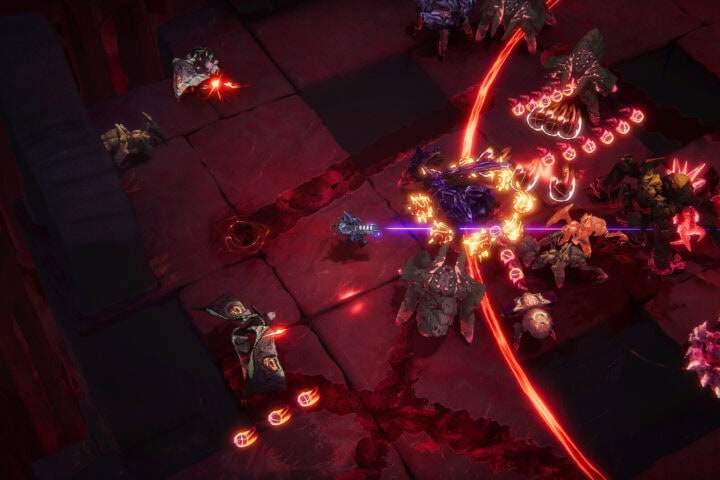
Like Housemarque’s Returnal, Saros is a perfectly tuned bullet hell of astonishing kineticism. Arjun sprints and dashes at breakneck velocity, flinging himself through the air with a grappling hook and finessing the hair’s-breadth gaps between the orbs launched at him by hostiles. For all the frenzy of the shootouts, though, Arjun must be handled with care, as urging him forward too fiercely can easily hurtle him off ledges and into chasms. His equipment is similarly sensitive—a half-press on the left trigger unlocks a different mode of fire, while a full press unleashes his most explosive tools—and his tactility and agility are transportive. He’s poetry in motion.
When killed, Arjun reanimates at the outpost where his hunkered-down crew, sent to Carcosa to locate a radio-silent colony, awaits news from his exploration. Visits to the base provide opportunities to catch up with Arjun’s splendidly voiced but banal colleagues, invest in permanent upgrades via the cheekily overbearing robot that represents his employer, and take a deep breath before venturing back into Carcosa’s wilds. (Arjun can start out at any previously reached biome—a kindness that leaves the degree of repetition up to the player.) Alas, it quickly becomes clear that the camp offers insufficient protection from Carcosa’s warping strangeness, as sweet, eldritch whispers begin turning minds to mush.
Saros pulls names and themes from the weird fiction stories in The King in Yellow, an 1895 collection by Robert W. Chambers (who himself found inspiration in Ambrose Bierce’s 1886 short story “An Inhabitant of Carcosa”). Chambers alludes to the spectral, delirium-inducing city of Carcosa abstractly, as though it would slip through the reader’s fingers if gripped too firmly. Saros proves less subtle, packing that ethereal place into a roguelite-shaped mound. This Carcosa’s ostensibly uncanny mysteries—its ever-mutating topography, Arjun’s inexplicable immortality, the artifacts that grant him minor attribute boosts—betray the influence not of some unknowable horror, but of the game’s need for randomization and iteration.
There are moments, however, in which Saros jettisons its pragmatic literality and nears the eerie spirit of Chambers’s stories. As Arjun cracks across gorgeous vistas, he finds audio logs left by previous expeditioners that chronicle their descents into madness. Rather than interrupting the frenzied flow of Arjun’s mission with lode-bearing worldbuilding, the logs impart feeling and mood with welcome abstraction, narrating over the chaos of combat like spoken tracks on an album. “I stared at the sun until I was blind. And then it looked back,” one says. “It saw what was broken. What I wanted and what I needed.”
Want and need, the things that drive humankind to create and destroy civilizations, reign on Carcosa. The planet is pocked with the ruins of a kingdom that enshrined greed and lust, for power and love—a ravenous psychosexuality embodied in the countless statues and architectural motifs that depict masses of grasping hands, not to mention the legion-limbed beings who yet linger in the rubble. Arjun is no stranger to such desire, having traveled beyond the stars to find the woman who left him. Beset by fiends and racked by trauma, which Saros hints at in hazy, evocative flashbacks, Arjun continues to think only of her. Which is to say, he thinks only of himself, lost in the gulf between what he longs for and what he has.
Playing Saros, I fared little better than Arjun. Carcosa, despite its fundamental contrivance, beguiled me. I hungered for more weapons to discover, more orbs to evade, more enemies to fell, more biomes to conquer. And Saros, seeing what I wanted and what I needed, provided.
Since the publication of our review of Days Gone in 2019, SIE hasn’t responded to our requests for review code. The game was reviewed with a retail copy purchased by the reviewer.
Since 2001, we've brought you uncompromising, candid takes on the world of film, music, television, video games, theater, and more. Independently owned and operated publications like Slant have been hit hard in recent years, but we’re committed to keeping our content free and accessible—meaning no paywalls or fees.
If you like what we do, please consider subscribing to our Patreon or making a donation.