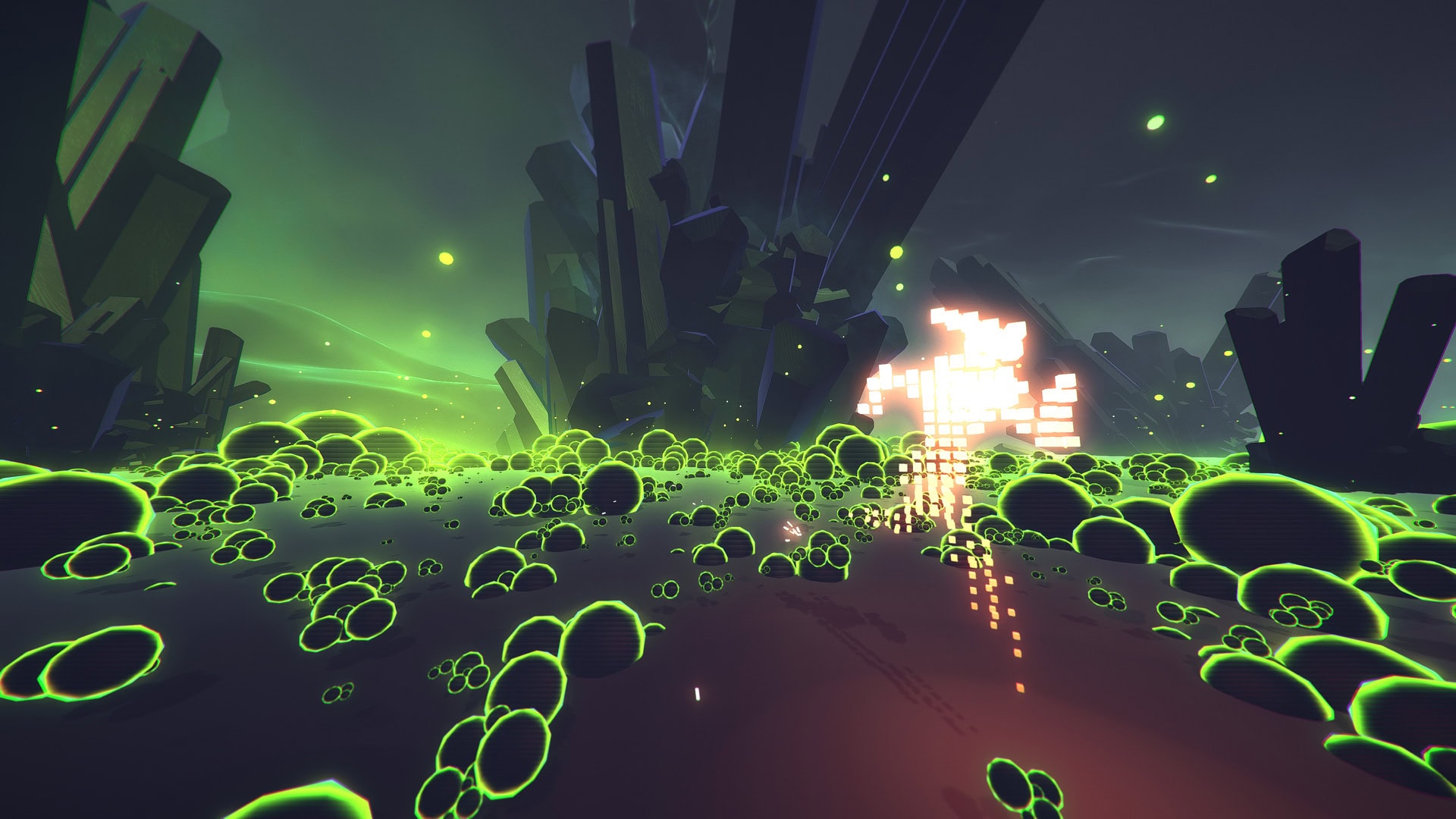
Phigames’s Recompile takes place entirely within the interior of a futuristic computer. It’s a brilliantly minimalistic setting, and this 3D action platformer, at its best, vividly imagines what a mainframe might look like to your protagonist, a pointilistically rendered recompiler program: from the harsh red enclosures of the security system, to the green synaptic tubes of the logical processors, to the yellow platforms of pure code, to the circular cool blue fan blades that cool the computer’s quantum cores.
However, because you’ve been installed into this computer to repair it, these regions aren’t in good condition, and they can be a chore to navigate. (This is especially true during the first half of the game, before you’ve acquired many movement, combat, or hacking upgrades.) The mainframe’s scope is impressive, but when you couple its size with the lack of objective markers and the low-light conditions that reflect the computer’s disrepair, it feels less like you’re making progress through it and more like you’re stumbling around in the dark.
The verticality of each of Recompile’s areas also makes platforming rather frustrating, because if you miss a jump, you have to wait until you hit the ground—which can take tens of seconds—to respawn. It’s already hard enough to gauge depth and distance when maneuvering your dotted humanoid avatar, but in areas where you’re forced to jump between narrow, jagged bits of fragmented data, you will find yourself falling quite often. All of these elements make narrative sense, but it’s nonetheless disappointing that gameplay pays the price.
Recompile communicates almost nothing of importance up until you earn the titular upgrade, which can be problematic, considering that this function, along with many other vital tools, can be missed. Only the first zone, a sort of tutorial Install space in which you initially boot up, is strictly linear, as you’ll be physically unable to progress without learning the Jump function or gaining the pistol-like Disrupt ability that lets you break through literal firewalls. But upon reaching the Central Exchange hub that leads to the four areas that you must at least partially repair, things get so nonlinear that it’s hard to tell if a difficult stretch is just poorly designed or if the game simply expects you to return to it later with an upgrade.

To progress, players have a choice between two unappealing options: throw themselves at a challenge over and over again until beating it, or laboriously backtrack to other areas. A more balanced game, one in which enemies can’t kill you in a matter of seconds, would make it easier to figure out what you’re doing wrong. Alternatively, a fast-travel option would go a long way to stave off the tunnel-vision urge to finish the combat-heavy Security biome before proceeding to the AND/OR/NOR logic-gate puzzles of the Engineering sector.
Instead, Recompile treats you like the self-learning Hypervisor AI that you’re trying to restore. This is immediately at odds with the game’s compelling narrative—relayed entirely through recovered data logs—given that undirected, unchecked self-learning is what led the Hypervisor to break in the first place. Yes, the AI picked up a sense of self and poetry—and that can be seen in the original and often artistic depictions of the computer world within Recompile—but the system also taught itself self-deception in the process, subsequently falling apart.
Recompile never comes close to having the same catastrophic levels of dysfunction as the Hypervisor. The game runs smoothly and looks great, but it would be more entertaining with just a little more gatekeeping. The Overclock ability, which slows time and allows for more precise shooting, is inexplicably off the main path, and playing through the game without it makes for a significantly less enjoyable experience. Other game-changing tools, like the AI Overwrite (which lets you turn foes into temporary allies) or long-range BSoD rifle, don’t have enough utility, as they’re late-game rewards for clearing a whole sector, and by the time you earn them, there isn’t all that much to do with them. You could say, then, that Recompile might have benefited from running a final pass on itself, to correct its unbalanced difficulty so that it’s not nearly as hard at first nor as disappointingly easy and anticlimactic in the end.
The game was reviewed using a code provided by Tinsley PR.
Since 2001, we've brought you uncompromising, candid takes on the world of film, music, television, video games, theater, and more. Independently owned and operated publications like Slant have been hit hard in recent years, but we’re committed to keeping our content free and accessible—meaning no paywalls or fees.
If you like what we do, please consider subscribing to our Patreon or making a donation.