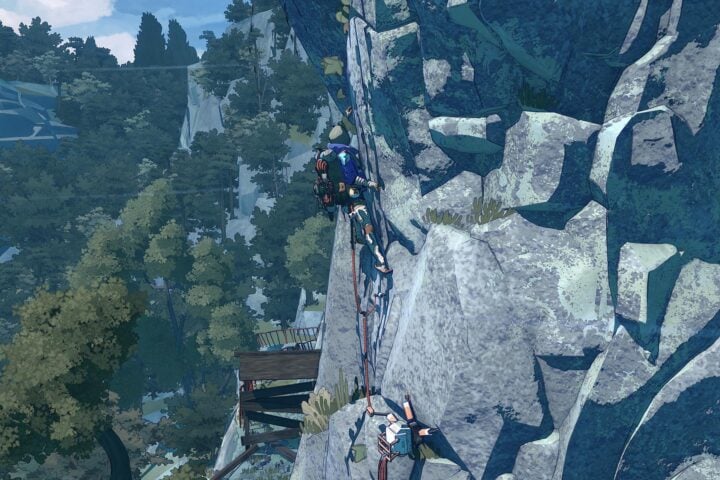
Look down and you’ll see an endless expanse of salt and desert. Look up and you’ll see no end to the mountain you’re climbing, only the space where it vanishes into the clouds. All the world here is neither the past below nor the future above, but rather the moment-to-moment of each handhold, as you climb, swing, and rappel your way forward. That’s where Don’t Nod’s Jusant is at its most gripping, forgoing the simplistic one-button climbing of other adventure games and instead focusing players wholly on the deliberate act of each move, requiring that they manually guide each arm to each rung, ledge, crevasse, rock.
Unlike in the real world, there’s no risk of death in Jusant, neither from enemies—as there are none—nor from falling. The game won’t let you step into thin air before you’re safely harnessed to a piton, and at worst, should you run out of stamina while climbing, you’ll drop and dangle from your tether and have to reel yourself back to your original position. Your connection to the environment is, in many ways, the point of this leisurely mountain-climbing puzzle game that’s closer to the quiet, explorative parts of Death Stranding than the breakneck upward flight of Catherine. Even the smooth, pseudo-cartoon art style feeds into Jusant’s incredibly scenic and meditative quality, tamping down on the vertigo that a more photorealistic style might amplify.
Which isn’t to say that Jusant doesn’t challenge the player. There are plenty of handholds but no hand-holding, and the correct way forward is often the longest way around. But the game isn’t interested in punishing players. Every attempt is a learning experience, one that shows you a little more about how people once lived and farmed in this now-desolate place, and should you run out of stamina mid-climb, you’ll simply wind your rope back to its initial anchor.
Over its evocative six-hour campaign, Jusant gives players plenty to think about, and it’s only occasionally heavy-handed, on account of the letters left along your route. Its title, a French nautical term that refers to a receding tide, reflects the game’s fascination with cycles of nature. Your goal, a call to action, is to restore natural balance to the mountain, and the seashells found along the way wordlessly emphasize the stakes by whispering the sounds of the past: the laughter of children and the running of water juxtaposed with a glimpse of long-abandoned toys sitting in a bone-dry fountain. This, Jusant suggests, is what we stand to lose.

Throughout, the game uses its mechanics to foreground the idea that we take seemingly mundane things for granted. In the first few chapters, players are indebted to those who came before, who dredged up grounded boats and made ladders from their planks. Later, you’ll come to learn to appreciate the shade, as you have to navigate time-sensitive crossings before the sun withers away the climbable roots along your path. Plunged into the darkness of the mountain’s interior, you must rely upon the natural bioluminescence of fungi and flying jellyfish.
The way in which level design conveys Jusant’s story is profoundly affecting. As you focus on and engage, bit by bit, with the details of your surroundings—from uneven planks to corrugated metal to mossy growths to indigenous creatures—you become intimately aware of the game’s world and your place within it. In places were traditional means of traversal fell into disrepair, you may encounter a windmill, a pulley, or pipes. And in such moments, Jusant invites the player’s awe for the ingenuity that made such infrastructure possible.
The game promotes a harmonious sense of working with the world, as in your interactions with firefly-like creatures that boost your jumps and pebble-looking critters that crawl across cliffs as mobile handholds. Jusant doesn’t see these creatures as tools, but as a living part of the environment that you can work with. And regardless of what pace you move through its world, the game is always encouraging you to be present in the moment. Most insistent in that regard is the stamina system, because if you try to rush through a segment of climbing without pausing every now and again to shake the lactic acid out of your arms, you will fall to the end of your rope and have to spool back to the start of your current climb.
Though Jusant gets a bit fanciful in its last level, abandoning its natural elements for an astronomical excursion, the rapturous feeling of climbing the seemingly unclimbable continues to drive the game forward. This is where Jusant’s deliberate, precise mechanics are so vital, as the more responsive the controls, the more responsible players are for each outcome. Nothing is impossible, the game suggests. You just have to take it one step at a time.
This game was reviewed with code provided by Homerun PR.
Since 2001, we've brought you uncompromising, candid takes on the world of film, music, television, video games, theater, and more. Independently owned and operated publications like Slant have been hit hard in recent years, but we’re committed to keeping our content free and accessible—meaning no paywalls or fees.
If you like what we do, please consider subscribing to our Patreon or making a donation.