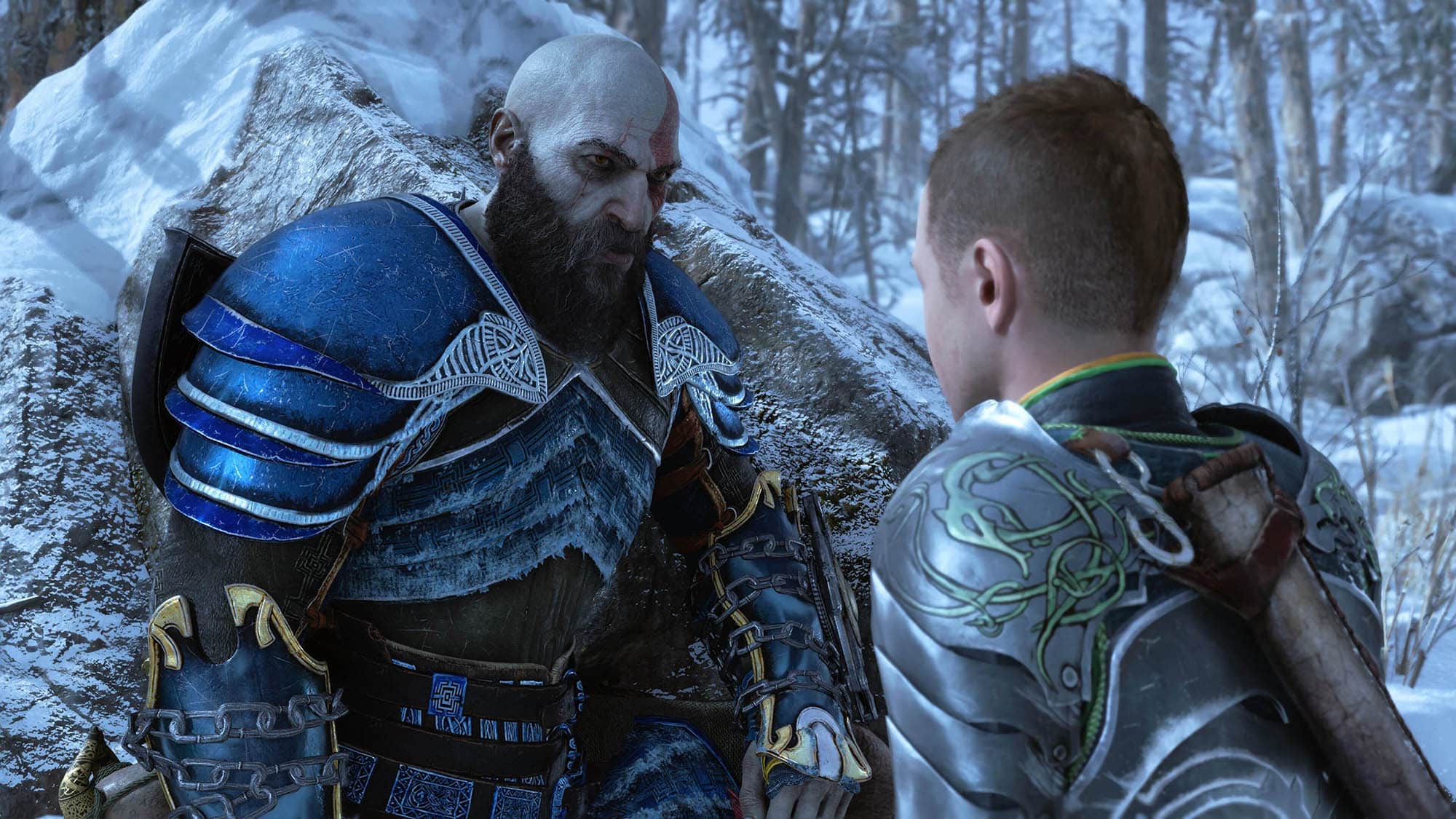

In 2005, the first time the world laid eyes on Kratos, after pressing start on the first God of War’s title screen, the ashen Ghost of Sparta, fresh off of murdering Ares, was ready to toss himself off of a mountain, gravely intoning that the gods had abandoned him. It was an eye-opening way to start a game, for sure, and the hours that followed, as we watched Kratos’s revenge bring him no peace, lent a modicum of weight to what we had seen at the beginning.
Seventeen years later, Kratos is old. His body is a leathery tapestry of scars, burns, and the simple ravages of time. His movements, when not fueled by deep wells of rage and adrenaline, are slow and considered. He’s tired, and he’s been roped into another war against a legion of gods and monsters, and the end, foretold by prophecy, goes down tomorrow. As for his teenage son, Atreus, he can’t sleep, tormented by his own problems. Early in God of War: Ragnarok, Kratos, presumably for the very first time, tells his boy a bedtime story, of a man who must carry cords of firewood on his back every day for years, dropping more and more on his path over the years. He prays for death, but something happens when he sees the face of Thanatos himself.
We don’t get the ending to that story just yet, but the message comes across regardless. Over the course of Ragnarok, through so much joy and pulse-pounding and often justified violence, we see how Kratos has been hardened by the accrued weight of all the bodies he’s left in his wake. We saw the beginnings of that process in 2018’s legacy sequel. The unexpected new narrative thread in Ragnarok is Kratos recognizing that not only does he need to heal his conscience, but that his son also needs to be witness to that, so as to keep him from making similar mistakes.
Unfortunately, Kratos is forced to impress that upon a teenager at the worst possible time. Fimblevinter—the long, cold prelude to the world-ending war of Ragnarok—has already set upon the nine realms, and the game imbues Atreus with a recklessness when it comes to stopping the inevitable, which is also far from the only sly allegory to current events. Despite Kratos’s best intentions, keeping Atreus safe is an impossibility. It’s bad enough that the goddess Freya—whose son, Baldur, was slain by Kratos in 2018’s God of War—comes for Kratos’s neck the second that he shows his face outside their sigil-protected homestead. But as teased by the previous game, Thor and the All-Father himself, Odin, show up at Kratos’s doorstep, offering to bury their grudge in exchange for Kratos sitting out Ragnarok.
Naturally, that doesn’t happen, but there’s a magnificent complexity to the particulars of how we wind up at the end of the world, with the game taking the intricacies of the Old Norse textbook Prose Edda and weaving a deeply pensive tale about the nature of storytelling itself, about the rippling effects of familial abuse and neglect, about nature versus nurture, and what kind of life parents owe their children. Besides the logical next steps in Kratos and Atreus untangling toxic masculinity without a guide, the Norse pantheon’s deep-rooted dysfunction, how its gods are amplified by their impairments, is conveyed masterfully and painfully.
Instead of the grandiose, lightning-tossing mountain of a man that we expected the All-Father to be, Odin is played with a quick, razor-sharp shrewdness by Richard Schiff. His encounters with Atreus all seem kindly, if slightly neurotic. Rather smartly, aside from one jaw-dropper of a gaslighting tactic, we never see much of Odin’s all-consuming, pervasive crimes on screen, only their effects. Elsewhere, much of Freya’s anger has less to do with the loss of Baldur than the knowledge that, without her son, her only options are to submit to a profound emptiness or sleep with the man who abused her and committed genocide against her people.
Despite his still formidable power, Thor—a mountain of a man played with an all-too-believable surliness by Sons of Anarchy’s Ryan Hurst—has taken to mostly drinking himself to death over the loss of his sons, getting absolutely no comfort from his father, leaving his wife, Lady Sif, a cold survivalist, and his daughter, Thrúd, stranded in her determination to become a valkyrie, left mostly to drag Thor’s bloated body home from the mead hall. That’s all to say nothing of the various tribes quaking in fear of the All-Father’s wrath, and the endless creatures who were promised the world by Odin, only to wind up his slaves. Odin is such a small, frail little man here, and he’s the most impressively abominable monster in the entire series.

That’s saying something, considering that Ragnarok is still a game with all manner of impressive, abominable monsters around every corner. For the most part, dealing with them involves the same bag of tricks as the 2018 game, with a few extra magical tchotchkes to enhance Kratos’s powers thrown in for good measure, and some additional emphasis on building up status effects to do the most devastating damage. There’s almost an overabundance of options, and there are some niceties that get lost in the mix—Quick Turn involves one button press too many now, though the weapon that eventually slots into its former button press is worth it—but it remains a logical and vast evolution of the series’s combat.
The cherry on top is the fact that Atreus gets to go off on his own on occasion, and somehow, the developers at Sony Santa Monica have managed to make a bow and arrow genuinely flashy, cool, and functional for taking out mobs of enemies. All of that is powerful, but more impressive is how careful the game’s writing is about letting players indulge in so much big, brutal, legendary action without crossing the line into the realm of ludonarrative dissonance. These characters wrestle with when it’s time to pull a sword, constantly trying to find the best way to not have to use it, and make a clear delineation between what’s necessary and what’s cruel.
More than this, if there’s any one thing that ties everything together in Ragnarok, it’s purpose. There’s not a single quest, not a single action, that isn’t without a reason, a story to tell, wrongs to address, a sight to see, or a direct emotional through line to follow for at least one of our menagerie of travelers. Every new quest in the game enriches these characters or the world they inhabit, sometimes both. Every step of the way, you feel the pull of that world, and the tangible, plentiful rewards pale in comparison to the company we keep and fight for. Ragnarok has such a way about making the player care about the smallest characters, the most thoughtless aspects of the larger quest, where even our loyal dwarf shopkeeps, Brok and Sindri, become some of the most fascinating, layered, and tragic figures in the entire game at points.
But, of course, it all comes back to Kratos and Atreus, both of them trying to figure out how to be decent men, or if that’s even a possibility in chaotic times. Theirs is a story of constant loss, and regret, and oppressive stress under circumstances familiar and wildly supernatural. But ultimately, it’s a story of power and dictionary-definition maturity, questioning the nature and responsibility of the power that lies within everyone who has people to care for.
Beyond that, we see the man that Kratos has become, and the sight is awe-inspiring: a monster who’s rejected his nature, has fought tooth and nail for the grace of his soul, for the sake of his child, and only found it at the end of the world. There’s no arc in all of video games like his—no character to fully redeem nearly two decades of digital slaughter and make it matter. Ragnarok works the kind of narrative miracles that the medium has no excuse not to follow suit on. This is the kind of love and care that’s not only possible for a big budget game, but deeply necessary.
Sony Interactive Entertainment did not respond to our request for review code. This game was reviewed using a retail copy purchased by the reviewer.
Since 2001, we've brought you uncompromising, candid takes on the world of film, music, television, video games, theater, and more. Independently owned and operated publications like Slant have been hit hard in recent years, but we’re committed to keeping our content free and accessible—meaning no paywalls or fees.
If you like what we do, please consider subscribing to our Patreon or making a donation.


Ok so now it’s proven you people are Sony fanboys. Xenoblade 3 was the true game of the year and you gave it shit rating. Same goes for every great Nintendo game except Mario of course because for some dumb reason you people are allowed to like Mario but nothing else Nintendo does. Thumbs down.