Mafia-related murders. An improbable constellation of 20th-century icons. Belated accessibility to the public after decades of obscurity. Are we talking about the JFK assassination or Winter Kills, William Richert’s 1979 film inspired by it?
Adapted from Richard Condon’s 1974 novel, the film flamed out on its initial release for many of the usual reasons: a troubled production, the short-sightedness of critics, and a willingness on the part of the filmmakers to potentially confuse, alienate, or offend audiences of the day. But even if you don’t go in with a conspiratorial mindset, one viewing of this riotously entertaining, chillingly perceptive film could leave you wondering if some larger force is at play, protecting the targets of this should-be New Hollywood classic by keeping it in the dark after all this time.
The history of Winter Kills is nearly as lurid and tangled as the conspiracy it depicts. Unable to secure financing for such an incendiary project, first-time director Richert turned to high-rolling drug dealers turned skin-flick producers Leonard Goldberg and Robert Sterling to front the cash. Despite the dubious funding, Richert was able to assemble a staggering cast to populate the film: Jeff Bridges in the lead, alongside (deep breath) John Huston, Anthony Perkins, Eli Wallach, Sterling Hayden, Mifune Toshirō, Dorothy Malone, Ralph Meeker, Tomas Milian, Richard Boone, and even Elizabeth Taylor herself in a wordless cameo.
The talent extends behind the camera as well, with cinematographer Vilmos Zsigmond, composer Maurice Jarre, and production designer Robert Boyle. Tales of sketchy production practices abounded: Goldberg was murdered (likely by the mob) while the film was still shooting, a shortage of funds led to cast and crew being paid in unmarked bills, and Richert was even forced to make and sell another film with Bridges to raise the money to complete shooting.
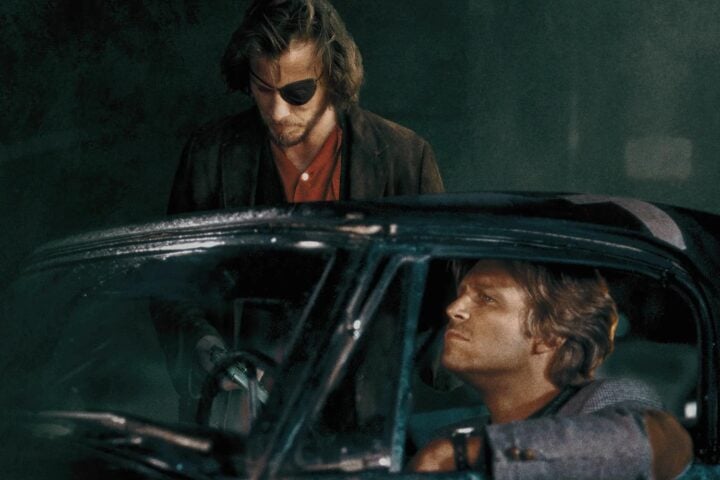
Such obstacles may have hindered the film’s success, but they contribute to the effect of its deep-seated anti-authoritarian paranoia. It opens at sea, on a ship where a dying man, Arthur Fletcher (Joe Spinell), claiming to be the assassin of former president (and JFK stand-in) Timothy Kegan (an uncredited John Warner) is brought to his brother, Nick (Bridges). Nick travels to Dallas Philadelphia to investigate, finding Fletcher’s murder weapon and confirming his story immediately before his companions are assassinated. So begins a cascade of ever-deepening mysteries as Nick is pulled further into the conspiracy, with only his father (Huston)—a Joe Kennedy-esque titan of industry and political influence—as an unreliable guide.

Richert plays the amateur investigation largely as a pitch-black comedy of frustration, as Nick’s blue-blood naïveté and sexual insecurities are exposed more and more with each new revelation. The parade of Old Hollywood stars, aside from helping us keep the dizzying barrage of names and faces sorted, contribute to the film’s vision of a supposedly modern world still lorded over by the reactionary centers of wealth and power behind the assassination.
Highlights include Wallach as “Joe Diamond,” the Jack Ruby to the film’s Oswald, Hayden as a psychotic right-wing military cosplayer, and Perkins as Mabusean surveillance man John Cerruti. At the center of it all is Huston, playing Pa Kegan as a reprise of Chinatown’s Noah Cross updated to the present day, his ambitions appropriately scaled up from the purchasing of a city’s future to that of an entire country. His magnificently repulsive turn was apparently informed by Huston’s own feelings toward Joe Kennedy, and watching him bark vulgarities at Bridges in a robe and speedo is worth the price of admission itself.
The conspiracy at the heart of Winter Kills only becomes more impenetrable with each of Nick’s revelations, and the breakneck pace at which they come doesn’t make it any easier to follow. There’s enough material here to fill a movie twice as long (which it did, for Oliver Stone), and the relentless forward motion arguably robs the movie of some of its power.
But Richert’s total embrace of paranoid fictions, paired with an unsparing vision of American power that cuts through their cartoon surfaces, has aged better in many ways than either the self-righteous romanticism of JFK or the dour defeatism of The Parallax View. Its final minutes only escalate the satire while delivering its most prescient idea: that nobody is really at the wheel, and that the post-human systems of control we’ve created have become our true masters.
Rialto Pictures re-release of Winter Kills, presented by Quentin Tarantino, will unveil at New York’s Film Forum on August 11 and L.A.’s New Beverly Cinema on August 25.
Since 2001, we've brought you uncompromising, candid takes on the world of film, music, television, video games, theater, and more. Independently owned and operated publications like Slant have been hit hard in recent years, but we’re committed to keeping our content free and accessible—meaning no paywalls or fees.
If you like what we do, please consider subscribing to our Patreon or making a donation.